
Photo credit belongs to FreeBibleImages.org
My friend Melanie recently published a blogpost based upon Psalm 126:5-6, which reads,
5 Those who walk the fields to sow, casting their seed in tears,
will one day tread those same long rows, amazed by what’s appeared.6 Those who weep as they walk and plant with sighs Will return singing with joy, when they bring home the harvest.
Psalm 126:5-6
In brief, it’s an important discussion about choosing to cling to God in obedient faith instead of the temporal things of this world (including those we love). Follow the link below to read this short post about costly obedience.
Costly Obedience | The Life I Didn’t Choose
Psalm 126:5-6 has long been a verse dear to my heart. It was a promise I could cling to after Cole’s death. I inscribed it across the bottom of every birth announcement mailed when Bethany Joy arrived 17 months after her brother was stillborn. She was the literal manifestation of the harvest from my promise keeping heavenly Father, but . . . and this is important. . .
really important. . .
the joyful harvest was never dependent upon her survival.
Before she was ever born I understood, I was painfully aware in fact, and very very fearful, that the harvest greeted with joyful singing might only occur in Heaven. I believe that one day Cole will be a part of my long awaited harvest. I believed that then and I believe it now.
They that sow in tears will reap in joy (KJV) was the mantra that circulated though my mind throughout the duration my pregnancy. Others were quick to tell me that everything would be okay this time . . . which frustrated me beyond belief.
To speak your fear out loud, to have it validated as a legitimate concern, loosens fear’s suffocating grip because you are no longer the only steward of truth.
Two things allow fear to grow, isolated silence, and flippant dismissal.
What I needed was someone to acknowledge the truth that while it was unlikely that I would lose another child, there were no guarantees that I would not leave the hospital empty handed once more. Over the course of three subsequent pregnancies, I never again counted my chickens before they hatched. There was always a part of my heart held in reserve – the part where naïveté was replaced with frank reality.
There were other verses that competed for my attention among the cacophony of swirling thoughts and fears during my pregnancy. One of significance was Psalm 127:3 – specifically the King James Version. The Bible translation in this instance is important because different versions appear to communicate different things. Check out the versions below and see if you agree:
“Lo, children are an heritage of the LORD: and the fruit of the womb is his reward.” King James Version
“Children are a gift from the LORD; they are a reward from him.” New Living Translation
Twenty-five years ago I wasn’t spending much time comparing Bible translations. Instead I meditated upon scripture as it was presented in my personal study Bible. I struggled to understand exactly what it meant to be “an heritage of the LORD.” But the last half of the verse impacted me most. I meditated on the King James translation and understood it literally as it was written . . .”the fruit of the womb is HIS reward”, not “[children] are a reward FROM Him.” Such a small but significant difference. I interpreted that phrase to mean that my children were literally His prize. And when you consider that in relation to Colossians 1:16b, it makes perfect sense:
“. . . all things were created by him, and for him:” (KJV)
He created Cole, Bethany, Katie, Gracen, David (my husband) and me for Himself.
The NLT version of Psalms 127:3, it tells me that my children were created by Him as a gift to me – a reward for something I’ve done.
Maybe both translations are correct (although it’s hard to understand how one earns the reward of parenthood). Many times I have found that scripture has a broader meaning than I initially was able to comprehend. Regardless, I approached Bethany’s birth with fear and trepidation reminding myself that the fruit of the womb is His reward, not mine. Who’s to say if my rejoicing would take place this side of heaven? God knows there are plenty of parents who have planted their seed, their children, back into the soil beneath their feet and are anxiously and sorrowfully enduring the wait for the harvest of our eternal souls.
I don’t know about anyone else but I am so very weary of sowing in tears. Recent events in our country lead me to believe that I am not the only one who feels this way.
As Melanie’s post makes clear, we can either cling to the things of this world or to God in faithful obedience.
I don’t think I am clinging tightly to my loved ones anymore. I think the futility of that practice has sunken deep into the very marrow of my bones. My palm is open, primarily because grasping to hold onto that which can so easily be snatched from it, is as exhausting as it is futile.
But . . . I’m not quite sure that I am clinging to Jesus either.
It “feels” as if I am clinging to His promises more than to the promise keeping Savior, Himself.
The nuance nags at me.
I can’t decide if I’m splitting hairs or if, in fact, at least one more scary and deeply painful trip through the Refiner’s fire will be required in order to strip away every last thing I might latch onto in place of God Himself.
Am I living in obedience or desperately grasping for anything . . . anything . . . that makes me “feel” better instead of actually getting better?
Promises make me feel better.
The Savior . . . well it’s complicated.
It’s easier, less painful, to anchor myself to His promises instead of to the God who allowed the deep wounds in the first place.
I know that God is the guarantor of every promise.
I know that the Holy Spirit serves as the earnest deposit securing my soul.
I know I can have confidence in His promises because of who God is, but I’m not confident that clinging to His promises is the same as clinging to Him.
In fact, I think they are two distinctly different things.
Has my heart rejected Christ in favor of His promises because I associate Him with the deep wounds that have been inflicted upon my heart?
Do I subconsciously blame God for the events that took my children from me and for the progressive disease that is systematically destroying Gracen’s body, instead of blaming the Devil, my true adversary and the author of lies who relentlessly seeks whom he might destroy?
Truthfully, the idea that I blame God for Satan’s actions doesn’t feel accurate.
I honestly believe (know to be true) that sin and Satan and the fall of man are to blame for all my suffering, but it’s harder to determine if I harbor animosity and resentment toward my Savior for choosing not to intervene and thwart the plans of the enemy.
I don’t want to look too closely.
I don’t want to examine my heart!
Yet the questions beg an answer.
Am I resentfully resigned to the sovereignty of God?
Am I clinging to animosity instead of acceptance?
And then I ponder . . .
Are resignation and acceptance the same thing? Does it matter?
Both recognize that there are things beyond our control but resignation is perceived in a negative light, as a defeatist attitude, because of its association with quitting or giving up a job, for example. (Not that leaving a job is a negative experience, just that “I resign” can be stated just as accurately as, “I quit”). On the other hand, acceptance is perceived in a more favorable light because we associate it with positive things. We accept a gift or a job. It carries a connotation of approval. We accept an individual into our circle of friends.
Research tells me that both resignation and acceptance are synonyms for acquiescence (reluctant agreement). In my opinion, a good definition for resignation is unresisting submission or acquiescence whereas acceptance is well defined as willing tolerance without approval.
I really don’t think God cares whether we accept or resign ourselves to His plans. I think He’s more concerned about the attitude with which we do either. Of the questions above, resentment and animosity matter more to God than resignation or acceptance.
Still these questions swirl around inside, and I find myself reminded that the heart is deceitfully wicked, that no one other than God knows and understands it. (Jeremiah 17:9)
So, It’s not surprising that I can’t unequivocally answer those questions.
I can’t resolve the confusion in my heart over clinging to God’s promises or clinging to God Himself, or even correctly discerning my feelings toward God as a result of the circumstances in my life. It’s not that I want to ignore those issues because I think they are important. But, my introspective nature has led me to decide that the confusion is irrelevant because I know that the Refiner of Silver, Almighty God, will not allow ugly impurities to hide unacknowledged, even in minuscule quantities, within the silver of my soul. The God who created and loves me is never satisfied with anything less than what’s best for me. He takes me places I have no desire to go, even if I sow in tears every step of the way – for my eternal good.
Always and only for my eternal good.
And when God works in your life, His goals are the same as they are for mine. They may play out through very different circumstances, but whatever He allows to transpire in your life, even if those things result in tears, will always and only be for your eternal good.
For I am confident of this, that He who began a good work in you will continue to perfect it until the day of Christ Jesus. ~ Philippians 1:6 Berean Study Bible
The LORD will accomplish what concerns me; Your lovingkindness, O LORD, is everlasting; Do not forsake the works of Your hands. ~ Psalm 138:8 New American Standard Bible
He will sustain you to the end, so that you will be blameless on the day of our Lord Jesus Christ. God, who has called you into fellowship with His Son Jesus Christ our Lord, is faithful. ~ 1 Corinthians 1:8-9 Berean Study Bible
We are all the fruit of the womb. God, Himself, sowed in tears when He sent His son to the cross. Everything that is for our eternal good increases the harvest – the labor of God’s heart and hands – you and I are God’s reward.
We are the harvest of tears.
By the way, in regards to resignation or acceptance – acceptance may sound more positive but I’d rather respond to God in unresisting submission and acquiescence than I would in willing tolerance without approval. That’s just the rebellious way I roll!


 Why is that important to anyone outside the special needs community? It’s important because one day rare disease may impact you or someone you love.
 Two of my daughters were born with a rare genetic disease known as ARSACS. For 15 years their disease went undiagnosed. In fact, only two labs in the US were testing for ARSACS at the time of Gracen and Katie’s diagnosis. World Rare Disease Day seeks to raise awareness and promote research for diseases that are far less likely to receive research funding than common diseases do. That’s why I support Rare Disease Day.
 I’ve learned much about the medical community in my sojourn through rare disease. I’ve met warriors and wimps, fighters and folders, the courageous and the weak-kneed and have discovered that some emotionally separate themselves, and some, the bravest of the brave, count the cost and invest their hearts and souls with little regard for their own mental health. Many ride the tide between the positive and negative—between hope and hurt—just as parents, friends, and family do. They paint on brave faces then hide in the supply closet as tears flow unchecked down their faces. They smile encouragement and swallow back the fear of failure to cure, treat, and simply to help. And they carry the weight of the dashed hopes and expectations that loved one’s pile on their shoulders as they reach, ache, and long for a cure—a treatment—a miracle. They see victory . . . they experience defeat . . . all with the frailest of hope that one day, one day, disease will be vanquished and hope will reign supreme. And the wimps and folders, the weak-kneed and the emotionally distant are far too frequently former warriors and fighters, the courageously tenacious and the bravest of the brave who have stood in the gap for so many and for so long that they have paid a high personal price in the form of compromised mental and emotional health.
 Today, World Rare Disease Day 2017, I’d like to take a minute to appreciate and thank the dedicated medical researchers and practitioners that invest so much time and effort searching for cures, prescribing medications and treatments, holding the hands and hearts of those desperate for answers and hope.
 June or July or somewhere around there—the first person went where angels fear to tread and recommended that I find a new perspective regarding my circumstances. It was a subtle message, but I grasped it right off. At the time I remember thinking, “Am I behaving in such a way that others feel the need to give me the positive thinking message?” The mere suggestion made me doubt myself.
 In Christian circles, you wouldn’t identify me by my faith unless there was something very unique about it. “She’s the woman that worships with snakes.” I guarantee you, if anyone in my church family included snakes as part of their normal worship activities everyone would know who that individual was, if not by name or sight, then by reputation.
 We all have a reputation. Some good, some bad, most a mix of both. The lady who drives the Aston Martin would certainly be known in most communities. And we all have things that make up our identity. Very few disabled people don’t recognize their disability as part of their identity, but it’s a defining characteristic of that person. Just like being an athlete or scholar, doctor, or maid becomes not only how others identify them but how they identify themselves.
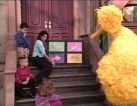 The point I’m trying to make is that you should expect behavior that correlates with the descriptors you use to define someone. The unsaved among the saved may be dressed less modestly. Their speech may be liberally sprinkled with expletives. You might see them drinking to intoxication, or find them bragging about things they’ve said or done that are not common among believers.
  Unless you are dealing with an abnormally moral individual there should be recognizable differences between the lost and the saved. You expect them to fit the Sesame Street standard—you know—one of these things is not like the other. That’s the Sesame Street Standard.
 I am who I am.
 I had a biopsy Tuesday. I was a bit surprised when the doctor told me that I had handled the news that the biopsy was necessary in an appropriate manner – in other words – he was glad I didn’t freak out. This is the fourth time I’ve had to have follow-up appointments when the initial tests revealed unexpected results ATA (after the accident).
 It was a period of time in which feeling good (in spite of the fact that I was having a biopsy and all that implies) didn’t feel bad – didn’t feel as if laughing or smiling or enjoying simple conversation diminished the inherent value of my daughters. There was no guilt – no shame – and believe me I found many a reason to feel both of those things!
 Those thirty minutes were worth waking up Tuesday.

 8) To earn eternal rewards that will far outweigh the temporal suffering we experience in life:
 As the day dawned Friday morning it finally dawned on me how little time I had left with Gracen before the fall semester begins.
 And then it happens. . . the moment I most dread . . . the wheel locks are released and Gracen is moving away from me. “I love you”, I call out to her retreating figure.
 Ten minutes or more pass waiting and watching Gracen’s sleepy eyelids open to half-mast then flutter closed again. And then, out of the blue, I begin to feel faint. I can feel perspiration begin to form on my upper lip and forehead. I feel like I’m going to hurl any second and I ask David if I’ve gone pale.
 I feel like I’m sinking—sadness weighing me down—regardless of the medications I’m taking. Why can’t I overcome this? Is it possible that trauma causes bipolar disorder?
 I am very much aware of the painful emotions that accompany my past and current life circumstances. When I find myself confronted with “negative” emotions, I don’t allow myself the freedom to experience and work through them. No, instead I distract my mind from them primarily via fiction (emotional numbing) locking them to the far regions of my heart. I am constantly aware of the existence of this metaphorically locked box of emotions, but I refuse to open and cope with the contents. Shoot, I’m pretty sure the contents of that box are under so much pressure that the slightest move to open the box (maybe my next effort to shove new emotional turmoil into the box) will result in the contents being forcefully expelled like an erupting volcano — an apt description as rarely does a volcano erupt without prior warning and I’ve experienced years worth of prior warnings. Warnings that the pressure is escalating.
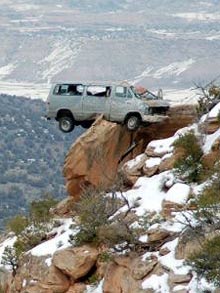 The tension required to push those emotional realities away, to pack them into my own personal Pandora’s Box, is the tension that my emotional health is standing, or maybe in my case a better word is “balanced” or “teetering” upon. Like a car precariously balanced upon a cliff, one shift in weight forward without substantial counterweight will send the vehicle plunging over the cliff.
 On top of everything that implies, opening Pandora’s Box only allows past emotional trauma to be vented. How then, in this new weakened and vulnerable state, do I cope with the ongoing trauma progressive disease constantly thrusts upon me? Where is my shield of defense when the communication device or the stander is delivered? How will I cope with the installation and use of a tracking system in my home, let alone the day when it no longer makes daily life less physically taxing for both Gracen and I, but when it becomes a necessity I must use alone in order to properly care for her?
 The boxer in round ten is less capable of withstanding a body blow that was thrown with far greater force in round one. The boxer’s split skin, bruises, and broken ribs don’t heal between rounds. He just rests, catches his breath, gets his cuts taped up and smeared with antibiotic ointment while receiving instruction and encouragement to continue the fight.
 What will be my fate when the fight ends? Will God step in and call the fight? Will I find myself stretched out on the mat breathing heavily but defeated all the same or will I be doing my best to hold my hands up in victory when the final bell rings?
 I hope to be silently caught up in the air as God calls the fight or to hear the sound of the trumpet signaling the arrival of my Savior, rescuing me from this body of death and torment. But I fear I will continue to find myself stretched out on the mat breathing in the stale and bitter aroma of sweat and fear–yet another bout in my future, yet another beating to endure. Will I enter the ring the next time stronger and better equipped?
 Boxx Banter