
Why a glimpse behind the curtain to the deeply personal and hidden grief of a bereaved parent? Not to inspire your pity; of that, I can assure you. Instead to inspire others to look beyond the surface of a grieving friend or family member. To consider how families are affected by a loss, emotionally, psychologically and spiritually, as well as the unique family dynamics that result; which might help you comfort, support and encourage them. The bereaved desperately want to be understood, to have their feelings validated, to break free of the isolation, to mourn unrushed, to have another share their sorrow (not attempt to fix it). This post was written months ago and is not reflective of my current state of mind.

I Can’t Do This Anymore!
 There are days and moments and very long nights when I think, I can’t do this anymore. Come to find out, that simple thought is a trigger for tears.
Intellectually, I know I can. Physically, I know I can. Emotionally, well there’s where the breakdown happens.
I don’t know if my impending empty nest is permanent or temporary. I know who I am for the next three months but not who I will be after that. I’m really afraid of that answer.
Emotionally I am weak, very weak. Within the borders of my emotions I fear failure — to prepare Gracen for what’s ahead for her physically — to be there for her in an effective way — to watch her experience the devastation wrecked by progressive disease — to experience it for myself alongside her — to watch David experiencing it alongside her, alongside me. To see the toll it takes on each one of us individually as we somehow  continue to put on a brave face and hide the true depths of the pain and sorrow from each other so as not to increase their individual burden in this bizarrely intertwined protection dance we unconsciously perform. And as all this plays out within our home and personal relationships, the current culture demands that we have a positive attitude and recognize our blessings. It’s exhausting. It’s overwhelming. It’s frustrating. It’s impossible.
Moments such as this one, Progressive Disease – A Moment of Triumph, are rare and bittersweet. (At the beginning of the clip, keep your eyes on the right side of the screen so you don’t miss Gracen’s appearance.)
“Don’t be afraid — trust God”, we are told in the midst of situations where there are very real things to fear. Sorry, those commands, biblical or not, are not helpful. I’m not saying they are wrong, just that they aren’t comforting and encouraging. It’s almost impossible to talk yourself out of fear — especially after your worst fear has already been realized. Those words, “Don’t be afraid — trust God”, heap indictment of failure on already emotionally overburdened believers who interpret those words as an accusation — “You aren’t trusting God”, instead of as the encouragement they are intended to be. At the same time, the searing pain within testifies to the truth that what we are trusting God for is eternal in nature. We are terrorized by the knowledge that our desires, for ourselves and those we hold dear in this temporary world, play second fiddle to God’s purposes. This, of course, I can attest to from all too much personal experience. God’s will serves our ultimate eternal good but the rub is that we reside in the here and now. And while from an eternal perspective our lives are no longer than a blip on a radar screen, in the here and now that blip lasts ten, twenty even thirty years or more. Our afflictions are light and momentary from an eternal perspective but they don’t feel that way in the day to day.

Yes, I need to cultivate an eternal perspective, lay up eternal treasures, yadda, yadda, yadda. But frankly, there are days, moments and very long nights during which I’m too emotionally frightened and exhausted to exercise my spiritual muscles.
Helping the Bereaved Bear their Burdens
1. Pray that the bereaved will put on the full armor of God. Their faith is under attack and they are exhausted and deeply vulnerable.
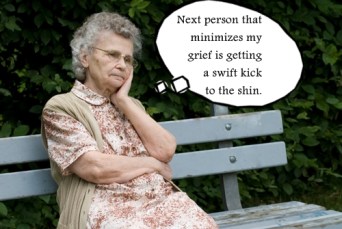 2. Avoid the use of platitudes and trite phrases. They serve to frustrate and unconsciously communicate unintended messages. (i.e., faith and trust in God mean things hurt less, our hope for eternity exchanges grief for joy, joy and happiness are the same thing, the salvation of the lost justifies the death of a loved one).
3. Be extremely careful in the use of Romans 8:28, “And we know that all things work together for good to them that love God, to them who are the called according to His purpose.” (KJV) There are a time and place for every season under heaven. There are a time and place for this verse. I personally think it’s more harmful than helpful in the face of raw grief and more appropriate a year or two down the road when the bereaved can look back and hopefully recognize the fulfillment of this promise.
4. Be cognizant of the fact that believing God has filtered everything through His hands before allowing it to happen can lead a believer to blame God for the tragedies that befall them. In truth, spiritual warfare, an individual’s exercise of free will or the fall of man that affected all of nature are responsible for the death of their loved one. The fact that God allows bad things to happen to His children is not the same as causing bad things to happen. For all we know, Satan was tempting while God was pleading when another’s actions lead to the death of a loved one. “For ours is not a conflict with mere flesh and blood, but with the despotisms, the empires, the forces that control and govern this dark world–the spiritual hosts of evil arrayed against us in the heavenly warfare.” (Ephesians 6:12 ~ Weymouth New Testament).
 5. Validate feelings. A grieving father who feels like beating the crap out of the person responsible for their child’s death is normal. It’s okay; it’s helpful actually to say, “I’d feel the same way if I were you.” Validating feelings in no way condones sinful actions. Feel free to tack on, “You’re not planning to act on that, are you?”, if in doubt.
6. Do NOT correct the emotions of the bereaved. Emotions are not right or wrong; they were designed by God and serve a purpose. A fellow 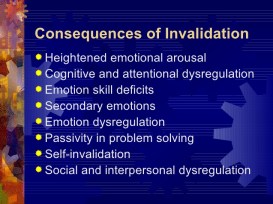 mourning mother recently told me, “Emotions are for emoting.” How an individual responds to their emotions can be right or wrong but never simply expressing them. Do NOT tell the grief-stricken that they can’t or shouldn’t feel any given way or that their feelings are sinful!
7. Affirm the bereaved’s ability to continue on. Be there for them through cards, text messages, phone calls and lunch or dinner dates. Don’t take it personally if your call and invitations go unanswered. Simply try again another time.
 8. Before you offer any advice, imagine yourself in that individual’s shoes; then personalize the advice. You are now the parent whose child just committed suicide. Consider how you might feel should someone tell you to count it all joy, or that God is good all the time, etc., before you offer any advice to the bereaved. Perspective changes when things get personal.
9. It is indeed rare for a bereaved person to continue in deep grief for an extended period of time (more than two years). There are always a few who never recover, however, Christians need to trust that God will heal the hearts of the bereaved as His word promises, in His time. There is a time to mourn and a time to dance (Ecclesiastes 3:4b KJV). When you encourage a fellow believer to move on, choose joy and be thankful for what they still have, you are, in effect, expressing that you yourself don’t trust God to heal their grief, but instead believe that the grief-stricken Christian must work to heal themselves.

 2. Realize that you cannot fix their sorrow and they don’t want you to try. They want their pain acknowledged, not ignored, not rebuked, not corrected, and definitely not minimized. Validate their feelings and affirm their ability to carry on. Be aware that their faith may be strong but they are weak in so many ways. They will likely feel as if their faith is not sufficient to see them through. Do NOT imply or state outright that God allowed their loss because their faith was strong enough to survive their loss!
 4a. The grave site can be a place of comfort or distress. Every bereaved individual is different (which I realize makes supporting the grief-stricken challenging and scary). Some spend a lot of time at the cemetery, others rarely go. It’s generally a big deal when the headstone is finally placed. The headstone often represents the only permanent legacy of the deceased. Offer to take the bereaved to the cemetery. Comment on the things you sincerely like about the marker they’ve chosen and the location selected. Never offer a negative opinion about either the burial site or the headstone!
 4b. Likewise when the deceased is cremated, the day the bereaved receive their loved one’s ashes is also a big deal. They’ve carefully chosen the urn—no negative comments! Some people display the urn, and others choose not to. Validate their choice as there will be people who are uncomfortable seeing an urn prominently displayed in a home and they will, unfortunately, let their feelings on the matter be known. There will also be people who will not understand if the grief-stricken choose not to display the urn. The bereaved often feel torn on such matters, and they need to do what feels best to them. No good, but plenty of harm, can come from burdening the bereaved with other’s opinions and expectations. If the bereaved choose to scatter their loved one’s ashes, honor their decision both in regards to how they wish to do it and who they wish to be present.
 5. Extended family needs to honor with grace the way those in mourning choose to handle holidays, anniversaries and birthdays. I’m well aware that extended family members also grieve and may be disappointed or even hurt when the bereaved choose to forego family gatherings. But frankly; it’s not about you! The highest degree of consideration should be shown to those with the closest personal connection to the deceased. Piling guilt upon grief is insensitive and unkind. Expecting the bereaved to celebrate, to be surrounded by intact families, to shake off their sorrow for the sake of the rest of the family is unrealistic and frankly puts undo strain on the brokenhearted. Family togetherness may be beneficial to some, may lift their sorrow and make them feel supported, but not to others. Be considerate. Love your bereaved family members enough to set aside your own desires in order to grant them the freedom to mourn without criticism and resentment for the choices they make.
 6. Assume that everything the bereaved tells you about how they are feeling or challenges they are facing, is confidential. A solid friendship can be utterly destroyed if the bereaved feels they are being gossiped about. Grief is hard. It hurts. Should someone inquire as to how the bereaved is doing, a safe response is, “She’s okay. She’s working through her grief.” Feel free to ask the bereaved how they would like you to respond to questions about their well-being and if there are prayer requests you can share. When in doubt, go with the safe response above. An individual who is normally an open book may become uncharacteristically private when they feel most vulnerable. Err on the side of discretion!

 We’ve been indoctrinated with the message that we must be able to turn every negative into a positive. Our culture as a whole no longer helps people work through their grief, instead we demand that they set it aside, suppress it, or spin it into an uplifting message – all the better if they can tie it up with a Biblical bow. As a result, we leave hurting people enmeshed in an internal battle pitting their normal need to express and work through their pain and sorrow against societies demand to find the silver lining and move forward.


 I didn’t lose a son and two daughters and begin picking up the pieces to move into a hopeful future. I live with the knowledge that I will always be picking up broken pieces and there is no way to repair the pieces that have been falling since MD entered our lives.




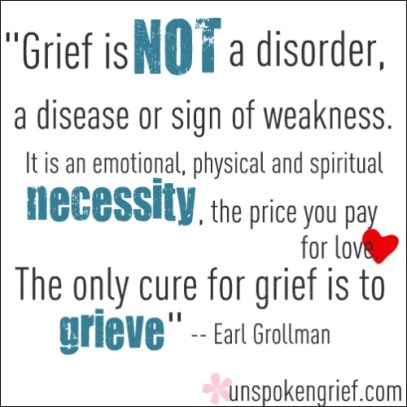 But some things in life cannot be rushed. Some things simply take as long as they take, which doesn’t seem to prevent us from feeling frustrated with the wait or pushing ourselves and others to shorten the amount of time to accomplish a given task. And that impatience has spilled over into every area of our lives including the expression of grief. A new definition can be added to Oxford Dictionaries definition of a pity party. It reads something like this: A term applied to an individual’s behavior when society and has lost patience with someone who has suffered a loss of grievous proportions.
 A fellow bereaved parent and blogger, Melanie, recently asked me if I still struggle with feeling God’s love. The question came in response to a post I published several months ago entitled,


 A fellow bereaved parent and blogger, Melanie, recently asked me if I still struggle with feeling God’s love. The question came in response to a post I published several months ago entitled,



 I think I’m starting to understand that the only thing I can do is ask God to help me recognize and experience His love for me. I can ask God to help me not only accept His love, like a gift wrapped package, and to receive it by opening the gift, but also to open my heart so I value the gift as it was intended. And that last point is critical. Have you ever received a gift and been disappointed because it wasn’t what you hoped for or maybe you wondered, “What am I supposed to do with this?” In order to grasp God’s love and care I need to be able to comprehend and fully appreciate the value of the gift given. Sometimes it’s only in retrospect that we understand and appreciate a gift.
 I guess I’m concluding that I need to humble myself and ask Him to help me experience the love I know, without a doubt, He has for me. I also need His help receiving His love because there is no earthly relationship that truly offers completely unconditional love and acceptance. I have experienced my parents and husband’s attempts to love me unconditionally, however, their example, will always fall short. We’re human, we all have expectations and unfortunately those expectations color our interaction with others either through spoken word or subtle body language, attitudes and actions. Only God offers unconditional love.
 1 Corinthians 13 tells us exactly what that looks like. You can substitute “God” or a personal pronoun for love in those verses and it reads something like this: God is patient and kind. He is not proud, rude or self-serving. He is not easily angered. He does not delight in evil [as the wicked do]. God always protects, trusts, hopes, and perseveres. God never fails.
  Furthermore, I must remember that because I have no plainly visible example of pure unconditional love, only God’s Word and the Holy Spirit can help me recognize and comprehend the reality of His unfailing love. God does not love me like anyone else loves me. He loves me better than anyone else has ever loved me and ever will love me. And yes, because I can’t see and touch God here on earth, I have to discipline myself to trust that what His word says is true, that He does love me with an everlasting love. Love is commitment and love is also an emotional response to stimuli. When I can’t feel that emotional response I have to have faith that God’s commitment to love me will not fail me.
 Boxx Banter