RSS

Category Archives: Faith

Down the Damascus Road, Again . . .

damascusroadI have found there are points in my life where I find myself completely unable to accept God’s obvious plan. Maybe you’ve found yourself in a similar situation? It’s what I refer to as my “Road to Damascus” experience. By that point in time I’m filled with frustration and anxiety and doing everything I can in my own power to change the circumstances I find myself in only to have God pull me up short and shine a painful, blindingly bright light of truth down, revealing that I am not just kicking against the pricks but actively working against His greater plan.

It’s hard to describe how it feels to know that the thing you least want to accept in your life is an irrefutable part of God’s plan. Oh, to be a two-year-old again so that the temper tantrum I want more than anything to throw, while not tolerated, is at least understood.

Harder still and completely beyond my human capabilities, is the ability to change the desperate desire of my heart, let alone make any attempt to surrender and embrace God’s unacceptable plan.

I firmly believe changing the heart and embracing God’s plan only happens at the point where a believer’s brokenness is met by the active work of the Holy Spirit in that believer’s life. Surrender definitely comes before embracing the plan.

In fact, embracing the plan may never actually happen and it may not even be something God expects from me — from any believer. Maybe all God really expects is for us to quit actively working against Him — not because we have the power to prevent His plan from unfolding but because the fight — the anger, fear, frustration, anxiety and bitterness exhausts and destroys us from within.

Maybe simple resignation, surrender to the inevitable, is a victory in and of itself. Maybe surrender, resigned or not, allows one the energy to take the next step, endure the next blow, and the next, until only the sorrow and quiet emptiness remain leaving room for the Savior to fill you from the cup of consolation and enabling the broken believer to receive the only remaining hope worth clinging to — an eternal future promised to stand in stark contrast to every aching moment the present reality reflects. Maybe that’s sufficient until the day we are made like Him.

 
9 Comments

Posted by on October 1, 2016 in Adversity, Faith, Grief


Tags: , , , , , , , , ,

Feelings; The Bane of my Existence

Counseling-theories“How do you feel about that?”, Ruth, my grief counselor asked.

Tears filled my eyes and choked my throat as I desperately tried to prevent them from falling, to prevent a sob from escaping, while my mind grappled for words to define my feelings.

For such a wordy person I find it ironic how completely inadequate I find words to be.

“It makes me sad, incredibly sad”, I choked out.

Sad? What kind of word is that? It’s so shallow, so tame, so far from describing the intense wave of emotion that swells and rolls over my heart, that sucks the air from my lungs, pinches every muscle in my neck and shoulders, and shoots quaking tremors through my body as I struggle to maintain control.

I can’t speak without control.

I realized after I left my counselor’s office that I rarely cry. In the two and a half plus years since Bethany and Katie died, since Gracen’s health was irrevocably changed, I’ve not shed the ocean of tears I would have imagined had someone told me how things would unfold for our family that fateful day.

My therapy sessions are pretty much the only place I cry.

My counselors are the only people who ask me how I feel about anything. I’m not sure if everyone else assumes they know how I feel (based upon how they think they’d feel in my place) or if they are too afraid of the answer to ask.

And conversationally people in general use deflective phrases when we describe our feelings. “I feel like . . .” or “I feel as if . . .” are frequent precursors to deflective phrases.

“I feel as if I’ve lost everything.”

“I feel like hitting something.”

Where are the adjectives that describe the actual feelings in those sentences?

That’s how I talk to people. Those phrases distance me from the descriptive words for emotions we are often told are inappropriate or just plain wrong. They allow me to talk about facts instead of feelings. I can expound upon the events that occurred, the facts, all day long without shedding a tear. But don’t expect me to directly address my feelings because I can’t do that without breaking down.

Society seems to think it’s wrong to say,

“I feel betrayed,

abandoned,

unloved,

unworthy,

inadequate,

enraged,

sad,

despondent,

discouraged,

defeated,

diminished,

detached,

numb”

and so on.

Every one of those words deemed inappropriate and negative are really just replacements for this simple two word sentence:

“I hurt.”

We like to toss out the phrase, “No pain, no gain.” in relation to exercise, but that short sentence is equally applicable to emotional healing. It’s helpful to be able to put your feelings into words because we have an inherent desire to be understood and for our feelings to be validated. But understanding and validation are not enough. We have to experience our emotional pain in order to vent it, process it and find our way past it.

onlygrieving                    


We don’t heal—we aren’t restored to full emotional health—until we work our way through our painful emotions. We can’t ignore them, hide from them, bury them, rationalize them, or intellectualize them away. Those are all avoidance measures. Our hearts must heave and keen out our grief in order to heal.


Counting it all joy is fine, as long as we don’t expect the grieving to skip the passage from the onset of the trial to the spiritual maturity and inner peace developed as a believer’s faith is tested and proven. Read the verses below and it’s pretty clear that the benefits of having one’s faith tested requires passage through a process:


“Consider it nothing but joy, my brothers and sisters, whenever you fall into various trials. Be assured that the testing of your faith [through experience] produces endurance [leading to spiritual maturity, and inner peace]. And let endurance have its perfect result and do a thorough work, so that you may be perfect and completely developed [in your faith], lacking in nothing.” ~ James 1:2-4 (Amplified Bible)

I told Ruth recently, “You know how everyone wants you to find the silver lining around every dark cloud? Well I can’t even find the outside borders of the cloud. Have you ever looked at a dark and stormy sky and the clouds just stretch out before you covering every bit of sky your eye can see? You can make a 360 degree turn and still all you see are dark clouds stretching across the sky. That’s what it’s like. Looking at my losses and the prognosis for Gracen’s disease is like looking up and seeing a single sheet of dark, stormy, roiling clouds. I can’t get far enough away to see where the storm clouds begin and end. How am I suppose to draw a silver lining around the negative circumstances of my life when I can’t find the borders?”

experience.png


Regardless, the ability to find the positive in adverse situations doesn’t make difficult circumstances easier to endure or work through. Brené Brown, in her book Rising Strong said,


“Experience and success don’t give you easy passage through the middle space of struggle. They only grant you a little grace, a grace that whispers, “This is part of the process. Stay the course.” Experience doesn’t create even a single spark of light in the darkness of the middle space. It only instills in you a little bit of faith in your ability to navigate the dark. The middle is messy, but it’s also where the magic happens.”

Apparently, as a result of my most recent trials, I have become extremely adept at the art of numbing hurt. Distraction and avoidance maneuvers are ways people numb pain. To top off Brené Brown’s list of emotional numbing behaviors which include alcohol, drugs, food, sex, shopping, work and religion among others she adds:

“And just so we don’t miss it in this long list of all the ways we can numb ourselves, there’s always staying busy: living so hard and fast that the truths of our lives can’t catch up with us. We fill every ounce of white space with something so there’s no room or time for emotion to make itself known.”

I find it interesting that the practice of religion and staying busy are included in Brown’s list of numbing behaviors, because those are two things that I’m constantly encouraged to practice. Although to be fair, I do believe she is referring to over doing any of these things individually, or completely filling your days with a combination of these coping behaviors.

As she said above, “We fill every ounce of white space with something so there’s no room or time for emotion to make itself known.” This is what I do. I read. I sleep. I think. I even write about emotions in order to avoid actually experiencing them. This is what the late great C.S. Lewis said in A Grief Observed:

“Feelings, and feelings, and feelings. Let me try thinking instead. . . Do I hope that if feeling disguises itself as thought I shall feel less? . . . Aren’t all these notes the senseless writings of a man who won’t accept the fact that there is nothing we can do with suffering except to suffer it?”


Maybe he [Lewis] tried to think and write his way around experiencing the emotions of grief too. Maybe his work, A Grief Observed, is the physical manifestation of his own efforts at numbing the pain.

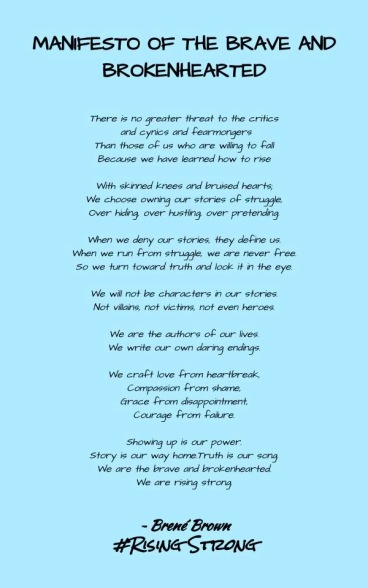
brave_brokenhearted


I’ve been struggling for two and a half years to find a way to cope with the pain of death and degenerative disease. But maybe I’m doing little more than intellectualizing my grief as opposed to experiencing or feeling it.  Maybe I’m deceiving myself by thinking I’m confronting my feelings and circumstances in relation to God’s Word when really I’m just making myself a character in my own story as opposed to writing my story (see the manifesto on your left). Maybe I’m not “crafting love from heartbreak, compassion from shame, grace from disappointment [or] courage from failure.” Maybe I’m just chasing my tail instead of becoming one of the brave and brokenhearted and rising strong.


How does that make you feel?

Confused,

Scared,

Sad,

Ashamed,

Weak,

Weary,

And very, very broken.

Lost.

I’m still lost.

All those emotions, and many more, are shoved down and shuttled aside as I continue to struggle to find the courage to process my emotions. I need to find a way to experience my feelings or healing will continue to elude me.

If anyone has any sage advice to help me through my magical mystery tour of life, please share it. Otherwise, I think the book of Jude contains the answer in verses 20 & 21:

” . . . you, dear friends, must build each other up in your most holy faith, pray in the power of the Holy Spirit, and await the mercy of our Lord Jesus Christ, who will bring you eternal life. In this way, you will keep yourselves safe in God’s love.”

And Jude tells us how we go about building each other up in verses 22 & 23:

“And you must show mercy to those whose faith is wavering. Rescue others by snatching them from the flames of judgment. Show mercy to still others, but do so with great caution, hating the sins that contaminate their lives.”


14 Comments

Posted by on September 28, 2016 in Faith, Grief


Tags: , , ,

Hunger Strike!

According to New Health Advisor, the primary purpose of nutrition is to fuel the brain and subsequently the body’s cells, muscles and organs.

Starvation is the process whereby the body generates fuel by progressively more destructive means until every fuel store has been depleted. Normally fuel is derived from the conversion of glycogen to glucose during digestion. When glucose is no longer available from nutritional input the body takes it from fat stores. When the body’s glucose has been expended it creates fuel from ketones stored in the liver. Once the body’s ketones have been consumed the body shifts to robbing protein stores starting with the muscles and moving to organ tissues. At this point death occurs as a result of illness due to the lack of vitamins and minerals that feed the immune system or the systematic shutdown of bodily functions known as a vegetative state. Muscle loss and a lack of energy along with a bloated belly are the hallmarks of starvation. The entire process takes approximately 70 days.

unknown-3This morning I realized that I’ve been on a hunger strike of sorts. It wasn’t a conscious decision on my part; well not entirely anyway. But I’ve spent a great deal of time trying to reconcile my circumstances, and my feelings about them, with what I know and believe to be true about the God who loves me. The thing I haven’t done is regularly sit down in His presence and let Him speak to me.

The truth is that I don’t really want to taste, chew and swallow what God wants to feed me. It’s a bitter, mushy, unpalatable meal that He has set before me, and so I’ve turned away from the nourishment I so desperately need. I’ve repeatedly refused to lift the fork to my mouth to taste, chew and swallow the bitter lessons of love, discipleship and suffering. And as a result, I’m wasting away much in the way a body dies of starvation.

In the absence of a steady diet of the Bread of Life (nutrition for the soul and spirit), I find myself weak and weary and more than likely my mind has become bloated with illogical thinking. (It’s hard to make a definitive statement on the state of my metal processing as it all makes sense to me)! Regardless, my spirit has been fueled by biblical nutrition from days gone by which leaves me vulnerable to the misinterpretation of scripture and misunderstandings about God—His character, will and purposes. It’s resulted in atrophied spiritual muscles and strength. Hence, I’m spiritually weak, weary, vulnerable and probably a bit delusional or at the very least misguided. Everything within me has shifted into self-protection mode.

I trust God with my eternal future. I trust Him to walk me through everything He will allow in my life; but I don’t trust Him with my heart. I don’t trust that He will protect me from further emotional pain—because life has taught me that He won’t. It doesn’t matter that He has a good purpose for my pain—the old the end justifies the means philosophy. It doesn’t really matter that He has provided comfort and consolation in my grief.

I think I have spiritual PTSD.

unknown-3

But I know—I know I’m spiritually anorexic.

Renee Swope said,

“We can find the plans God has for us when we surrender our plans to him.”

Surrender—that’s the last thing I want to do! No, fear has left me grasping to hold on to the two people I hold most dear. I’m terrified to lose them too. I wish fear were as easy to conquer as simply reciting Bible verses. “Fear not for I am with you.” “When I am afraid I will trust in you.” “Be ye strong and courageous. . . ” I know these verses, and more. They are written upon the tablet of my heart. But it’s not enough for this wounded heart . . .

“Because God loves my kids more than I do, I must trust His plan for them.” ~ Lysa TerKeurst

unknownIf you search the Internet for articles about trusting God with your children you will find the majority of the articles revolve around things that, while not insignificant, are also not matters of life and death. A quote like Lysa’s can sound painfully trite, if not impossible, to parents of sick or special needs children; especially when death is dogging their every step, regardless of the truth of her words.

Spiritual maturity is a process that requires ever increasing trust in God. And trust is hard to come by when it’s been betrayed, or feels as if it’s been betrayed. Self-protection is the knee-jerk reaction. Resistance, cynicism and even rebellion often follow.


But there are things that can help overcome those common worldly responses.


unknown-4

Romans 12:2 comes to mind:


“Do not conform to the pattern of this world, but be transformed by the renewing of your mind.”

And in this, I have failed.

Living on lessons learned in the past has limited ability to renew my mind let alone transform my heart.

unknown-1


Psalm 34:4 “I sought the Lord and He answered me and delivered me from all my fears.”

And I haven’t sought the Lord for deliverance from my fears, or my circumstances either. . .

Why you might ask.

Why would you deny yourself the bread of life?

Why deny the power of God to change your circumstances and deliver you from your fears?

God’s Word is filled with triggers that incite my fight, flight or freeze reflex. Verses that torment—that feel untrue. Verses about protection—about healing. Verses that reflect promises for the here and now—or maybe for eternity alone—or could they apply to both? God’s Word hurts!

Praise and worship music lifts me up then slaps me back down as it cycles through praise and thanksgiving followed by trials and victorious overcoming. But I don’t feel like an overcomer and I certainly don’t feel victorious.

Prayer—prayer is just plain emotional. Faith and fear, anger and resentment, trust and bitterness assault me. Prayer is an exercise in trust. It’s begging God to do that which I cannot do myself; which generates expectation—hope—within my heart. Prayer requires reaching for His hand, grasping it when it comes within reach, and trying desperately to cling to it as things continue to get worse—when it feels as if my prayers have gone unheard or worse yet—that my feelings have been disregarded.

I’m resigned to Gracen’s prognosis. Every request for the removal of the thorn in her flesh has been repeatedly answered in the negative (lest I dare hope His answer is ‘wait‘ instead of ‘no‘). Begging for a change in circumstance in the face of continued negative responses just sets me up for further disappointment. I don’t need my glasses to read the writing on the wall. Encouraging me to continue in prayer and have hope for healing leaves me feeling guilty and ashamed as if I’ve failed in my Christian duty—as if I’ve failed my daughter. However, even the Apostle Paul quit asking for his thorn to be removed after three seasons of prayer.

romans12_3And deliverance from my fears is beyond the scope of my faith . . . at this time.

My fears are all bound up in Gracen’s future, her prognosis, and deep spiritual wounds that remind me that I have trusted God for things in the past that He never promised. That’s not to say that He failed me, no, not at all, but I was still hurt by misunderstanding the promises He did make.

Sometimes I think it’s a cop-out to say I don’t currently have enough faith. Maybe you do to. But I ask you to return with me to Romans chapter 12. After Paul’s admonition to avoid being conformed to this world—after his encouragement to be transformed by the renewing of our minds—he went on to say this in verse three,

For I say, through the grace given unto me, to every man that is among you, not to think of himself more highly than he ought to think; but to think soberly, according as God hath dealt to every man the measure of faith.

In the majority of card games, cards are dealt by the dealer either upon request or as the rules dictate. If faith and trust are living and growing spiritual fruit, I think it’s highly likely that at times God deals me a bit more faith when I request it, and at other times He deals me more because His plan dictates that I will need it. The well of faith is always sufficient; but faith still needs drawn out of the well!

uninvitedI recognize that my unintended hunger strike needs to come to an end. I’ve devoured every last bit of spiritual knowledge stored up in my heart and mind. I need a regular diet of the meat of the word in order to renew my mind and transform my heart. I’m sure I’ll miss meals on occasion, but I’m making a conscious effort to be regularly fed.

Right now, my diet consists of a Proverbs 31 Online Bible Study by Lysa TerKeurst called Uninvited. It’s subtitled: Living Loved When You Feel Less Than, Left Out And Lonely.

It’s a start and it’s hard.

It’s hard because the foundation of the lessons are the love of God, as it should be. Yet, Lysa TerKeurst, points out that, “What we see will violate what we know unless what we know dictates what we see.” Did you get that? What we see undermines truths we absolutely believe about a God, and will continue to do so, until our hearts and minds are transformed. Then the truths we know will alter our spiritual perspective, thereby overcoming sight by faith.

Every time I look upon my daughter, I see disease reigning victorious over her physical body. Fear of losing her, fear of unbearable grief have created a living, breathing terror within my heart—terror of God almighty—of His plans—terror over how much His plans will hurt. And that terror undermines what I know to be true. God loves me. He loves me and I have nothing to fear from Him. But what I know to be true is not dictating what I see when I look upon my daughter. I don’t see her one step closer to complete healing. I don’t see her drawing ever closer to no more pain. I don’t see her through the eyes of eternity. The hope of eternity is obscured by the dimmest of mirrors reflecting and distorting what will be with the reality of what is right now.

And right now I feel less than—less important, less valuable, less loved than the believers who surround me with joyfully intact and healthy families. Right now I feel left out—left out of the blessings everyone around me takes for granted. Watching their children grow up, embark on careers, marry, have babies, and watching those babies grow. Right now I feel lonely—lonely for missing family members, lonely for friendship, lonely for the Lord because it’s so very hard to draw close to someone you know will hurt you, or allow you to be hurt, again—maybe even soon. Lonely because grieving is very much a solitary activity.

So I am trying with this online Bible study. My self-imposed hunger strike is over! And I’m hoping to find a way to live loved. To live in the full assurance of the height, width, and depth of God’s love for me so that I can be renewed and transformed—so that the image in my mind of the mastery of disease over Gracen’s body will be concealed—will be completely replaced—with a clear image of Gracen the way Christ will see her when she steps into His presence. That’s a pretty tall order; but I know that God is able. It won’t happen overnight; or quickly for that matter. But given time, it’s a possibility.

It’s a possibility.

 
6 Comments

Posted by on September 19, 2016 in Faith


Tags: , , , , , , ,

A Mourner’s Thoughts On Sickness, Sorrow, Pain And Death – Scott Sauls

Scott Sauls, Pastor of Christ Presbyterian Church in Nashville, a man well acquainted with ministering to the sick, sorrowful, those in pain and those grieving or living in anticipation of death, opens God’s Word and reveals important scriptural truths about suffering. This post has the power to equip the Saints as well as offering much needed validation to the suffering. Click on the link in red below to read Pastor Sauls’ article.

” Let all who have ears give heed to what the Spirit is saying to the Churches.” ~ Revelation 3:22 (Weymouth New Testament)

Source: A Mourner’s Thoughts On Sickness, Sorrow, Pain And Death – Scott Sauls

 
Comments Off on A Mourner’s Thoughts On Sickness, Sorrow, Pain And Death – Scott Sauls

Posted by on September 17, 2016 in Adversity, Faith, Grief, Links


Tags: , , , , , , , , , , ,

Thanks for Listening!

Thanks for Listening!

My virtual friend, Melanie, simply shares my heart, my brokenness, my faith, my struggle and my purpose for blogging. She has much to offer the bereaved and those who care for them, on a foundation of sound doctrine.

Melanie, has been such a blessing to me personally. Everything she writes echoes a chord within my soul. In this post, she touched on the one thing I have been too vulnerable – too afraid to share – that need – that craving, for ongoing support.

I hope you will read Melanie’s post and visit her blog at thelifeididntchoose.com. God is working and ministering to brokenhearted parents worldwide through her struggle.

Melanie's avatarthelifeididntchoose

One year ago today I began sharing my grief journey publicly on this blog.

IMG_1790

You can read that first post here.

It was (and still is) scary to expose my thoughts and feelings to a wider audience than just the pages of my personal journal.

I’m never certain that what is helpful for me is necessarily helpful for anyone else.  But in writing it down I find that I am able to sort through things better than when I leave it bouncing around in my own head space.

I decided upfront that I would be as honest as possible about what I felt and how I was coping.  I wasn’t sure if I would post only a few times or a lot, if it would turn into a day-by-day diary or a more sweeping revelation of deeper things.

I think it’s kind of been both at times.

And…

View original post 321 more words

 
Leave a comment

Posted by on September 16, 2016 in Faith, Grief


Tags: ,

Questions I Ask & Thoughts I Ponder

The Apostle Paul said in Philippians 1:21,

“For me, to live is Christ and to die is gain.”

I can in no way claim to be anything like the Apostle Paul, but I can relate to his statement – if not in whole, then in part.

For me, to live is to care for Gracen, and I desperately want to be there for Gracen, but to die . . . to die is gain.

In our day and age, no one wants to hear that sentiment expressed. Maybe it makes people fearful that I might harm myself, but I wonder if maybe it is more about an individual’s fear that at some point in their life, they might find they desire death over life.

I have an eternal hope.

Death is not something I personally fear.

And neither did the Apostle Paul.

And if . . . if God’s purpose for the latter part of my life is to care for Gracen . . . if that is my ministry and service for Christ, then am I not, in effect saying just as the Apostle Paul did, “For me, to live is Christ and to die is gain”?

Is it spiritual to laud his statement and rebuke mine?

If we as Christians are to be Heavenly minded, is it wrong to long for our eternal home?

Is it wrong to desire Heaven more than we desire this temporary world we currently reside in?

Do we unconsciously believe Paul’s ministry, the ministry of evangelism, is the pursuit of Christ and His desires, whereas ministry to the members of our family or the sick really doesn’t equate to living for Christ?

img_1412-1Is that why my longing for my eternal home is met with admonitions that I must have hope? That it is wrong for me to desire the rapture in order to escape these earthly sorrows?

Is that really wrong?

Does my motivation somehow make my desire impure?

Does God care why I desire Heaven or just that I do?

Does not a longing for my eternal home reflect the deepest trust that I, in fact, have an eternal home waiting for me?

Does it not reflect true faith?

And should I lose it all—should I lose both David & Gracen—what, if anything, would be capable of anchoring my broken heart to this earthly prison?

I know what the answer to that last question should be. I certainly don’t need anyone to educate me with the “correct” response. But what “should be” and “what is” are often two different things. I know that my mind and my emotions will not agree if my worst fears are realized. I know they won’t. They don’t now.

These are questions I ask myself.

Maybe that last question is the reason people so adamantly attempt to cram the necessity of hope down my throat.

Maybe that’s their secret fear too.

Maybe no one knows what would hold enough sway in their individual lives to anchor their souls to this world if they lost everything they value most in this world.

Maybe—God help us all—maybe there is nothing strong enough to do that for any of us.

img_1416Maybe that’s where the Holy Spirit steps in and performs a supernatural work in our hearts that enables us to receive God’s all sufficient grace instead of rejecting it in our agony . . . instead of taking action outside of the will of God due to complete despair and utter desperation.

These are thoughts I ponder.

I’d love to know how you answer these questions—if you think these same thoughts.

 
6 Comments

Posted by on September 10, 2016 in Faith


Tags: , , , , , , , , , ,

Thirty Minutes

hourglassI had a biopsy Tuesday. I was a bit surprised when the doctor told me that I had handled the news that the biopsy was necessary in an appropriate manner – in other words – he was glad I didn’t freak out. This is the fourth time I’ve had to have follow-up appointments when the initial tests revealed unexpected results ATA (after the accident).

I find that ATA I am no longer shocked or surprised by disconcerting news. I’ve just adopted a low-level of expectation mixed with a high-level of resignation.

The nurse told me prior to the procedure that they do a lot of these biopsies and that a cancer diagnosis is very rare. My tongue-in-cheek response was, “Please don’t use that word rare. I’ve found that if it’s rare it happens to me.” Stillbirth is rare. ARSACS is rare. Losing two children in a car accident, while not unusual, is also rather rare among the population.

The biopsy wasn’t as uncomfortable as I expected in spite of finding that the pre-procedure medication hadn’t quite done the job it was designed to do. An additional step was required, which the nurse assured me was NOT a rare occurrence. The three of us, the doctor, nurse and I actually found a host of things to laugh about throughout the process.

As I left the clinic Tuesday afternoon I found myself thinking, ‘This is the most normal I have felt ATA.’ It wasn’t that I escaped the awareness of Bethany and Katie’s deaths. Nor did I forget Gracen’s disease and her prognosis. Those things are simply deeply ingrained in my being. They are ever before me. They have shaped me in so many ways. They color my perception of everything I see, hear and experience.

I don’t really know what made the interaction with my doctor and nurse different than all the interaction I have had with others ATA. Maybe. . . hopefully. . .  it reflects that a measure of heart-healing has taken place. I am both hopeful and wary of finding out if that will prove to be true.

clocksIt was a period of time in which feeling good (in spite of the fact that I was having a biopsy and all that implies) didn’t feel bad – didn’t feel as if laughing or smiling or enjoying simple conversation diminished the inherent value of my daughters. There was no guilt – no shame – and believe me I found many a reason to feel both of those things!

It was thirty minutes, not of escape, but of the assurance that there could and maybe even would be more moments like this. Moments when each one of my children is a joyful part of me, not simply a bitter or wounded reminder that life is not what I hoped, expected or dreamed it would be.

I fear I’m not describing these moments well at all, but suffice it to say that it was the first time that I discovered that living another day might not be so bad. That I might eventually enjoy life again. Not the naive existence I walked before Cole was stillborn, before Gracen and Katie were diagnosed, before Bethany and Katie died, before Gracen survived even as her health continues to deteriorate. No, it was a glimpse of what might be possible in spite of all those other things.

For thirty minutes of my life Tuesday . . . I felt free.

I felt for the first time as if God just might have some good plan for me in the here and now; not just my eternal future. Believe me when I say that I have long known intellectually that God cares about my here and now as well as my eternity, but it’s the first time I actually felt as if that was true. Finding any single occurrence where my mind and my feelings agree is huge for me.

HUGE!

For two and a half long years I have struggled to find a way to make my mind and emotions agree . . . and I’ve failed miserably. I honestly don’t think it’s something I have any power over. I think that’s the Holy Spirit’s job, so I don’t believe I’m a failure. I do, however, think the Holy Spirit is meticulous and that takes time – more time than I have the patience for.

So for now . . . all I want to do is bask in the thirty minutes of freedom I experienced.

30-minutes-400x234-1_1Those thirty minutes were worth waking up Tuesday.

Worth getting showered and dressed.

Worth having a biopsy.

Those thirty minutes. . .

That feeling of freedom . . .

it’s priceless.

 
6 Comments

Posted by on September 7, 2016 in Adversity, Faith, Grief, Muscular Dystrophy


Tags: , , , , ,

Girl, Who’s Your Daddy?

If you don’t want to take the time to watch this three minute video, below is a paraphrased transcript. I thought you might like to have Priscilla’s answer to her own question. 

I added my own comments below the transcript.

“When you feel like you can’t handle the task at hand; and you ask yourself, Girl, who’s your daddy’s?. . ., And what if, when you got a good look at your God, remembering who He is and that you belong to Him, listen, I think until the Lord stops me from taking platforms and ministering to women, I will say this until the day I die, reminding myself as I do when I am quietly alone and I look myself in the mirror and say, Girl who’s your daddy?; you know what I tell myself, I tell       myself… ”

“He is the First and the Last. The Beginning and the End. He’s the Keeper of creation and the Creator of all. He is the Architect of the universe and the Manager of all time. He always was, always is and always will be unmoved, unchanged, undefeated, and never undone. He was bruised but brought healing. He was pierced but eased pain. He was persecuted but brought freedom. He was dead and brings life, risen to bring power, and He reigns to bring peace.”

“The world can’t understand Him. Armies can’t defeat Him. Schools can’t explain Him. And leaders, they can’t ignore Him. Herod couldn’t kill Him. Nero couldn’t crush Him. The new age cannot replace Him. And Oprah cannot explain Him away!”

“You remind yourself that He is Light, He is Love, He is Longevity, and He is the Lord.”

“He is goodness and kindness and faithfulness and He is God.”

“He is Holy and Righteous and powerful and pure.”

“His ways are right, His Word eternal, His will unchanging and His mind is on us.”

“He’s our Savior, our guide, our peace, our joy, our comfort, our Lord and He rules our lives!”

“I serve Him because His bond is love, His yoke is easy, His burden is light and His goal for us is abundant life.”

“I follow Him because He’s the Wisdom of the wise, the Power of the powerful, the Ancient of days, the Ruler of rulers, the Leader of all leaders.”

“His goal is a relationship with me.”

“He’ll never leave you, never forsake you, never mislead you, never forget you, never overlook you, and never cancel your appointment in His appointment book.”

“When you fall He’ll lift you up. When you fail He’ll forgive you. When you’re weak He’s strong, when you’re lost He’s your way, when you’re afraid He’s your courage, when you stumble He will steady you, when you’re hurt He’s going to heal you. When you’re broken He will mend you. When you’re blind He will lead you. When you’re hungry He will feed you. When you face trials He’s with you.”

“When I face persecution He shields me. When I face problems He will comfort me. When I face loss He will provide for me. And when we face death He will carry us all home to meet Him.”

“is everything, for everybody, everywhere, every time and in every way.”

“He is your God and that, Sisters, is who you belong to.”


I don’t know about you, but every morning when I crawl out of bed, I know I can’t handle the task at hand. But, I do know,… I do know that I can trust in the One who is able…

the thing is…

I don’t want to.

Or more accurately, I don’t want to have to, or need to, trust in Him for the task at hand.

I don’t want to go where my life is leading…

At All!

I just don’t want to go there.

And, given my history—given the prognosis that lies ahead for my daughter, can you blame me? Can you really think that all I’m doing is throwing the longest lasting pity party known to man?

Really?

If that’s what you think…

it’s not personal to you.

Try to imagine living with my daily reality—not the deaths of my three kids—not the progressive disease that is destroying my surviving child’s body—No, not that. Put your children’s faces on those bodies. Imagine you are really living my daily life.

And if…

if…

you still think I’m throwing a pity party, then, please, keep your criticism and judgement to yourself. Because…

Every.

Single.

Day.

I need to…

Remind myself…

Who My Daddy Is.

Every Day.

That doesn’t make what’s coming my way okay.

Not at all.

But…

It makes it bearable…

most of the time.

I need Priscilla Shirer’s answer. I need her words. I need the reminder of exactly who my Daddy is.

Maybe you need her words too…


Who’s Your Daddy? by Priscilla Shirer

Taken from the DVD Bible Study Anointed, Transformed, Redeemed. A Study of David. Video Session 1. By Priscilla Shirer, Beth Moore and Kay Arthur.

 
2 Comments

Posted by on August 31, 2016 in Faith


Tags: , , , , , , , , , , , ,

Six Stone Jars and a Cup of Forgiveness | Light & life

Today’s post comes to you from the blog Light &
Life; just click on the source link in red below to see the article in its entirety. I’d encourage you to check out Julie’s About page before you leave her site to see if you’d like to explore further or simply visit her site at thereluctantbaptist.com.

I love the literary use of foreshadowing and you’ll find some of that here. The article is a little bit of Easter on a late summer day. I don’t know about you, but I could do with a little bit of Easter several times of year. So without further ado . . .

“I heard something beautiful in church yesterday as we read the story of Jesus’s first recorded miracle at the wedding in Cana. If you know the story, you know that there was a wine shortage. …”

Source: Six Stone Jars and a Cup of Forgiveness | Light & life

 
Leave a comment

Posted by on August 29, 2016 in Faith


Tags: , , , , ,

Lessons on Suffering

Pauls-thorn-in-the-flesh

It was the Spring of 2013, and I was struggling with the myriad of difficult circumstances our family was facing and attempting to reconcile my spiritual beliefs in light of those circumstances.

Gracen and Katie had been diagnosed with ARSACS, a rare and progressive form of muscular dystrophy a year before. Their prognosis was not encouraging. We saw increasing deterioration in Gracen’s health, which seemed to be moving faster than we’d expected based on the limited amount of information available. Bethany had completed her freshman year of college at the University of Central Arkansas and was growing increasingly cynical toward the faith of her youth. And David’s job was in jeopardy. He is the sole breadwinner for our family and we were unsure if he would qualify for unemployment benefits. Needless to say, I was a tad stressed.

Funny how none of the things above was my personal problem. Each one was a battle for those I love most deeply and as a wife and mother, their suffering became my own. The curse of empathy is the ability to personalize another’s suffering as your own and that’s exactly what I did. Every physical setback Gracen and Katie experienced resulted in grieving the lost abilities for my daughters and for myself. Each time Bethany attacked a biblical truth, I ached and feared for her, for her future, for her eternal safety and for myself knowing her choices might lead me to endure painful consequences alongside her. And I was well aware how a man’s job impacts his self-esteem not to mention the burden of financial insecurity.

One morning I sat out on my back patio with my bible and smartphone and began searching the scriptures for what God’s Word said about suffering. This is what the Apostle Paul wrote about his own trials:

7 And lest I should be exalted above measure through the abundance of the revelations, there was given to me a thorn in the flesh, the messenger of Satan to buffet me, lest I should be exalted above measure. For this thing, I besought the Lord thrice, that it might depart from me. And he said unto me, My grace is sufficient for thee: for my strength is made perfect in weakness. Most gladly, therefore, will I rather glory in my infirmities, that the power of Christ may rest upon me. 10 Therefore I take pleasure in infirmities, in reproaches, in necessities, in persecutions, in distresses for Christ’s sake: for when I am weak, then am I strong.”  —  2 Corinthians 12:7-10 (KJV)

When Paul asked God to remove the thorn in his flesh, this was God’s response:

(2 Corinthians 12:9)  “My grace is sufficient for thee . . . “

“My strength is made perfect in weakness . . . “ KJV

Or in another translation

“My power is perfected in weakness . . .” NASB

006-jesus-gethsemane

Christ praying and sweating blood in the Garden of Gethsemane

In 2 Corinthians 12:7 Paul tells the reader the purpose of the thorn in his flesh. I find it interesting that Paul knew and understood why he was suffering, just as Christ did in the Garden of Gethsemane, yet both Paul and Christ asked for their suffering to be taken from them. That tells me that understanding God’s purposes doesn’t make suffering any easier to endure. Knowing why doesn’t make the hurt or the fear go away. The truth is that, in our humanity, we are desperate to escape pain in spite of recognizing God’s greater plan.

In this particular case, the purpose of Paul’s thorn in the flesh was to keep him humble. Paul understood that the normal human response to being singled out by the resurrected Lord—and receiving the sheer abundance of revelation he received—would commonly result in pride; a very destructive character trait.

Paul described the thorn in his flesh two ways:

1)  As a gift; well he doesn’t actually call it a gift.  He simply says it was given to him which implies to me that it was a gift and its purpose implies it was a gift from God (to keep him humble).  Funny how a message from the enemy to buffet a believer could be seen as a gift from God when it serves His purpose. And it was a good thing because it saved Paul from the pain and destruction pride brings. Maybe some of our sufferings are considered good from God’s perspective because it saves us from a fate that is far more detrimental to our overall well-being or damaging to our character.

2)  As a message from Satan to torment him.  It’s as if God allowed Satan to afflict Paul, just like God allowed Satan to afflict Job.  The Bible is riddled with such instances.  Satan intended this thorn in Paul’s flesh to hurt Paul just as Satan, via the conduit of his brothers, intended harm, even death, for Joseph.  Satan was also allowed to bring Christ to the cross, although Jesus laid down his own life in obedience to God.  Satan’s intent was to destroy God’s plan of redemption but again, God thwarted Satan through Christ’s resurrection which defeated the power of sin and death in men’s lives. It appears that two plans are being implemented simultaneously with very different goals. Satan’s goals are destructive but God is well aware that Satan has set out to destroy His children and God uses Satan’s own devices not only to thwart Satan’s plans but to triumph over them. Isn’t that the most satisfying form of serving justice and meting out righteous vengeance—to turn your enemy’s own evil plans against him? It’s pretty much the ultimate slap-down.

Although the message Satan wanted to communicate to Paul isn’t directly outlined, we can extrapolate it ourselves based on what we’ve heard other broken believers express through trials. Here’s a reasonable sampling:

1)  God doesn’t love you or He wouldn’t have allowed this bad thing in the first place

2)  If God really loved you, He would have healed you from this affliction

3)  God isn’t as powerful as He claims because He obviously can’t heal you or He would have

4)  God can’t protect you from me (Satan) – I’m more powerful than God

Just like Job, when Paul didn’t respond to suffering the way Satan expected, Satan added to Paul’s affliction.  2 Corinthians 11:23-27 says that Paul suffered more than any man for the sake of the gospel.  Paul:

1)  Received 39 stripes on five separate occasions at the hand of the Jews

2)  Was beaten with rods three times

3)  Was stoned once

4)  Was shipwrecked three times

5)  Spent a full day and night in the ocean on at least one occasion

Throughout his journeys to spread the gospel, Paul’s life was in danger from robbers, fellow Jews, Gentiles and false Christians wherever he went and however, he got there.  He suffered from cold, exposure, manual labor, sleepless nights, hunger & thirst all while shouldering the concerns of the churches he planted.

Satan uses affliction to:

1)  Discourage and torment believers

2)  Derail efforts to spread the gospel

3)  Cause believers to doubt God’s love, kindness, and power

I recently read a very interesting article about John 10:10, “The thief cometh not, but for to steal, and to kill, and to destroy: I am come that they might have life, and that they might have it more abundantly.” The article examines the Greek words in this verse to aid in gaining a better understanding of the scripture. Click on the following link for an eye-opening read from the Renner Ministries Blog:

The Devil Has a Plan For Your Life!

God uses affliction to:

1)  To prevent us from becoming prideful — 2 Corinthians 12:7 (See above); Or maybe to prevent us from developing some other trait that damages our character or is personally destructive.

2)  To save His chosen people:

“Now do not be grieved or angry with yourselves, because you sold me here, for God sent me before you to preserve life. . . God sent me before you to preserve for you a remnant in the earth, and to keep you alive by a great deliverance.” — Genesis 45:5 & 7

“You intended to harm me, but God intended it for good to accomplish what is now being done, the saving of many lives.” — Genesis 50:20

3)  To provide His children with the assurance of their own salvation:

The Spirit Himself testifies with our spirit that we are God’s children.” —  Romans 8:16

4)  Conform us into the image of Christ and share in the fellowship of His suffering, His consolation, and His glory:

“But we all, with open face beholding as in a glass the glory of the Lord, are changed into the same image from glory to glory, even as by the Spirit of the Lord.”  — 2 Corinthians 3:18

“And we know that in all things God works for the good of those who love him, who have been called according to his purpose. For those God foreknew he also predestined to be conformed to the image of his Son . . . And those he predestined, he also called; those he called, he also justified; those he justified, he also glorified. — Romans 8:28-30

“And if we are children, then we are heirs: heirs of God and co-heirs with Christ—if indeed we suffer with Him, so that we may also be glorified with Him.” — Romans 8:17

“For just as the sufferings of Christ overflow to us, so also through Christ our comfort overflows. . . And our hope of you is stedfast, knowing, that as ye are partakers of the sufferings, so shall ye be also of the consolation.” — 2 Corinthians 1:5 & 7

“But rejoice that you share in the sufferings of Christ, so that you may be overjoyed at the revelation of His glory.” — 1 Peter 4:13

5) To produce endurance, develop your faith, and lead to increased spiritual maturity:

“Be assured that the testing of your faith [through experience] produces endurance [leading to spiritual maturity, and inner peace]. And let endurance have its perfect result and do a thorough work, so that you may be perfect and completely developed [in your faith], lacking in nothing.” — James 1:3-4 AMP

6) Enable us to comfort and encourage others who are suffering:

“Blessed be God, even the Father of our Lord Jesus Christ, the Father of mercies, and the God of all comfort; Who comforteth us in all our tribulation, that we may be able to comfort them which are in any trouble, by the comfort wherewith we ourselves are comforted of God.” — 2 Corinthians 1:3-4

7) To display the works of God:

“His disciples asked him, “Rabbi, who sinned, this man or his parents, that he was born blind?” Jesus replied: “Neither this man nor his parents sinned,” said Jesus, “but this happened so that the works of God might be displayed in him.” — John 9:2-3

crown-and-thorns8)  To earn eternal rewards that will far outweigh the temporal suffering we experience in life:

“Therefore we do not lose heart. Though outwardly we are wasting away, yet inwardly we are being renewed day by day. For our light and momentary troubles are achieving for us an eternal glory that far outweighs them all. So we fix our eyes not on what is seen, but on what is unseen, since what is seen is temporary, but what is unseen is eternal.” — 2 Corinthians 4:16-18


Why is it important that we understand God’s purpose in allowing His children to suffer?

I think it’s critical that we realize that God uses affliction for a variety of purposes and each trial a believer encounters may serve a completely different purpose.

One thing I have discovered through child loss is that fellow Christians often try to encourage the grieving by reminding them that their current suffering will allow them to comfort another hurting soul somewhere down the road.  This may or may not be true. Depending upon the circumstances, the level of trauma involved, or the personality of the bereaved, God may never intend that believer’s suffering to be used to minister to another. The experience may be so negative that the individual may not be able to support and encourage another. The pressure to minister may re-victimize the believer or the individual may not be able to talk about their situation without inciting fear in another thereby doing more damage than good.

I have also discovered that those who are called to minister to others generally are not capable of taking on that role until a significant amount of healing has taken place in their own lives. Discernment is definitely required before encouraging anyone to minister to another as a result of their trial and also required for the tested, the survivor, to know if God is really calling them to this type of ministry or to minister to a specific individual. Ministry is about more than shared experience. Personality and approach matter.

Of all the purposes of suffering I uncovered in my research, all but one can generally be confirmed in hindsight. The one that can’t—when God allows suffering in order to prevent something He deems more damaging to His child. There are some things we will never be able to understand or explain.

Suffering almost always leads to the why question. But ultimately, having a definitive answer doesn’t make the suffering less painful or even lead a believer to embrace the pain for the joy that lies before them. Knowing why is less important than the fruit God produces as a result of affliction. Understanding why may come in hindsight, but even if it doesn’t, I believe there’s always a purpose, whether I approve of it or not, and God allows it for our individual, eternal good.

As Ruth, my grief counselor, pointed out to me recently, at creation, God proclaimed everything He created “good” not “perfect”. Why would Adam be made caretaker of all of creation if there were no problems to resolve? Had there been no problems, Adams job would have been superfluous.

Perfect is a life without problems, without suffering. Good is a life that includes problems, inconveniences, and even suffering. It’s a life that matures through time and experience. It’s a life that includes overcoming adversity, recognizing our dependence upon God, helping our fellow man, bringing glory to God and earning eternal rewards. We don’t earn anything unless we work for it. And God’s grace is sufficient to enable us to live a good life in spite of trials, afflictions, and suffering.

 
2 Comments

Posted by on August 26, 2016 in Adversity, Faith, Grief, Muscular Dystrophy


Tags: , , , , , , ,