RSS

Category Archives: Faith

Pre-Move-in Day Challenges

move-in-dayAs the day dawned Friday morning it finally dawned on me how little time I had left with Gracen before the fall semester begins.

I sucked in a shallow breath.

Dread settled deep within.

The funny thing is, I’d been aware of this encroaching date all along. I just refused to think about it. I gave it an intellectual nod when the thought of her back to school date came up and quickly pushed it out of my mind.

But thoughts like those have a way of festering beneath the surface of one’s psyche. I’d noticed the signs—typical stress reactions for me. Nights spent reading that stretched into the wee hours of the morning or even until daybreak, the soreness at the tip of my tongue from rubbing it on the inside of my lower front teeth, the itchy feeling beneath my skin, a desire to write then frustration swelling when I was unable to put anything down on paper as my mind flit from one concern to the next. Creeping anxiety.

But it wasn’t until this morning that I counted the remaining days. Today, Saturday and Sunday. Move-in day—Monday afternoon. Then I will turn my back once again and hold my breath waiting and hoping.

Waiting for that phone call.

Hoping it doesn’t come.

You know, the one where a university official calls to tell me Gracen’s been hurt . . .

or worse.

Oh yes, worse is always on my mind.

Then again maybe you don’t know.

Maybe after you dropped your child off at college and piled back in the car your worries were vastly different from mine. Maybe you fret over poor judgment, too much freedom, a lack of academic commitment, or maybe you are more concerned about the echoing silence that will greet you when you once again cross the threshold of your home.

All those things bother me too, especially the silence, but mostly because I fear it could be permanent—that that last hug might really be the last hug—ever. That thought lurks.

The other lurking thoughts are regrets. Regrets for missed opportunities. Really for forfeited opportunities. Those I consciously chose to skip for reasons related to anxiety and depression . . . I’m ashamed to admit.

And that’s really it I think. Fear and shame constantly assail my heart and soul.

I should be handling this better.

I should be healing instead of falling apart more and more as time goes by.

I should be able to make decisions.

I should be less afraid of people; of social situations. What does it matter what anyone else thinks?

I should quit escaping into fiction.

I should, I should, I should, I should not. And every un-distracted minute is filled with shoulds, should nots, and fear—because anxiety is just a synonym for fear.

She’s sleeping late. Is she breathing?

Is she safe in the shower?

Will she be safe when she returns to school? Not safe from others. Not safe from impulsive decisions or risky behavior, but safe getting out of bed, getting in the shower, getting dressed in the morning. Safe doing all the simple tasks we routinely do without thought.

And fiction and sleep are the two activities that shut out the shoulds, should nots and fear.

But there are times when I can’t focus to read or write and sleep eludes me and that itchy, tingling feeling under my skin about drives me insane. I find myself frantic for some escape. Trapped inside this human shell while inwardly keening for release.

Now I understand why people drink to intoxication—the befuddled mind is their escape and they are pleasantly numb.

But there will be no escape for me. Just repeated hopping up to leave the security of my bedroom for some distraction only to find the available distractions (talk, TV & pets) annoying so I flee back to my bedroom. A shower maybe, but the pounding water doesn’t shut out my thoughts. A drive . . .

to the crosses . . .

only to feel frustration rise.

Oh to be able to rip the top off my head and let all the painful, toxic thoughts and emotions escape!

I don’t know how to do this, Lord! I don’t know what to do let alone how to do it. I spin in circles like the Tasmanian Devil and hear only silence from You. Unbearable silence. I’m defeated by the truth that there is no fixing this. There are no good answers. No paths without pain. No solutions whatsoever. I need You to speak, to step in, to do something—something I can see—something that won’t hurt. Something that reveals a purpose for this madness.

Something that carries me through Friday, Saturday, Sunday, and Monday. Something that prepares me for the silence I’ll return home to and wake up to Tuesday morning. Something other than the dread of that phone call coming; of the remaining pieces of my life-shattering at my feet.

I just need . . .

Something.

 
8 Comments

Posted by on August 20, 2016 in Adversity, Faith, Muscular Dystrophy


Tags: , , ,

Déjà Vu Day Arrives

save-alarms
The alarm rang at 4:15, shocking me awake from the four restless hours of sleep I’d managed to get prior to waking Gracen. Time to dress and leave for the hospital for her scheduled appointment to have her wisdom teeth removed.

The day went much as I’d anticipated.

It’s just a hospital I told myself when I first noticed the Mercy sign glowing in the predawn sky.

An inane conversation followed, “Maybe this time we will arrive early enough to get a handicap parking space.” (No such luck Monday when we arrived for her pre-op appointment.)

“Score! Right in front of the hospital entrance.” (Not many people out at 5:00 a.m.)

It’s not an emergency—nothing serious—just wisdom teeth—I told myself as I exited the car and unloaded the wheelchair from the trunk.

Deep breath in.

Exhale.

One foot in front of the other.

Whoosh! The pneumatic doors slide open. All’s quiet at the front desk: nary a volunteer in sight. Elevator ride. Registration. One more elevator ride to the third-floor surgery waiting room.

Thank God for social media and a smartphone! Facebook status updates and videos meet the currently limited duration of my attention span. Reading is simply not possible.

“Gracen Boxx”, the intake nurse calls and we are off. Double doors swing wide after a card key is scanned and we enter the surgical pre-op area which I silently note is eerily reminiscent of the ICU corridor at Freeman Hospital, just a slight bit narrower. I quietly suck in a deep breath as I follow the nurse who is pushing Gracen’s wheelchair to room 323.

Scrubs.

Tile floors.

Medical equipment.

A tech, Kim, enters the room, lowers the bed as far as it will go, and places a gown on the bed along with a plastic drawstring bag in which to store Gracen’s street clothes. The anticipated snick as the curtain is drawn follows as Kim exits the room and Gracen and I left alone in the small cordoned off space.

We gown her up, make a quick stop at the restroom next door then I maneuver the wheelchair into place, lock the wheels, move the foot pedals out of the way, lift Gracen to a standing position and perform an efficient quarter turn before seating Gracen on the edge of the hospital bed. It’s just a wee bit too tall requiring that I boost her up and back before elevating her legs and spinning her another quarter turn to lay prone.

I indulge in a deep breath before shifting the tray table and a chair down to make room for the wheelchair to sit in an out of the way corner.

Sit down!

In comes the pre-op nurse, Jennifer.

The blood pressure cuff velcroed in place.

Temperature taken.

Pulse and oxygenation recorded.

When did you eat and drink last?

When did you last take this medication and that medication individually until the list of her normal meds is thoroughly reviewed.

The dreaded IV is inserted and a steroid injected into the port in her left hand.

Breathe in.

Breathe out.

Doctor Baker enters the room in blue surgical scrubs. He greets us, asks if we have any questions and reassures us that all will go smoothly.

Next up the Anesthesiologist quickly followed by two operating room nurses. I hug and kiss my only surviving child and whisper, “It will be okay.”

hospitalbed2And then it happens. . . the moment I most dread . . . the wheel locks are released and Gracen is moving away from me. “I love you”, I call out to her retreating figure.

The first set of doors swing open, my eyes track the progress of her bed. A second set of doors swing wide . . .

and I pray.

It’s just a simple one line prayer that spontaneously whispers through my mind as the first set of doors begin to swing closed and she’s gone. . .

beyond the reach of my care.

I swallow hard.

Breathe in.

And begin pushing Gracen’s empty wheelchair back down the hall to the surgical waiting room. The fact that it’s empty is significantly sobering to me. It’s a stark reminder of what I fear most—a day when it [the wheelchair] becomes permanently empty.

I’m doing fine, I tell myself, and it’s true.

Then just before I enter the waiting room my mind flashes to another woman I know of whose husband years before was admitted for knee surgery, and something completely unexpected and terribly wrong happened and he never returned home to his wife and children. A painful, life-altering and devastatingly tragic loss of a godly husband, father, son, and beloved coach.

I swallow hard.

I know deep down in the places of my heart that I refuse to examine too closely, that this too could happen to me. Hasn’t it already happened three times before? An inconceivable cord death and the firstborn child we’d looked forward to with such anticipation never came home from the hospital. An unexpected motor vehicle accident and Bethany and Katie never even made it to the hospital. The incomprehensible diagnosis of an extremely rare and progressive disease. I know all too well that life is fragile. That it can be snatched from my feebly grasping hands oh, so quickly, so unexpectedly. I wish I could un-know it. How I wish I could return to my prior state of blissful ignorance!

Deep breath.

I find a seat, drop into it and retrieve my tablet.

I force myself to concentrate.

Ten minutes later David appears and I can breathe just a little easier. Just a little deeper.

I didn’t expect him.

Didn’t ask him to come.

But he read my blog post about this day and concluded that he was needed in spite of the seemingly innocuous nature of this surgery. The same procedure performed years ago by the same doctor in his office on my oldest daughter, Bethany. David was not present that day.

Life has changed in irrevocable ways.

I’m different.

My soul is bigger than it was before—filled with knowledge too wonderful for me—and my soul has shrunk in equal proportion by the invasion of personal experience with the fallen world—a world filled with sin and death. 

I’m very different.

Painfully different.

In no time at all, Dr. Baker stands before us. The surgery is over, it went well, no unanticipated surprises and Gracen is waking up.

Shortly thereafter we are called and escorted back to room 323 which we find empty.

We wait impatiently and then she appears, pale and groggy, but breathing. No neck brace, no breathing tube, no stitches in her face, no shards of glass shimmering in her hair. I stand and touch her cold forehead. Ask if she’s warm enough and request additional heated blankets for her feet and calves because her circulation is poor and they are often cold to the touch.

I take a seat.

Reply to a text or two.

Faint-WomanTen minutes or more pass waiting and watching Gracen’s sleepy eyelids open to half-mast then flutter closed again. And then, out of the blue, I begin to feel faint. I can feel perspiration begin to form on my upper lip and forehead. I feel like I’m going to hurl any second and I ask David if I’ve gone pale.

The tech coincidentally enters the room right after, takes one look at me and asks if I’m okay. She gets me a cold wet cloth with which I mop my face and the back of my neck. David begins to fan me then turns to Gracen as she mumbles a question around her gauze-filled mouth.

She wants to know if I’m okay.

The nurse enters the room. The tech sent her in. I tell Jennifer it’s just stress. I’m embarrassed to have such an out of proportion response to a simple and reportedly successful procedure. I feel the need to explain, but I remain mute. Does she really need to know what makes this simple surgery so stressful for me? Is my pride that important?

I begin to feel marginally better; try to find a comfortable way to sit with my head back or forward toward my knees. There’s no place to recline.

I’m shocked by my physical response. Shocked that I continue to feel faint and nauseous. Begin to wonder if it’s something I ate, but all I’ve had is coffee since four in the morning. David gets me some peanut butter filled crackers from the waiting room, which I slowly begin to eat hoping they will settle my stomach.

Every time I try to sit up I feel faint and increasingly nauseous once again.

Eventually, the nurse disconnects Gracen’s IV, heart rate monitor and blood pressure cuff. David heads out to get his laptop from his car then pull mine to the patient pickup area. (I’m not safe to drive. We will figure out how to retrieve his vehicle later.)

I’m not at all confident that I can get Gracen dressed and into her wheelchair without passing out, but I manage it weak knees and all.

I hate that I have become so weak before her very eyes. How much confidence can she have in my ability to care for her after this? I’ve managed multiple trips to clinics and hospitals and two trips to the ER one of which required a call to 911 and an ambulance ride without such a staggering reaction. Am I just getting worse instead of better two and a half years later?

I follow the volunteer pushing Gracen out to the pickup area hoping she won’t faint and tumble out of her wheelchair and that I won’t pass out in the hall.

And I breathe a sigh of relief as David pulls up just minutes after we exit the hospital. I load Gracen into the front seat and climb in the back leaving him to stow the wheelchair in the trunk.

As I lay my head back in the car, I notice I no longer feel nauseous, no longer feel faint and we haven’t even exited the parking lot. But I’m no longer in that place.

That building.

The facility David and I were transported to and treated with such care and kindness—Mercy Hospital in Rogers, Arkansas. The ER Doctor, nurses, and techs who treated us, cried for us, and prayed over me, for us, and for Gracen.

I am filled with gratitude, respect, and appreciation for the men and women who served us and serve this community day in and day out and yet it’s a reminder of dark and stress-filled days.

A reminder of what’s been lost.

A reminder of the high yet worthy price of love.

And I don’t need reminders.

Every waking breath I draw remains charged with the tension of love and loss and fear and faith. Every single breath is weighted with emotion sitting heavy on my heart.

A text message comes in just before we arrive home from the grief counselor, Ruth, both Gracen and I see. I tell her that Gracen did much better than I and am surprised by the response I receive to my recitation of my unexpected reaction a few hours later. “Yes, we [mental health care professionals] would anticipate a fairly significant trauma response as described in your piece last night.” (She received a pre-release copy of my blog post describing how I expected to feel at this time.)

Ruth’s response is as liberating as it is knowledgeable. Maybe it’s liberating because it’s knowledgeable. And as a result, my mind soaks in this truth . . . regardless of what others think; I’m not a freak, just a badly traumatized mother who manages to hold it together 99% of the time.

Now if I can just learn to extend myself a little grace, to reject feelings of embarrassment and humiliation the 1% of the time when my biochemical response is triggered by unavoidable sights, sounds, smells, words, and fears. Maybe that would represent more of a victory than trying to master my body’s biochemistry.

And Gracen—she is doing well.  When we first got home, I told her we needed that communication device we’ve been selecting and justifying to Medicaid right now.  I couldn’t understand a single word she was trying to speak.  But, the bleeding has stopped and she no longer has a mouth full of gauze.  She’s much more understandable although she sounds pretty croaky due to the tube the Anesthesiologist threaded through her nose and down her throat. We’re also managing pain well and she’s not terribly swollen, although we’ve been told that will get worse before it gets better. So Friday and Saturday may not be very pleasant. One day at a time is my mantra these days so we’ll just let tomorrow worry for itself to the best of our ability.

Many thanks to all who prayed for Gracen, David and me today.

“The insistent prayer of a righteous person is powerfully effective.” ~ James 5:16b (World English Bible)

 
6 Comments

Posted by on August 12, 2016 in Adversity, Faith, Muscular Dystrophy


Tags: , , , , , , , , , , , , , ,

Stay

Jesus was a storyteller. He used everyday examples He knew His audience could relate to in order to teach biblical principles. He understood the power of a good analogy.

This blog post paints a vivid word picture describing a thought provoking truth regarding a Christian’s struggle to wait upon the Lord. Frankly, it was a valuable, yet painful read for me, in this season of my life. But I believe Adrien Rogers got it right when he said,

“It is better to speak the truth that hurts and then heals, than falsehood that comforts and then kills.”

Follow the link below by clicking on the word “Stay” highlighted in red to read the article from blogsite “Patchwork Scraps of Life”. I added the scriptures below the link regarding waiting upon the Lord  for your review.

The command was clear and firm… and it appeared to be just about killing her…

Source: Stay

Psalms 130:5-6 “I wait for the LORD, my soul waits, and in his word I hope; my soul waits for the Lord more than watchmen for the morning, more than watchmen for the morning.”

Psalms 27:13-14 “I believe that I shall look upon the goodness of the LORD in the land of the living! Wait for the LORD; be strong, and let your heart take courage; wait for the LORD!”

Isaiah 30:18 “Therefore the LORD waits to be gracious to you, and therefore he exalts himself to show mercy to you. For the LORD is a God of justice; blessed are all those who wait for him.”

Lamentations 3:25 “The LORD is good to those who wait for him, to the soul who seeks him.”

Micah 7:7 “But as for me, I will look to the LORD; I will wait for the God of my salvation; my God will hear me.”

 
4 Comments

Posted by on July 21, 2016 in Adversity, Faith, Links, Uncategorized


Tags: , , , , , , , , ,

The Wrecking Ball of Grace

The Wrecking Ball of Grace

I hope one day, I will be able to minister grace to those I’ve hurt as I’ve licked my own wounds. I know it’s true that hurting people hurt others. I take no pleasure in the wounds I’ve inflicted in the search for understanding and validation as the waves of grief have flowed over me.

(Clink on the link highlighted in red below to read the article in its entirety.)  

Melanie's avatarthelifeididntchoose

In the aftermath of loss, relationships suffer.

Sometimes it’s because of harsh words exchanged in the heat of emotional moments.

Sometimes it’s due to disagreements about how to deal with ongoing issues.  Often, it’s because most people just don’t know what to say and don’t know what to do in the presence of great pain and suffering.

Days and weeks and months pass and one day we wake up and realize that a previously close relationship is now distant and strained.

I know that in my grief I have felt abandoned by people I felt sure would stand with me, would never leave me, would be my most stalwart encouragers.

And I know, too, that I have shut some people out.  Some were too chipper or too quick to offer platitudes and others just seemed intolerant of my ongoing pain and sorrow.

Walls have been erected.

My heart sectioned off…

View original post 146 more words

 
Leave a comment

Posted by on July 16, 2016 in Faith, Grief, Links


Tags:

Trust, Works & Supernatural Power

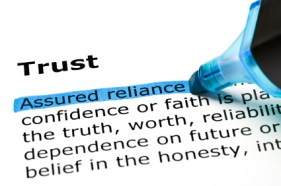
Trust with blue marker

I came across a bit of dialog in some fiction I was reading recently. Within that dialog was a nugget — a small, small thought that struck a chord within. The male character was imploring the female character not to worry, but to please trust him instead. The author revealed the female’s thoughts more than a reply. The female’s internal response was that she could do that — trust him — for the time being, but also acknowledged that the time was coming when they would have to have a serious discussion about this issue in their relationship. The issue was the effect the male character’s abusive father played in their interaction as a couple.

The woman was afraid to blindly trust that the man had overcome the far reaching impact of abuse at the hands of his father; one of the two people every individual should be able to trust for unconditional and sacrificial love.

ca777683f74be57ee1436a610eb174a9The author communicated that the woman needed more than the male character’s word that he was trustworthy — she needed more information to feel comfortable that the emotional wounds inflicted by the abusive father would not result in destructive, self-protective responses when their own relationship hit difficult challenges. In fact, the entire story was built around the fact that the male character had run and shut the female character out, at an earlier point in their relationship.
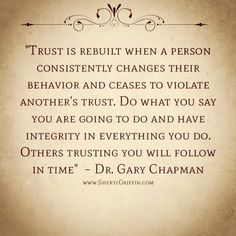
Personal, painful experience had taught the female character to be wary. She desperately wanted to trust, but experience had taught her a painful lesson and her own self-protective instincts were screaming that as hard as the male character was trying, trust damaged is not easily, and without evidence of change or misunderstanding, rebuilt. Fear and the instinct for self-preservation demanded more than unchallenged trust. She needed to know her trust was merited.

And this is that small nugget — the thought that struck a chord within as I read this work of fiction: This need for more evidence in the aftermath of deep wounds is not only normal but wise. Isn’t that what you, as a parent, would advise your child to do — Trust but verify? Is it then so hard to comprehend that the broken believer needs the same thing from God? Is it sinful? Personally, I don’t think so.

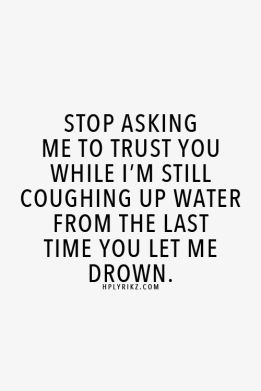
Eventually every Christian hears these words, “Don’t worry, trust God.” There’s absolutely nothing wrong with that advice, unless it is offered to someone who perceives themselves to be betrayed or abandoned by the God they are being encouraged to trust. 08e8f8fff3f9e983cb822826a9feef30If that’s the case, the wounded Christian may very well be thinking, “Stop asking me to trust God while I’m still coughing up water from the last time He let me drowned!” Is it any wonder then that such advice is met with cynicism, anger, extreme frustration, ridicule or even abject terror? This biblical admonition heaps guilt and shame upon the struggling and broken believer.
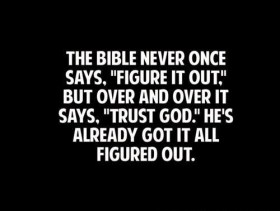
The well-known phrase, Fool me once, shame on you. Fool me twice, shame on me!, comes to mind here doesn’t it? Self-preservation demands more than biblical platitudes. And lest that statement offends let me clarify before continuing. A platitude is defined as a trite phrase spoken as if it were profound or fresh. Synonyms for the word platitude include trite and cliché. The common theme in definition among all three of these words is the idea that a phrase has become commonplace and lost it’s effectiveness due to overuse. Can a Bible verse become cliché? Trite? A platitude? I think the answer is yes.

Oh, I can just imagine the hackles rising here, but please bear with me!  Maybe the definition of those three words above should be expanded to include misuse as well as overuse. From my personal perspective, advice becomes trite when it is offered in a flip manner, without adequate thought or as a quick and easy fix to a complicated problem. And honestly, I am smart enough to realize that just because a verse has been overused or misused doesn’t make it any less true.

The real problem — what makes Bible verses about trust (in this case) into platitudes — is the failure to acknowledge that from the believer’s perspective, trust has either not been adequately established or for the more mature believer, trust is perceived as having been breached.  Therefore, the admonition to trust God is both perceived as a criticism and an oversimplification.

Trust is developed over time. It’s the result of positive reinforcement — and damaged when it is betrayed or extended to someone prematurely or foolishly. I think, when a child is well cared for by its parents, trust is developed and the young mind assumes everyone is trustworthy. Life experience soon teaches the child that that assumption is invalid. Trust is eroded and less easily extended as we get hurt in big and small ways.

trust-God-01Yet the Christian faith appears to demand unconditional trust in the Savior we believe in but cannot see; cannot touch. It appears to demand that in the face of evidence to the contrary we hold fast to scriptures that seem to communicate the opposite of what life experience teaches us.

That word, appears, is really the key, don’t you think? Appearances are deceptive. Our culture is so driven by positive thinking that we gloss over the difficulties the Bible tells us will surely befall us and rush to the tail end of the verses that promise a positive outcome.

When we read Isaiah 40:31, ” . . . they that wait upon the LORD shall renew their strength; they shall mount up with wings as eagles; they shall run, and not be weary; and they shall walk, and not faint.”, we focus on the positive outcome of waiting upon the Lord. But I fear that we fail to recognize what this verse implies as we desperately cling to its promises. What this verse implies, but doesn’t explicitly say, is that the believer will find themselves weak and weary. Our strength need not be renewed if it is never weakened. Yet somehow, we interpret this verse to mean that we will never feel weak and weary, only that we will triumphantly mount up with wings as eagles! Then when we find ourselves weak and weary we wonder why or believe that we have somehow failed to live out our faith.

Likewise, Isaiah 43:2 says, “When you pass through the waters, I will be with you; And through the rivers, they will not overflow you. When you walk through the fire, you will not be scorched, Nor will the flame burn you.” When we read this verse we gloss over the fact that we will pass through the waters, through the rivers (fast moving current), through the fires. We overlook or maybe refuse to consider what it will feel like as we enter the waters and feel it quickly rising, threatening to overflow us and forcefully dragging us downstream. We fail to anticipate how it will feel when we feel the heat of the flames, smell singed hair and choke on the heavy smoke that surrounds us as we walk through the fire.

Instead we focus on the promise that God will be with us, that the waters will not drown us and the fires won’t burn us. It’s all stated without emotion as if fear, pain, discouragement and a multitude of other emotions won’t batter us in the midst of the flood waters and fiery flames of life circumstances. But the scriptures don’t promise that — they just promise God’s presence and protection from complete devastation as we go through those harrowing experiences. Ask the near drowning victim. Ask the individual who barely escaped without injury when a fire broke out in their home. Consider the Christian martyr; consider Paul who was whipped five times (39 lashes on each occasion), beaten with rods three times, stoned once, shipwrecked three times and spent 24 hours on the open seas (2 Corinthians 11:24-25) and imprisoned at least once. Were they unafraid in spite of the constant presence of the Holy Spirit? Doubtful, highly doubtful! More likely they were still terrified.

The Bible tells us to reason together with the Lord (Isaiah 1:18). To taste and see that He is good (Psalm 34:8). To try the Lord (Malachi 3:10), at least in regards to tithes and offerings. It doesn’t demand unconditional or unchallenged trust. God, by grace, gives us enough evidence to take that step of faith. *For further clarification on trying the Lord please read the notes at the end of this article.

trust-building-big-sizeWhen faced with a believer who is grappling with difficult circumstances, who is afraid or discouraged, I, like every other Christian I know, struggle with how to respond – how to support and encourage. We want to fix the problem and when we are helpless to effect change we point them to the only One capable of pulling them through. We encourage them to trust God. But I wonder if that is the very last thing the hurting believer needs to hear. They, like the female character in the novel I mentioned above, need something more; more than unchallenged trust. The trust they had has been shaken by circumstances. They need more information; more knowledge and evidence to boost their confidence that their faith is grounded on a firm foundation and not built upon shifting sand.

I wonder if what the broken believer really needs to hear from fellow Christians is:

  • A promise that prayers for either assurance or the restoration of their battered hope and trust in Christ will be lifted to the throne of grace.
  • I wonder if maybe that struggling believer needs an acknowledgment that trusting God in their circumstances is not simply a matter of the will.
  • That fledgling faith and perceived betrayal or abandonment results in shaky trust.
  • That supernatural help is required to trust God more fully.
  • That the believer’s need for more evidence that God is trustworthy is expected, entirely normal, and is no easy or simplistic feat.

And let’s be real here. The body of Christ is not strengthened when we refuse to acknowledge our doubts about God.

God is not afraid He will be found lacking. He’s completely confident that as we test our faith, as we reason together with Him, as we search to determine if He is good like He claims, we will discover He is all He proclaims Himself to be.

Life has taught me to expect disappointment, pain and suffering. It’s unrealistic to expect that I can simply ignore the lessons of days gone by and trust that God will not allow me to be hurt further. I need time to reexamine the evidence presented in the Word of God. I don’t think He is the least bit offended by that. And this is what I’ve discovered:

  • What I need from God is the supernatural ability to rise above the pain and fear; not to believe in vain that more pain and sorrow will not befall me.
  • That I don’t need encouraged to trust God more – I need to comprehend and make peace with what I can and cannot trust Him for.
  • And I need supernatural help to find the peace that passes all understanding so that I can endure what lies before me without discouragement and despair — undefeated by circumstances and Satan’s mechanizations.

I think grace believing Christians still get tripped up in works related theology. I know I do. We think we are responsible for our spiritual growth. That if we just do the right things (practice the spiritual disciplines – Bible reading and prayer), acquire the  right mindset (taking every thought captive, thinking on things that are pure and just, choosing joy) that we will overcome. And we are frustrated when we find that approach unsuccessful for ourselves and others. Intellectually we know we are dependent upon God to change us, but Satan’s deceptions woven into culturally ingrained messages have insidiously crept between the gaps in biblical knowledge within our hearts and minds. Truth has been perverted. Our beliefs have been infected with half-truths. And as a result . . .

We believe walking the walk equates to spiritual transformation.

We believe if we follow the prescribed formula, we will be successful at overcoming our problems. But that idea when boiled down . . .

Denies the very work and power of God in the lives of Christians!

That formulaic philosophy is grounded in works not faith. It disguises the truth that while we ascribe our spiritual well being to God we subconsciously restrict His participation as we try to solve our own problems; as we try to heal or improve ourselves.

Don’t get me wrong, there is great value in practicing the disciplines of the faith, however, those practices are the means by which we cooperate with the Holy Spirit in spiritual growth and maturity but they are not, in and of themselves, responsible for spiritual growth. Here is the truth . . .

  • We cannot grow spiritually without supernatural intervention.
  • Spiritual growth requires the work of the Spirit.
  • Only the Holy Spirit can bridge the gap between our humanity and holiness in a process known as sanctification.

I don’t need encouragement to find a way to make myself do the impossible (heal myself).

I need prayer that God will do the impossible within me.

IMG_1212I need fellow believers to recognize and acknowledge that healing will not come solely from activity on my part.

I need believers to tell me that they are praying for God to step in and do what I can’t do for myself, what no man, regardless of how strong willed they are, can do for themselves.

And frankly, I need Christians to verbalize (well, after I’m confident that they actually believe this) that unfinished healing isn’t representative of a failure on my part to cooperate with the Holy Spirit. Instead it means the Holy Spirit is still at work in my heart.

I wonder if those who read this blog think I might harp too much on the ill effects of the culturally popular positive thinking philosophy. But as my grief counselor pointed out to me Tuesday, the command to think upon things that are true and just, etc., is not at all a command to think positively or to dwell on only good things (which is exactly how I’d interpreted it). What’s true and just may not necessarily be good or positive. 

I find myself at war within — cognizant that I am waiting on the Lord to do His work within my heart as I cooperate in those efforts, but simultaneously self-condemning — believing the cultural messages I’ve been raised with — that are ingrained within. The messages that say I can pull myself up by my bootstraps, that if I just apply myself I will succeed, that choosing joy eliminates sorrow. And while there may be a kernel of truth hidden within each of those messages, the success they promise is all predicated upon my works, not the power of God!

bible-idolChristians reduce the Word of God to a mere idol when we attribute spiritual growth to following biblical precepts while excluding the God who empowers that Word from the process.
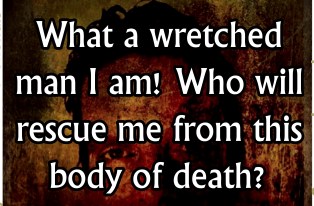
Is that what I do? Is that what the Christian community of our generation does? Do we serve God ritualistically without humbling ourselves to acknowledge our desperate need of His personal intervention in our lives? Do we subconsciously deny or rebel against the power of God in our lives? Are we modern day Pharisees?

“These people come near to me with their mouth
and honor me with their lips,
but their hearts are far from me.
Their worship of me
is based on merely human rules they have been taught.”

 ~ Isaiah 29:13

I can’t effect true and real transformation in my life by the practice of spiritual disciplines in the absence of the supernatural work of the Holy Spirit. At best, I can create an elaborate facade that gives the appearance of transformation. There are things only the Holy Spirit can do. He, alone, is capable of transforming my life, thereby, increasing my trust in Him.

I wonder how I would have felt — what difference it might have made — if just one person had said to me, “Janet, you are going to have to trust God for Gracen’s health and future. But know this: spiritually mature trust is impossible without the work of the Holy Spirit in your life. Practice the spiritual disciplines to the best of your ability, but don’t beat yourself up when you find yourself afraid for the future, when you realize that you can’t force yourself to trust God by an act of your will alone. Understand supernatural intervention is required and it doesn’t happen overnight or even quickly.”

What would words such as those do for a broken or struggling believer?

What would they do for you?


 *Notes on Trying the Lord

There is a fine line between trying the Lord, as in searching the scriptures to see what He says about Himself and trying the Lord by demanding that He prove to us He is worthy of our trust.

Got Questions?.org has a great article that discusses the distinctions between the two. And while the article says of Malachi 3:10 “This is the only situation given in the Bible in which God tells His people to “test” Him.” It later concludes that “The Israelites at Massah tested God because they lacked faith in Him. The Israelites in Malachi’s day were invited to test God because they had faith in Him.” (To read the article in its entirety, click on the following link:  What Does it Mean to Test God?).

I am in no way advocating tempting the Lord. As a believer and disciple of Christ Jesus, I am coming to God from a position of faith. There’s an important distinction that must be drawn between coming to God doubting his power and character and coming to Him fully confident of his power and character yet confused because He didn’t behave as we expected. Are we not then trying our faith as opposed to testing God? (James 1:2-3)

 
9 Comments

Posted by on July 9, 2016 in Faith


Tags: , , , , , , , , , , , , , , ,

This Body of Death 

VR-JULY-7-24 - EditedI feel like I’m sinking—sadness weighing me down—regardless of the medications I’m taking. Why can’t I overcome this? Is it possible that trauma causes bipolar disorder?

I just want to escape this body of death. That phrase, “body of death”, had little impact on me before—before my world imploded. Now, well now, I have an entirely different view of—and response to—that phrase. Now it’s way too personal, way too descriptive!

Every day I am bombarded with the visual representation of that phrase. I perform acts of service that reinforce those images. I cannot escape this body of death and I desperately want to. I want to flee from the future and the daily reminder that things are just going to get worse—lots worse.

But there is nowhere to go, nowhere to hide and the only means of escape available is one which further injures those I love, who frankly, have already suffered enough—more than enough in my opinion.

Somehow I have to learn to live with the cumulative pain and losses of the past while surviving the emotional erosion of the soul caused by daily care requirements, simultaneously bracing for and absorbing the blows each new and upcoming setback includes.

I can continue to put one foot in front of the other (although I’ve noticed it getting harder and harder to do; which concerns me) but I have yet to discover an emotionally heathy way to cope with this life I’ve been left with.

Distraction, distancing, withdrawal and emotional numbing may be effective coping mechanisms to prevent a complete breakdown but they are not healthy. They are nothing short of a delaying tactic that builds barriers between an individual and the people they love and later serves to compound the pain in the long run.

Those coping mechanisms are a completely normal and common human response to emotionally deep wounds, I’m told, regardless of the cause. They are not unique to my situation. But when consistently exercised they heap guilt, shame and despair on the heart as the individual becomes aware that they’ve lost precious, unrecoverable opportunities to spend time and deepen relationships with those they love in a conscious or unconscious attempt to protect their hearts from further pain. And that awareness, when it can no longer be avoided, is nothing short of agony. Time lost cannot be redeemed in this earthly realm.

Some time ago I questioned my daughter’s physical therapist about the potential benefit of a medical procedure that had worked well for another child in the clinic Gracen receives services from. The procedure involves creating holes in the overly tight muscles of the legs so that the muscles will stretch and enable more freedom of movement.

The PTs response was that the tension–the tightness of Gracen’s leg muscles are the very thing that enable her to stand. Loosening those muscles would make her legs noodle-like; unable to support her slight weight.

IMG_1195I am very much aware of the painful emotions that accompany my past and current life circumstances. When I find myself confronted with “negative” emotions, I don’t allow myself the freedom to experience and work through them. No, instead I distract my mind from them primarily via fiction (emotional numbing) locking them to the far regions of my heart. I am constantly aware of the existence of this metaphorically locked box of emotions, but I refuse to open and cope with the contents. Shoot, I’m pretty sure the contents of that box are under so much pressure that the slightest move to open the box (maybe my next effort to shove new emotional turmoil into the box) will result in the contents being forcefully expelled like an erupting volcano — an apt description as rarely does a volcano erupt without prior warning and I’ve experienced years worth of prior warnings. Warnings that the pressure is escalating.
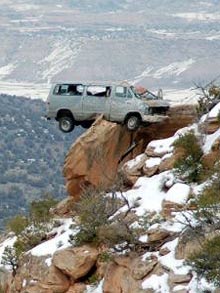


IMG_1200The tension required to push those emotional realities away, to pack them into my own personal Pandora’s Box, is the tension that my emotional health is standing, or maybe in my case a better word is “balanced” or “teetering” upon. Like a car precariously balanced upon a cliff, one shift in weight forward without substantial counterweight will send the vehicle plunging over the cliff.

Opening Pandora’s Box is the means to healing I’m told, but it is a terrifying prospect. It will push me over the emotional precipice and I fear what that will mean, what it will look like; what living with it, living through it, will cost and what, if anything, will be left of the woman I once was. And worst of all, my greatest fear, will I be left in a recoverable state?

images (45)On top of everything that implies, opening Pandora’s Box only allows past emotional trauma to be vented. How then, in this new weakened and vulnerable state, do I cope with the ongoing trauma progressive disease constantly thrusts upon me? Where is my shield of defense when the communication device or the stander is delivered? How will I cope with the installation and use of a tracking system in my home, let alone the day when it no longer makes daily life less physically taxing for both Gracen and I, but when it becomes a necessity I must use alone in order to properly care for her?

How will I cope in a healthy way with the complications that arise from a lack of mobility: pressure sores, stiffening and less moveable joints, decreasing core strength that results in the inability to sit up from a prone position and maintain an upright position once seated? How emotionally strong will I be when verbal communication is lost and I can no longer hear the sound of my daughter’s voice?

IMG_1201The boxer in round ten is less capable of withstanding a body blow that was thrown with far greater force in round one. The boxer’s split skin, bruises, and broken ribs don’t heal between rounds. He just rests, catches his breath, gets his cuts taped up and smeared with antibiotic ointment while receiving instruction and encouragement to continue the fight.

Is this not a picture, yet another metaphor, of the Christian life? God binds up our wounds between rounds, but the damage inflicted in the early rounds affects our ability to fend off and endure the blows taken in later rounds. Training, muscle memory and endurance developed prior to the fight are the believer’s  primary form of defense in the midst of the fight.

When the metaphorical boxer ignores the instructions, is unable to rest as adrenaline floods their system,  rejects the antibiotic balm and encouragement in the early rounds as young, brash believers are known to do, determined to “Do it My Way” as Sinatra sings, ineffective strategies are employed and more blows from the opponent successfully land escalating pain and weakening the cocky boxer.

Come the later rounds, desperate for the ministrations pridefully refused when the fight began, the beleaguered boxer attempts to tune his ear to those words of instruction. Humility has replaced pride and his brain, so distracted by pain and fatigue is far more inclined to seek and listen for the guidance of the Holy Spirit as we rest on the Cornerstone of our faith in dreaded anticipation of the sound of the bell that propels us back into the fray. And when the final bell rings we either find ourselves flat on our backs from a knockout blow or in the middle of the ring, beaten, bruised, and so fatigued that we can barely lift our arms in victory.

The bell has rung repeatedly in my life and I’ve been forcefully shoved back into the battle over and over and yet again. So weak, dreading the next blow that I know without a doubt is coming, trying to simply raise my arms to protect myself. Too tired to be effective, desperately attempting to put into action the instructions received in the corner, I huddle against the ropes frustrating my opponent and the audience who scream at me to step into the fight, defend myself, and destroy the enemy who contends for my faith.

IMG_1205What will be my fate when the fight ends? Will God step in and call the fight? Will I find myself stretched out on the mat breathing heavily but defeated all the same or will I be doing my best to hold my hands up in victory when the final bell rings?

Your guess is as good as mine!


IMG_1203I hope to be silently caught up in the air as God calls the fight or to hear the sound of the trumpet signaling the arrival of my Savior, rescuing me from this body of death and torment. But I fear I will continue to find myself stretched out on the mat breathing in the stale and bitter aroma of sweat and fear–yet another bout in my future, yet another beating to endure. Will I enter the ring the next time stronger and better equipped?

Will I ever find myself hands raised, a victor over the cares of this world?
 
2 Comments

Posted by on July 6, 2016 in Adversity, Faith, Muscular Dystrophy


Tags: , , , ,

Michaela Evanow  – An Honest Look at Prayer and Faith After Child Loss

I cannot pray. I don’t know how. It’s not that I don’t want to, but words fail me. They come out muffled and fake. They are stale and regurgitated from the days of my youth. I want to remember how …

(Clink on the link highlighted in red below to read the complete article.)  

Source: an honest look at prayer and faith after child loss.

 
Leave a comment

Posted by on July 5, 2016 in Faith, Grief, Links


Tags: , ,

Philosophical Thinking, Unicorns & Rainbows

8 Great Philosophical Questions That We’ll Never Solve - Does God existOn my more philosophical days, I have been known to think that I am far more blessed than those around me who seem to live lives devoid of tragic loss and health challenges. Truth be told, I’ve not found myself terribly philosophical in the two and a half years since Bethany and Katie’s lives were stolen by the selfish and reckless actions of an unlicensed driver. But I remember those moments in what feels like the distant past.

Life is hard. Circumstances have driven me to my knees literally and figuratively. In fact, circumstances have led me to a full body prostrate position, the nubby carpet of my bedroom floor, imprinting my cheek as I’ve petitioned the Lord for the hearts, souls, and health of my children.

And I’ve lost. I’ve lost too many of the things I love most in this life. No great spiritually inspiring story to be told. Just loads of heartache, anger, and questions for the One True God of love and justice.

Loss and heartache translate into vulnerability and weakness. And in this day and age both are intolerable to society at large. We are a nation of overcomers. We pull ourselves up by our bootstraps and keep going. We deceive ourselves into believing that through sheer force of will and dogged determination we can overcome every challenge, every trial in life.

I-have-the-strength-to-overcome-the-impossible.

We perceive ourselves as strong when we ignore negative feelings and refuse to be beaten by circumstances beyond our control. We pat ourselves on the back (as do others) for moving forward while we are really undermining our future health and happiness by ignoring or repressing emotional needs all in the effort to meet societal expectations and exercise control over the chaos that has somehow infiltrated our lives.

images (44)According to John Powell, author of Why Am I Afraid to Tell You Who I Am? the two major causes of anxiety are supercharged repressed emotions and unmet emotional needs. Emotional needs include the need to feel accepted, approved of, believed in, forgiven, listened to, needed, important, useful, respected, valued, supported, understood, in control, trusted, and worthy to name a few. The cultural demand to overcome, to turn every negative into a positive promotes and encourages the unhealthy practice of ignoring emotional needs and repressing negative emotions.

I fear this secular theology of overcoming against all odds, when boiled down reveals that we believe ourselves to be, or are bound and determined to make ourselves, God. And these efforts, are obviously in utter and complete opposition to the doctrine of the Bible.

The philosophy that enables me to believe that I am far more blessed than those whose lives appear to be filled with unicorns and rainbows, is grounded on the Biblical truth that I am NOT God. I am not capable of independently and self-sufficiently controlling and overcoming the chaos that surrounds and invades my life.

Tragedy, weakness, and suffering have driven me to work out my salvation. I’m constantly comparing my beliefs to the Word of God which reveals secular untruths I have absorbed, personal misconceptions or interpretations that don’t hold up under stress or simply an incomplete understanding of scripture.

I fear that the average Christian, myself included, doesn’t hold up the shield of faith in order to protect themselves from Satan’s fiery arrows but instead in an effort to hide their vulnerability and project an image of spiritual maturity to a watching and expectant audience of believers and non-believers alike.

Somehow we have interpreted the shield of faith as an impenetrable barrier of protection from pain instead of protection against Satan’s deceptions and lies than weaken and destroy the very foundation of our faith; trust in God Almighty.

Weakness and dependence are paradoxically the strength of the Christian faith. The beauty of weakness is the revelation of Christ’s power at work within us. A supernatural strength is inexplicably revealed through our weakness and humility that far exceeds the strength manufactured by force of will alone. Is this not why Paul said in 2 Corinthians 12:9b-10, “Therefore I will boast all the more gladly of my weaknesses, so that the power of Christ may rest upon me. For the sake of Christ, then, I am content with weaknesses, insults, hardships, persecutions, and calamities. For when I am weak, then I am strong.”? (ESV)

In my humanity, I desperately long for a life filled with unicorns and rainbows. I long for a life that is filled with nothing more than common everyday hardships; car repairs, defiant children, financial fears. Garden variety, everyday frustrations, and irritations.

Dark Clouds an Little Blue SkyGiven the opportunity, I would rewrite the story of my life. But in the recesses of my mind, the storm clouds of sorrow shift and briefly reveal the truth that hides behind; losses and sorrow have gifted me with things of great value. Empathy, compassion, and understanding poured out on others in an effort to help meet their emotional needs. The assurance of my salvation and an awareness of the solid foundation of my faith even as it is battered by the storm. The development of a more holy and heavenly perspective. And then the wind picks back up shifting the storm clouds once again obscuring those encouraging truths. And I am left frustrated and discouraged instead of philosophical; feeling more cursed than blessed, desperate to escape the suffering that plagues my daily existence and longing for unicorns and rainbows.

 
7 Comments

Posted by on July 2, 2016 in Adversity, Books, Faith


Tags: , , , , , , , , , , , , , , ,

What If?

A godly grieving father’s perspective. . . Meet Ron Duncan.

My husband wrote this earlier this last night. He said, “I’m not there yet, but I am walking towards this.”  God is working in our lives to conform us to the image of Christ.…

(Clink on the link highlighted in red below to read the full article.)  

Source: What If?

 
Leave a comment

Posted by on June 28, 2016 in Faith, Grief, Links


Tags: ,

Silence Doesn’t Serve Anyone Well

Silence Doesn’t Serve Anyone Well

Melanie's avatarthelifeididntchoose

One of the reasons I write is to share my grief experience with others.

I realized when tossed into the ocean of sorrow that of all the things I had heard about or read about, surviving child loss was never mentioned.  

Oh, someone might comment that so-and-so had LOST a child, but then the conversation quickly moved on to more comfortable topics.

But if we don’t talk about it, we can’t learn to live through it.

Silence doesn’t serve anyone well.

I agree with Mr. Rogers:

Anything that’s human is mentionable, and anything that is mentionable can be more manageable. When we can talk about our feelings, they become less overwhelming, less upsetting, and less scary. The people we trust with that important talk can help us know that we are not alone.”
― Fred Rogers

spotlight3

During the course of my lifetime I have seen many topics dragged from…

View original post 370 more words

 
Leave a comment

Posted by on June 24, 2016 in Faith, Grief


Tags: , , ,