

Why a glimpse behind the curtain to the deeply personal and hidden grief of a bereaved parent? Not to inspire your pity; of that, I can assure you. Instead to inspire others to look beyond the surface of a grieving friend or family member. To consider how families are affected by a loss, emotionally, psychologically and spiritually, as well as the unique family dynamics that result; which might help you comfort, support and encourage them. The bereaved desperately want to be understood, to have their feelings validated, to break free of the isolation, to mourn unrushed, to have another share their sorrow (not attempt to fix it). This post was written months ago and is not reflective of my current state of mind.

Move or Remodel?
Several months ago David and I wandered down the hall to the main bathroom in our home. We stood inside and outside the doorway discussing if it was possible to widen the doorway (which sits on an angle) to enable Gracen’s wheelchair to fit through the door and other changes to make the bathroom accessible for her. It was a frustrating discussion because changes could be made that would work for now but maybe not down the road as Gracen needs a bigger wheelchair or moves into a power chair that has a wider base. If we remodel to fit Gracen’s current wheelchair, the changes would make it harder to sell our home later. What was the best choice for now? For the unknown later? How to decide?
At one point I sat down on the closed lid of the toilet, bowed my head and grasp the hair on either side of my head pulling it away and growled in frustration. David’s eyes rounded and fairly popped out of his head in alarm as he asked, “Are you OK?” To which I responded something along the lines of, “NO, I’M NOT OK!! No, no, no, no, no, I am so very far from OK! I’m completely overwhelmed and I’m so freaking tired of trying to find the positive in the negative, of getting up every day without Bethany and Katie, of watching Gracen’s body change, of living!” A sob escaped and tears fell as David pulled me to my feet and wrapped me in his arms until the tears subsided.
I didn’t, I still don’t want to move away from my home. Figuring out what we need in a new home is overwhelming; it’s costly, and how am I suppose to plan for the unknown future? How do I leave this place where my children grew up without them? How do I move into a new place without them around to make new memories? This home bears witness to their existence. To love and laughter and tears — to the last remnants of our intact family (as much as any place could in the absence of our stillborn son, Cole).
That young man stole my daughters and Gracen’s mobility and now here I am, sorting through Bethany and Katie’s things in fits and starts, parsing out their lives bit by bit. Give it away? Keep it? Oh, God, throw it away? Troy Robins, an unlicensed & reckless driver, took Bethany and Katie’s lives and now I’m systematically removing them from my home; from their home. It feels so very wrong — as if I’m throwing my children away.
No, no, no, no, no, I am so not OK!
Helping the Bereaved Bear their Burdens
1. Listen closely to what the bereaved say. If they tell you they are struggling with something, try to think of practical ways to help. Pray for those specific concerns. Keep your eyes open for needs they might not mention; yard work, snow removal, dishes that need to be washed, etc., then step in and take care of it.
 2. Realize that you cannot fix their sorrow and they don’t want you to try. They want their pain acknowledged, not ignored, not rebuked, not corrected, and definitely not minimized. Validate their feelings and affirm their ability to carry on. Be aware that their faith may be strong but they are weak in so many ways. They will likely feel as if their faith is not sufficient to see them through. Do NOT imply or state outright that God allowed their loss because their faith was strong enough to survive their loss!
3. If they tell you they are having a hard time going through their loved one’s things, offer to come and help, or to simply sit with them as they do it. Do NOT try to go through those things with a get ‘er done attitude. Expect to listen to the bereaved reminisce. Expect tears. As uncomfortable as tears make us feel, they are a much-needed outlet for the grieving. Venting their sorrow is healing, so don’t cut and run at the first sign of tears. Locate the tissues. Offer hugs, if appropriate. *Please note, an offer to help with a task such as this should generally be extended by a close personal friend or family member.
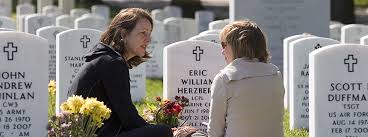 4a. The grave site can be a place of comfort or distress. Every bereaved individual is different (which I realize makes supporting the grief-stricken challenging and scary). Some spend a lot of time at the cemetery, others rarely go. It’s generally a big deal when the headstone is finally placed. The headstone often represents the only permanent legacy of the deceased. Offer to take the bereaved to the cemetery. Comment on the things you sincerely like about the marker they’ve chosen and the location selected. Never offer a negative opinion about either the burial site or the headstone!
 4b. Likewise when the deceased is cremated, the day the bereaved receive their loved one’s ashes is also a big deal. They’ve carefully chosen the urn—no negative comments! Some people display the urn, and others choose not to. Validate their choice as there will be people who are uncomfortable seeing an urn prominently displayed in a home and they will, unfortunately, let their feelings on the matter be known. There will also be people who will not understand if the grief-stricken choose not to display the urn. The bereaved often feel torn on such matters, and they need to do what feels best to them. No good, but plenty of harm, can come from burdening the bereaved with other’s opinions and expectations. If the bereaved choose to scatter their loved one’s ashes, honor their decision both in regards to how they wish to do it and who they wish to be present.
 5. Extended family needs to honor with grace the way those in mourning choose to handle holidays, anniversaries and birthdays. I’m well aware that extended family members also grieve and may be disappointed or even hurt when the bereaved choose to forego family gatherings. But frankly; it’s not about you! The highest degree of consideration should be shown to those with the closest personal connection to the deceased. Piling guilt upon grief is insensitive and unkind. Expecting the bereaved to celebrate, to be surrounded by intact families, to shake off their sorrow for the sake of the rest of the family is unrealistic and frankly puts undo strain on the brokenhearted. Family togetherness may be beneficial to some, may lift their sorrow and make them feel supported, but not to others. Be considerate. Love your bereaved family members enough to set aside your own desires in order to grant them the freedom to mourn without criticism and resentment for the choices they make.
**A word about bereaved parents of married children. When a married son or daughter dies, a unique set of circumstances arise. Depending upon the parent’s relationship with their in-law, things can go smoothly or be very difficult; especially when grandchildren are involved. Please pray for these families. Pray that the grieving parents and in-law can agree on funeral and burial arrangements, on seeing and spending time with the grandchildren, on holiday and anniversary plans. Emotions run high, relationships can be destroyed, and heartbreak can be compounded. Pray that both the parents and the in-law will be considerate of the other, that they will each be willing to compromise, and that the best interest of the grandchildren will be a priority on both sides. As a friend of either the parent or the in-law, allow them to vent their frustrations and I can’t say this enough, validate their feelings!
 6. Assume that everything the bereaved tells you about how they are feeling or challenges they are facing, is confidential. A solid friendship can be utterly destroyed if the bereaved feels they are being gossiped about. Grief is hard. It hurts. Should someone inquire as to how the bereaved is doing, a safe response is, “She’s okay. She’s working through her grief.” Feel free to ask the bereaved how they would like you to respond to questions about their well-being and if there are prayer requests you can share. When in doubt, go with the safe response above. An individual who is normally an open book may become uncharacteristically private when they feel most vulnerable. Err on the side of discretion!
7. Be aware that the death of a loved one often leads to further problems, such as our need to find a fully wheelchair accessible home. Families are often left with staggering medical bills, traumatized children, loss of income, broken marriages and deep spiritual wounds. The bereaved are left emotionally overwrought, frightened and sadly, ashamed. Pay attention and look for practical ways to help.





 Faith is an integral part of my life. In many ways it defines me. However, my true nature is that of a sinful human being. Faith is second-nature to me. My first nature, sinfulness, far too often drives me. Yet, I committed to following Christ and over the years the Holy Spirit has been busy. More and more often I find my initial thoughts ruled by Biblical truth. I’ve been changed by God’s unmerited favor with increasing confidence and assurance (faith) that not only does He exist but that I can trust Him to keep His promises.
 I have discovered that I do have a strong faith after all; but that I am less faithful than I expect myself to be. I don’t need Satan to denounce me as a fraud, my own heart and mind taunts me with that truth. However, the same grace that enticed me to faith, is poured from a fountain of unlimited supply.

 We’ve been indoctrinated with the message that we must be able to turn every negative into a positive. Our culture as a whole no longer helps people work through their grief, instead we demand that they set it aside, suppress it, or spin it into an uplifting message – all the better if they can tie it up with a Biblical bow. As a result, we leave hurting people enmeshed in an internal battle pitting their normal need to express and work through their pain and sorrow against societies demand to find the silver lining and move forward.

 Every time I buckle up and point my car down Highway 102 toward JBU, I anticipate flying down the twisting, turning two lane stretch between Centerton and Gentry with the radio cranked up – loud!
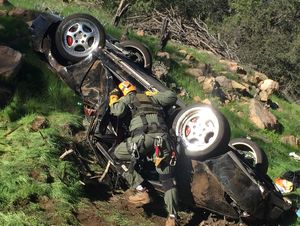 So, as much as I might itch to fly down highway 102, leaning into the curves and blasting down the straightaways, it’s highly unlikely that I will ever actually cut loose and do it. (Well, not the way I’d really like to anyway). I still have important relationships here to enjoy – and no amount of adventure and adrenaline is worth the price some other unsuspecting family might have to pay should I selfishly choose to ignore the risk to other drivers on the road one day and open that throttle up and fly.


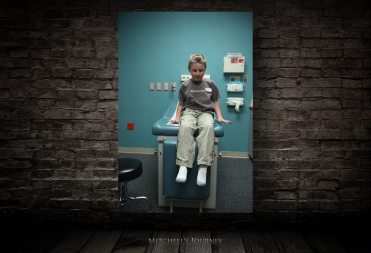

 I didn’t lose a son and two daughters and begin picking up the pieces to move into a hopeful future. I live with the knowledge that I will always be picking up broken pieces and there is no way to repair the pieces that have been falling since MD entered our lives.




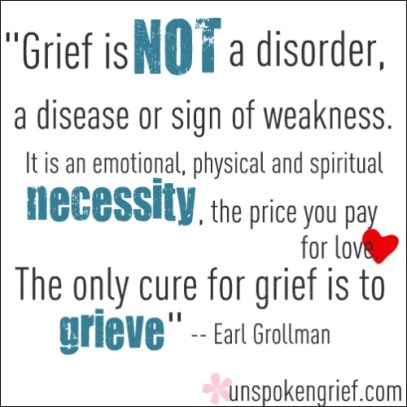 But some things in life cannot be rushed. Some things simply take as long as they take, which doesn’t seem to prevent us from feeling frustrated with the wait or pushing ourselves and others to shorten the amount of time to accomplish a given task. And that impatience has spilled over into every area of our lives including the expression of grief. A new definition can be added to Oxford Dictionaries definition of a pity party. It reads something like this: A term applied to an individual’s behavior when society and has lost patience with someone who has suffered a loss of grievous proportions.
 Boxx Banter