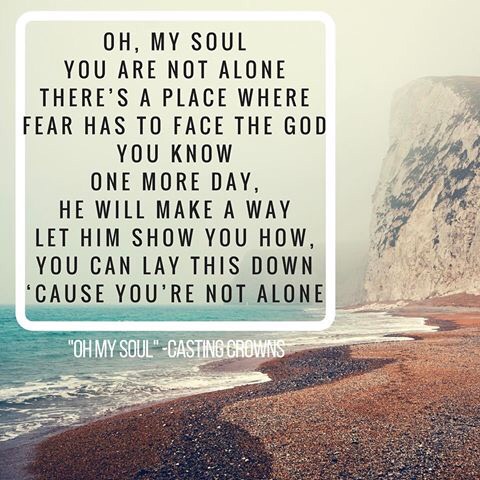
 I am intimately familiar with fear, but I am no longer consumed by it. These days when fear rears its ugly head it is quickly overtaken by resignation (the acknowledgment that I am not able to change some things) and acceptance (the knowledge that God’s plans trump my desires every time – and rightly so) and the hope of eternity (the assurance that what befalls me in this world is not the end of the story). I know the Bible repeatedly tells us not to be afraid, but I think that has less to do with fear being sinful than it does with God’s acknowledgement that fear is the natural response to a perceived threat.
God knows we will repeatedly confront fear in this life!
Fear is often the impetus that leads us to reach out to God. And maybe God tells us not to be afraid because when we call out to Him we have summoned the most powerful entity in all existence, therefore there is no need to be afraid. He is the giant that steps between us and that which we fear. Instead of interpreting, “Fear not!”, as a command we are all too prone to fail to implement, maybe we should instead interpret it as a gentle reminder or reassurance. Maybe,”Don’t be afraid. I’m here. I can take care of this. Nothing is too difficult for Me.”, is a better translation than “Fear not!” Of course I lean toward wordiness (which is why I think the Amplified Version of the Bible is the all-time best Bible translation) and “Fear not!” is unarguably concise. But I also think Biblical saints were frequently told not to be afraid because a great big, glowing angel appeared before them and having never seen one they were reasonably terrified. The greeting, “Fear not!”, may have effectively snapped a terrified individual out of their adrenaline induced fight, flight or freeze response.
This world is filled with very real dangers. In some ways fear is a gift to us from God who loves us. Fear inspires us to be aware of our surroundings and often prevents us from blindly walking into trouble. The admonition to fear not may have a more robust meaning than those two simple words imply. I think what goes unsaid is the reason why God encourages not to be afraid and the truth that He is not disappointed in believers when they are frightened. God does not want us to be consumed or crippled by fear. He certainly doesn’t want us to be paralyzed by fear. He absolutely doesn’t want us to be controlled by fear. In 1 Peter 5:8 we are told,
“Be sober [well balanced and self-disciplined], be alert and cautious at all times. That enemy of yours, the devil, prowls around like a roaring lion [fiercely hungry], seeking someone to devour. ~ AMP
When we interpret the occurrences of “fear not” in the Bible as commands we set ourselves up for failure. Conquering fear is not accomplished by positive self-talk. Maya Banks in her book, Hidden Away, distilled this overlooked and dismissed truth in one short sentence,
“We can’t turn it [fear] off just by realizing we shouldn’t be afraid.”
I can’t tell you how many times I’ve been told that God commands us not to be afraid. But that just didn’t sit right with me (primarily because I felt it was not something I could do by sheer force of will). So I set out to google the Greek and Hebrew definitions of the word “fear” to determine the original intent of the word and I inadvertently stumbled upon the definition according to the Holman Bible Dictionary. Below you will find the portion of that definition that applies to the phrase “fear not”:
“Fear not” The expression “fear not” (also translated “do not fear” or “do not be afraid”) is an invitation to confidence and trust. When used without religious connotation (15 times), “fear not” is an expression of comfort. These words come from an individual to another providing reassurance and encouragement (Genesis 50:21 ; Ruth 3:11 ; Psalm 49:16 ). When “fear not” is used in a religious context (60 times), the words are an invitation to trust in God. These words appear in the context of the fear and terror that follows divine revelation. God invites His people not to be afraid of Him (Genesis 15:1 ; Genesis 26:24 ); the angel of the Lord seeks to calm an individual before a divine message is communicated (Daniel 10:12 ,Daniel 10:12,10:19 ; Luke 1:13 ,Luke 1:13,1:30 ); a person acting as a mediator of God invites the people to trust in God (Moses, Deuteronomy 31:6 ; Joshua, Joshua 10:25 ). ~ Holman Bible Dictionary, Claude F. Mariottini
Now that makes more sense to me. An invitation to trust, not a command. An expression of reassurance, encouragement and comfort.
Conquering fear requires a conscious decision on our part, and I personally believe, the supernatural work of the Holy Spirit. I have become increasingly aware of my utter dependence, my desperate need, of the intervention of the Holy Spirit in order to live the Christian life as God intends. . . The Christian life was designed to be one of cooperation between the believer and the Holy Spirit. Psalms 56:3 tells us what our part of that cooperative effort to overcome fear entails. Since different Bible translations often provide a more comprehensive understanding of scripture, below are several versions that present nuanced interpretations of the same verse.
When I am afraid, I will put my trust in You. ~ New American Standard Bible
Even when I am afraid, I still trust you. ~ GOD’S WORD® Translation
From the height of the day I shall fear: but I will trust in thee. ~ Douay-Rheims Bible
In the day that I am afraid, I will confide in thee. ~ Darby Bible Translation
The day I am afraid I am confident toward Thee. ~ Young’s Literal Translation
One thing Psalm 56:3 makes abundantly clear is that we all experience fear regardless of the depth of our faith. Fear and trust, faith and fear, are not mutually exclusive.
The NASB represents the most common translation of Psalm 56:3, but I love how the God’s World translation acknowledges that fear and trust coexist. I love that the Douala-Rheims Bible makes it clear that fear will always plague us. I love that the Darby Bible Translation reduces trust to the act of confiding our fears to the One who is able to do something about them. And I love that Young’s Literal Translation expresses both fear and confidence simultaneously.
Take a look at what the Pulpit Commentary says about this verse:
“What time I am afraid, I will trust in thee; literally, the day when I am afraid. When the day comes that I feel fear stealing over me, by an act of will I (even I, weak as I am) will put my trust in thee (comp. Psalm 7:1; Psalm 11:1; Psalm 18:2, etc.).”
Of course any discussion of fear and faith is incomplete without addressing 1 John 4:18,
“There is no fear in love; but perfect love casteth out fear: because fear hath torment. He that feareth is not made perfect in love.” – KJV
I don’t know about you but when this verse is tossed out, I often feel condemned. It’s presented as if fear can be eradicated from our lives – as if we are capable of attaining the goal of perfect love. I’ve pretty much concluded that anytime the word perfect is placed before an adverb in the Bible and contextually applies to humans instead of God, it is a quality that I will not be capable of achieving this side of heaven. The Pulpit Commentary seems to agree in a much more theologically comprehensive manner.
“Love here means the principle of love in general; it must not be limited to God’s love to us, or our love to God, or our love of the brethren. Love and fear coexist only where love is not yet perfect. Perfect love will absolutely exclude fear as surely as perfect union excludes all separation. It is self-interested love that fears; pure and unselfish love has no fear. . . To cease to fear without attaining to perfect love is to be irreverent and presumptuous [taking unwarrantable liberties with Almighty God]. Hence the apostle is . . . pointing out an ideal to which Christians must aspire, but to which no one attains in this life.”
Casting Crowns, Oh My Soul, reminds us that when fear encounters almighty God, God will be victorious over it if we confide in Him* and place our trust in Him with confident assurance that He will hear us and perform that which is for our eternal good. And that last bit about God performing what is best for our eternal good, that’s the kicker right there. Fear keeps us in its clutches when our humanity demands that which is for our earthly good over surrendering to that which is for our eternal good.
Overcoming fear is not a battle – it’s an all out war made up of numerous individual squirmishes. Understanding that truth prevents us from the self-condemnation that leaves us feeling defeated and more inclined to quit trying. But knowing we will live to fight another day and recognizing that we are in fact gaining ground on the enemy, builds confidence and encourages us to persevere.
“I have told you these things, so that in Me you may have [perfect] peace. In the world you have tribulation and distress and suffering, but be courageous [be confident, be undaunted, be filled with joy]; I have overcome the world.” [My conquest is accomplished, My victory abiding.]” ~ John 16:33 AMP
Here is the story behind Oh My Soul:
And here’s the official lyric video:
Oh My Soul Official Lyric Video
I hope both will bless and encourage you.
Soldier on Saint!
*It should be noted that confiding in God may necessitate repeated conversations on the topic. I can’t tell you specifically why that may be the case although a number of theological explanations have been discerned by numerous Biblical scholars. That’s a topic for another day. However, there are times I think revisiting the conversation in prayer peels away unknown beliefs and misconceptions about God’s love and enables us to uncover the true root of our fears. I know from my own experience that praying and making a conscious decision to trust God has not frequently resulted in the much longed for peace that passes all understanding. Maybe that’s because I haven’t yet succeeded in consistently keeping my thoughts fixed on God (Isaiah 26:3).

 I reiterated to my grief counselor last week that I trust God for my eternal future and I trust that God will walk me through anything He allows to transpire in my life but that I don’t currently trust Him with my heart.
 You have to know the day eventually came where David was confronted by one of his daughters who’d actually had a nightmare on Free Dream Night. David managed to successfully pass it off as an error reading that very complicated calendar. Fortunately, none of our three daughters were plagued by nightmares, but had that happened, their trust in their dad would have been damaged.
 And sometimes, we break trust intentionally. We need that young child to be safe around water. We need them to learn to hold their breath, to kick and paddle their way to safety should they fall into a pool. So dad, after catching the child multiple times without letting their face go under water eventually lets his child’s head fall below the surface immediately pulling them back above water. The child learns that dad will still catch him, but he also learns he’s not as safe as he previously thought he was. Has the child lost all trust in his dad? No, he still knows his dad will feed him when he’s hungry but he isn’t as trusting the next time he stands on the edge of the pool and his dad beckons him to jump.

 Is that why my longing for my eternal home is met with admonitions that I must have hope? That it is wrong for me to desire the rapture in order to escape these earthly sorrows?
 Maybe that’s where the Holy Spirit steps in and performs a supernatural work in our hearts that enables us to receive God’s all sufficient grace instead of rejecting it in our agony . . . instead of taking action outside of the will of God due to complete despair and utter desperation.
 The author communicated that the woman needed more than the male character’s word that he was trustworthy — she needed more information to feel comfortable that the emotional wounds inflicted by the abusive father would not result in destructive, self-protective responses when their own relationship hit difficult challenges. In fact, the entire story was built around the fact that the male character had run and shut the female character out, at an earlier point in their relationship.
 If that’s the case, the wounded Christian may very well be thinking, “Stop asking me to trust God while I’m still coughing up water from the last time He let me drowned!” Is it any wonder then that such advice is met with cynicism, anger, extreme frustration, ridicule or even abject terror? This biblical admonition heaps guilt and shame upon the struggling and broken believer.
 Yet the Christian faith appears to demand unconditional trust in the Savior we believe in but cannot see; cannot touch. It appears to demand that in the face of evidence to the contrary we hold fast to scriptures that seem to communicate the opposite of what life experience teaches us.
 When faced with a believer who is grappling with difficult circumstances, who is afraid or discouraged, I, like every other Christian I know, struggle with how to respond – how to support and encourage. We want to fix the problem and when we are helpless to effect change we point them to the only One capable of pulling them through. We encourage them to trust God. But I wonder if that is the very last thing the hurting believer needs to hear. They, like the female character in the novel I mentioned above, need something more; more than unchallenged trust. The trust they had has been shaken by circumstances. They need more information; more knowledge and evidence to boost their confidence that their faith is grounded on a firm foundation and not built upon shifting sand.
 I need fellow believers to recognize and acknowledge that healing will not come solely from activity on my part.
 Christians reduce the Word of God to a mere idol when we attribute spiritual growth to following biblical precepts while excluding the God who empowers that Word from the process.
 On my more philosophical days, I have been known to think that I am far more blessed than those around me who seem to live lives devoid of tragic loss and health challenges. Truth be told, I’ve not found myself terribly philosophical in the two and a half years since Bethany and Katie’s lives were stolen by the selfish and reckless actions of an unlicensed driver. But I remember those moments in what feels like the distant past.
 According to John Powell, author of Why Am I Afraid to Tell You Who I Am? the two major causes of anxiety are supercharged repressed emotions and unmet emotional needs. Emotional needs include the need to feel accepted, approved of, believed in, forgiven, listened to, needed, important, useful, respected, valued, supported, understood, in control, trusted, and worthy to name a few. The cultural demand to overcome, to turn every negative into a positive promotes and encourages the unhealthy practice of ignoring emotional needs and repressing negative emotions.
 Given the opportunity, I would rewrite the story of my life. But in the recesses of my mind, the storm clouds of sorrow shift and briefly reveal the truth that hides behind; losses and sorrow have gifted me with things of great value. Empathy, compassion, and understanding poured out on others in an effort to help meet their emotional needs. The assurance of my salvation and an awareness of the solid foundation of my faith even as it is battered by the storm. The development of a more holy and heavenly perspective. And then the wind picks back up shifting the storm clouds once again obscuring those encouraging truths. And I am left frustrated and discouraged instead of philosophical; feeling more cursed than blessed, desperate to escape the suffering that plagues my daily existence and longing for unicorns and rainbows.
 But the limbo bar has lowered and I am left to bend and contort myself in an attempt to fit within the new shrunken boundaries of my life.
 And I wait. I wait for healing. It can’t be rushed. It takes as long as it takes for the Holy Spirit to do His work in my heart – for my terror of God and His plans to subside – for my resistance to a future void of my most precious dreams to recede – for my heart to soften, for it to feel safe enough to tear down the protective walls I’ve built in an attempt (futile though it may have been) to guard my heart from any more excruciating pain.
 Boxx Banter