RSS

Category Archives: Faith

Canine Nesting: The Circling Mind

dogcircling

(Written mid-March 2015)

I awoke again to thoughts circling my mind as I feebly try to wrap my heart and mind around all that has happened in the last 14, almost 15 months.

Have you ever seen a dog settle down to take a nap?  The dog picks his spot them circles and circles and circles before settling into place.  At the first noise or distraction the dog pops up investigates and then picks a new spot repeating the process.  Circle, circle, circle, settle.  That’s pretty much how my brain works – restless fidgeting – circling around and around in an attempt to wrap my arms around all the facts so that I can process them and finally be done with them.

But there is no resolution – there will be no resolution – and maybe that’s the hardest thing of all to come to terms with.

Which leaves me with this truth . . .

My problem is with God.   Not the impotent prosecutor.  Not the foolish judge.  Not the ignorant man-child who placed me in this situation.  No, my problem goes straight to the top.  To the highest authority in all the world.  My problem is with God, Himself.  And how do I feel about that?  Well, this picture captures my current relationship with God quite well:

halt1

My hand extended before my body in the classic signal for “Stop!  Don’t come any closer!”  I haven’t walked away from Him, I simply cannot beckon Him closer.

I know God loves me, know He wants to comfort me, and know that I want His comfort and yet, right now, right now, His love just hurts.  His plans hurt.  His ways hurt.  His love for the lost hurts because He has allowed my children to die, He has allowed this pain, and will allow me to suffer again in order that my faith is refined and revealed, so that the lost will be saved, and that He will be glorified, all at the expense of my fragile, already broken heart.

It’s easier to mentally attack the humans involved than go rounds with the Lord Almighty. After all, God is always right.  His plans are always for my good and even the bad things He allows work for good for those who love Him and are called according to His purposes. There is no arguing your case or winning an argument with the Lord God Almighty, as Job discovered.

And so I fruitlessly continue the canine nesting ritual in my mind.  I continue shuffling through the events of that tragic day.  I continue circling round and round the behavior of the prosecutor, the judge, the man-child who swaggered into court.  All before turning my attention to the Lord in a conversation that goes something like this:

Me:  I’m mad at you. You hurt me.

God:  I know you’re hurt.  I know you’re angry.  I want to help you.  I want to comfort you.

Me:  Stay back!  You will just comfort me and then allow me to be hurt again.

God:  The hurt I allow leads to your ultimate healing.

Me:  I don’t want healed.  I just want my life back!

God:  There’s no going back.

Me:  I know that.  I hate that!  I don’t want to be here anymore but I can’t leave Gracen. She’s burdened by that knowledge.  She wants me and doesn’t want me at the same time. She loves me and resents me.  Only time and maturity will change that, but it hurts me to experience it and I’m afraid she might never quit resenting me – that we will never have a good mother/daughter relationship.

God:  She feels about you the way you feel about me.  You want me and don’t want me. You love me and resent my authority in your life.  Time and the Holy Spirit can and will fix the brokenness within you, but your terror of the personal cost of discipleship and spiritual healing wars with your anger over the direction my sovereign authority has taken in your life.  You want to feel my love and presence but at the same time you are terrified of me.

Me:  I don’t know what to do to change that.

God:  First, you can’t do it by yourself. You were never intended to.  But you do know what to do. You do know what steps to take.

Me:  Study Your Word and pray.

God: Yes, but your anger and hurt leads you to resist and you also know those things are not enough.  You know you can’t fix your problems with a formula.  You know that you have to allow the Holy Spirit to do His work within you and you know that doesn’t happen overnight.

Me:  I don’t know how to release the anger and hurt, especially knowing I will be hurt again.  I feel as if I am standing in the middle of a fast moving stream and the current is forcing me in a direction I don’t want to go.  I’m resisting yet I keep getting pushed forward.

God:  That fast moving stream is my will and I’m fully aware you don’t want to go where I’m taking you.

Me:  I really, really don’t want to go there.

God:  I’ll be with you.

Me:  That doesn’t make it hurt less.

God:  It does, it’s just that you no longer know what desperately alone feels like because I’ve been with you for so long.  To truly be alone feels much worse – you’ll have to trust me on that.

Me:  I still don’t know how to surrender my will to yours.  I still don’t know how to let go of the hurt and the anger.

God:  I’ll help you with that.  I’m already helping you with that.  It’s a deep wound.  Deep wounds take a long time to heal.  You just now found words to express what you are feeling.  It’s a step in the process.

Me:  The process sucks!

God:  Yep, fortunately, I have perfect patience.  You on the other hand, not so much!

Me:  A sense of humor?  Now you show a sense of humor?

God:  Hey, laughter is a good medicine, I designed it that way, and my timing is perfect.  You would have resented it if I had displayed it earlier . . .

(Feel free to call it my imagination, or call it God speaking with me.  Draw your own conclusions, but, I will say that things were revealed in my thoughts above that I was not consciously aware of prior to this time.)

Flash forward to December of 2015 and you will find that my hand is no longer extended before the Lord demanding that He stay back and give me space.  I have resigned myself to what I knew all along; that God alone can help me through this living nightmare.   We never stopped speaking, but there were things I refused to bring before Him.  There are still things I hold back.  I’m far from healed, far from OK even.  Over the last two years I have repeatedly asked the Lord, “What do you want from me?”  And instead of silence I hear a quiet, one word response.  “Rest.”

He’s not once reminded me of His sovereignty, as He did Job.  He’s never scoffed and told me to quit throwing a pity party.  He’s not demanded that I stop grieving and count my blessings.  He’s never once told me not to be afraid.  He just quietly encourages me to rest which I’ve found much harder to do than one would expect.  Resting requires more than slowing down and sleeping in.  This rest seems to include finding a way to be completely still before the Lord.  So the canine nesting ritual continues and I try to learn to rest.  But, even now, there is no condemnation from my Savior, for which I’m profoundly thankful.

 
2 Comments

Posted by on December 14, 2015 in Faith, Grief


Tags: , ,

Trauma Momma?

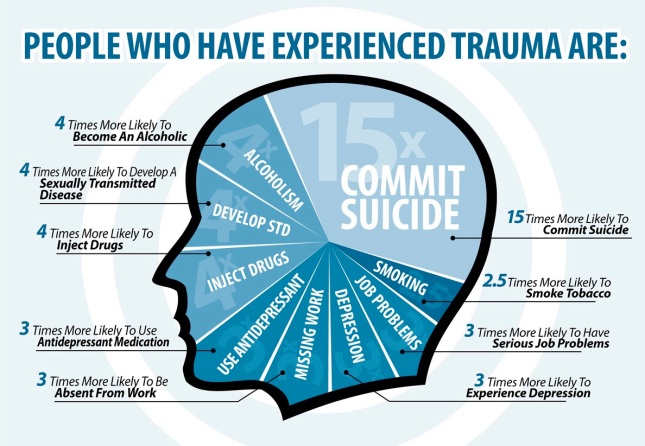
IMG_4279I haven’t wanted to talk about trauma and how it impacts an individual; those who grieve in particular. I haven’t wanted to go there primarily because of the reaction one receives if they try to talk about it; skepticism. I’m not sure if people think they can simply look at a person and tell they are dealing with the after effects of trauma, or if they simply don’t believe it happens to people outside of the military and first responder communities. Who knows? The truth is we all experience trauma; usually in small, manageable degrees. Generally we ride it out, push through it, brush it off and move forward and beyond it. We remain standing and to the outside world appear largely unscathed. But sometimes we experience trauma of a far greater magnitude. Below are the sobering statistics of how people are affected by trauma:

Traumatic experiences may or may not result in PTSD – Post Traumatic Stress Disorder. The general public understands little about this disorder. I understood little about PTSD and am slowly learning how it might impact an individual. What little people do know about the disorder has come from TV and movies and is usually, and justifiably so, attributed to military personnel who have seen and experienced frightful & life-threatening situations. Combat related PTSD generally results in the most severe effects and can dramatically alter an individual’s every day existence.

PTSD, like many other conditions, can be experienced in mild, moderate, severe or extreme forms. What most people don’t understand is that it can develop in an individual who lives in a continual state of heightened anxiety (soldiers on patrol who’ve never seen combat, individuals, especially children and family members who cope with life-threatening illnesses such as cancer, parents of special needs children, individuals who live in high crime neighborhoods or who have become refugees due to war or natural disasters all qualify) or PTSD can result from a single traumatic event.

If you asked a random group of people to describe the symptoms of PTSD, I imagine the single most common response would be the occurrence of flashbacks. A heightened sense of situational awareness is another common symptom of PTSD and I believe, the general public is vaguely aware that sounds, smells, and images can trigger disproportionate responses in those who suffer with PTSD. Less understood are the more subtle ways in which people who have experienced trauma internally process their experiences and the ways in which previous trauma changes an individual and therefore, how they cope with subsequent traumas.

Shock is an additional component closely related to trauma. One thing I didn’t understand about shock was the duration of time an individual might live and walk through life under the influence of shock. I didn’t understand that disassociation, a means of separating oneself from the events until one is capable of dealing with them, is what long-term shock looks like.

There was and continues to be a lot I don’t understand about shock and trauma. For one thing, people are amazingly resilient and for another, every individual is unique and can respond and react to the same trauma in unique ways.

So what kind of symptoms are commonly seen in individuals who suffer from PTSD?

*Extreme reactions (emotional and physical) to sights, smells or sounds (triggers) that remind the individual of traumatic events

*Avoiding people, places, and conversations related to the trauma

*Avoidance behavior designed to escape thoughts, memories and heightened levels of anxiety, abuse of alcohol, over-the-counter or prescription drugs, watching TV, spending time on the computer or reading excessively; anything that numbs pain or distracts the mind

*Experiencing feelings of emotional numbness or detachment, lack of interest in things previously enjoyed, guilt and blaming of self and others, depression

*Inability to concentrate, irritability and/or angry outbursts, difficulty sleeping

*Panic attacks involving intense fear, heart attack symptoms including chest pain, numbness, tingling, dizziness, shortness of breath, shaking, sweating and hot flashes

*Nightmares about an event

*Flashbacks (visions of a traumatic event where the individual feels as if they are reliving the experience while awake)


Aside from combat exposure, what kinds of trauma can precipitate PTSD? Surviving or witnessing situations involving extreme stress such as physical or sexual assault, natural disasters, torture, imprisonment, accidents and the sudden or unexpected loss of a loved one. Law enforcement officials, firefighters, paramedics, and medical professionals frequently deal with traumatic situations that make them vulnerable to PTSD.

Simply surviving traumatic experiences puts a person at risk for developing PTSD. However, most people will not develop the condition. Experiencing extreme fear or helplessness during the traumatic event, seeing others injured or killed, isolation after the event and dealing with additional stress such as pain & injuries, loss of a loved one, home or job, and a history of mental health issues all increase the risk of developing PTSD. Women are twice as likely as men to develop the condition.

There are several ways to lower the risk of developing PTSD. Support from family, friends, support groups and developing a coping strategy are chief among them. Surprisingly, how well an individual personally believes they responded during and immediately following a traumatic event or through the course of a series of lesser traumas plays a role in the development of PTSD. If an individual is able to act in a manner they perceive as effective during the traumatic event, if they feel good about their response in the face of danger, they are less likely to develop PTSD.

More than a year after the collision I received a CD from the McDonald County Dispatch Center of the 911 calls and the coordinated emergency response efforts related to the car wreck my family was involved in. It was disconcerting, to say the least, to hear my shrill voice in the background of two of the 911 calls reporting the accident. There was a definite tone of hysteria in my voice. However, the first emergency service provider who arrived on the scene, the Pineville Fire Chief, Gregg Sweeten, told me that when he approached me at the side of our minivan where I was kneeling and supporting Gracen’s head and shoulders, he thought I was a bystander who had stopped to help and had no idea that I was a passenger in the vehicle, let alone Gracen’s mother.

The grief counselor I see asked me how I felt about hearing that I was not initially identified as a victim. I hadn’t really thought about it from that perspective but I’m glad she asked because it led me to analyze my feelings. It helped me to realize that overall, I feel good about my response in the aftermath of the motor vehicle accident. There are things I wish I had the wherewithal to do, such as checking for a pulse or deciding if CPR should be started.  But, I am thankful that I didn’t become hysterical to the point of inactivity or worse by far, to the place where my behavior prevented Gracen, David and O’rane from receiving needed medical care.

I’m glad I was able to help a bystander locate O’rane’s bag so the hospital would be aware of the medications he was taking.  I’m glad I was coherent enough to explain to David’s mother the scope of our accident quickly over the phone. I’m glad I was able to tell the paramedics that Gracen is allergic to penicillin, to verbalize the medications she takes and the name and nature of her disease so the medical team might know about potential drug interactions, etc. Had I fallen to my knees screaming out my agony and despair emergency workers would have been distracted from caring for Gracen, and frankly, her life hung in the balance at that point in time.

I am beyond grateful that I was able to hold it together so that she got much needed medical attention and that I am not left with the suffocating knowledge and guilt that would have surely destroyed me had my reaction in the moments following the collision resulted in a failure for Gracen to receive prompt medical care resulting in her death.

I can’t say I’ve handled every traumatic experience in the way most beneficial to my daughter. There were moments when pain was not well managed well and I escaped Gracen’s hospital room, in effect abandoning her to the care of the medical staff and leaving David or my sister-in-law, Sandy, alone in the room to cope with this new trauma. How does a mother, or a father for that matter, determine if staying with their child when they are personally falling apart is more harmful to their child’s psyche than leaving the room so that the child doesn’t carry the burden of their parent’s despair along with their own? All I know for sure is that had another family member not been present, the staff would have had to drag me out before I would have left Gracen alone regardless of my state of mind.

Several years ago, I was driving home from dropping Gracen & Katie off at school when I heard a news report on the radio. The report stated that research had shown that long-term care givers were among those who suffered from PTSD due to the constant anxiety. I remembered thinking at the time, “I wonder if I have that?”

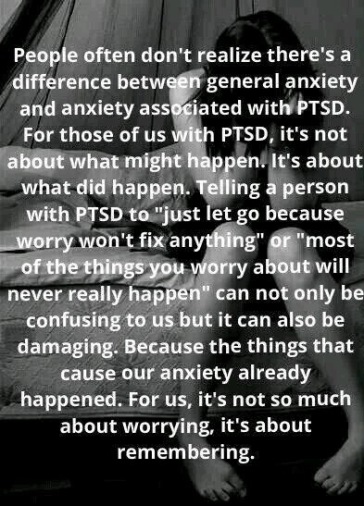
Looking back, and having become aware of lesser known symptoms of PTSD, I can see that not only was I actively practicing classic avoidance behaviors but that both Gracen and I were exhibiting emotional responses common to those who suffer from PTSD long before the collision that so impacted our lives. Observing the physical changes related to Gracen’s disease, coping with chronic daily migraines as well as complicated migraines coupled with painful medical tests, fears related to safety and an uncertain future took a toll. The most painful of which is the realization that the avoidance behaviors that allowed me to continue to perform day to day tasks while enduring the unrelenting anxiety also resulted in distancing myself from greater intimacy with my daughters.
IMG_4284

Avoidance behaviors serve to insulate your heart from further pain and are a form of psychological protection. For example, consider the mother of a child who is undergoing cancer treatment. You may find her consistently present in her child’s hospital room. She brings a book or her tablet to occupy her time while her child sleeps or during times when her child is undergoing tests she can’t be present for, such as an MRI. As her child’s condition worsens you may notice that during times when her child is awake the mother may still be consistently present, may meet every physical need but personally engages less frequently. She may play with her smart phone while her child watches a movie instead of watching with them. She may read while her child colors a picture instead of coloring with them. She slowly and without conscious awareness, disengages from personal contact. The behavior that grants her a distraction from her worst fears and the lack of control also creates an emotional disconnect that is nothing short of emotionally devastating when she becomes aware of them.

This is the face of PTSD.
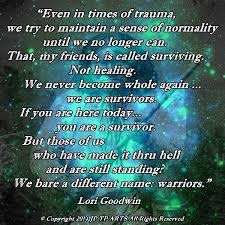
IMG_4280Rarely can you identify an individual who is coping with PTSD by simply observing their behavior. Unless you are present when they encounter a trigger, have a flashback or wake up screaming in the middle of the night, PTSD can silently hide beneath a veneer of socially acceptable behavior.

Even when someone suffering from PTSD encounters a trigger or experiences a flashback you may not recognize the trembling hands, the internal panic, the flinch as gruesome images assault their minds. When they drop out of normal activities you may simply think they are grieving instead of recovering from a night without sleep or filled with nightmares. And how many people are privy to the methods of distraction utilized or the inability for those affected to perform simple tasks like returning phone calls, making appointments or paying bills?

Then shame takes center stage causing the individual to castigate themselves for all they can’t control or accomplish without understanding why the lesser known symptoms of PTSD are plaguing them. Unless they’ve seen a counselor they may not even know they have PTSD.

And of course, depression plays an active role as well. There’s also a difference between a mild or moderate case of depression and full-scale clinical depression. While the symptoms of mild and clinical depression are the same, the intensity of the feelings and the degree to which everyday life are impacted differ greatly. Common symptoms such as a change in sleep patterns (either sleeping too much or too little), new eating habits (evidenced by weight gain or weight loss), sadness, and a complete lack of motivation abound.

Outsiders look in and can’t understand why this person declines invitations. Why they don’t return to normal activities, get a job, or do any number of other things in order to help themselves never realizing the extreme melancholy, fatigue and shame often prevents them for taking the initiative to do anything. It takes too much energy or exposes their vulnerability to the outside world. Both are adequate deterrents by themselves.

Who wants to admit they are clinically depressed? Aren’t those people in institutions? Who wants to confess to struggling with PTSD? Isn’t that just a bid for attention? Who wants to admit that simple things are much too difficult – that they can’t quite cope – that they aren’t enough – that the awareness of their utter lack of control is terrifying?

Where is your faith, one might ask? Right where it always was, solidly grounded in my Savior, Jesus Christ. Then why can’t you trust in His loving care?

Consider Isaiah 43:2 with me.

“When thou passest through the waters, I will be with thee; and through the rivers, they shall not overflow thee: when thou walkest through the fire, thou shalt not be burned; neither shall the flame kindle upon thee.”


We like this verse because we concentrate on God’s promised care. But it seems to me that we only meditate on the “good” parts of the verse. We focus on the fact that the waters won’t overflow is, the fire won’t burn us or kindle a flame on us and that God will be with us, but we overlook or ignore the less desirable truth this verse reveals. We will be in deep water fighting to keep our heads above the surface. We will walk through the fire. And God will be with us – but we will still feel the water rise, we will still feel the heat of the flames. Experiencing PTSD and/or depression are not evidence of a failure to trust God, they are simply normal responses to trauma. PTSD, depression and anxiety, represent the deep waters and the firery flames of life’s tribulations. So we’d do well to recognize that it won’t be easy in spite of God’s presence. Additionally it will likely take a great deal of effort to try to respond in a Biblical way. Thankfully, there is love and grace and mercy when we stumble or outright fail to behave as we believe or expect we should.

There is hope of healing. Hope in making peace with an unknown future when experience has taught us that it will be painful. There is hope that we will exit the firery furnace without the stench of bitterness clinging to our hair and garments. There is hope that shock, depression, anxiety and PTSD will not define us but instead refine us, but oh, it’s a slow and painful process and we need to show ourselves grace along the way.

My personal prayer is that I will lower my self-imposed expectations. That I will be oblivious to the expectations and perceptions of others and that I will find overwhelming comfort in the unfailing presence and love of God, because the spirit is indeed willing but the flesh is oh so weak.

 
4 Comments

Posted by on December 3, 2015 in Adversity, Faith


Tags: , , , , ,

Graceful Gratitude

grace2

Thanksgiving started early for me this year. 2:15 a.m. to be exact.  That’s the time my cell phone rang alerting me that Gracen was in need of some help.  Following her call, I hurried to the bedroom next door to find Gracen flat on her back, thirsty, hot and trapped under her covers with her knees bent and sore.

I peeled her covers back and removed the new knee-high AFOs (Ankle/Foot Orthotics) she now wears to bed nightly. Then I helped her to straighten her legs out by pulling her ankles toward the end of the bed and simultaneously pushing down on her knees one at a time before getting her some water.

Through all that, she accepted help without one complaint, in spite of the fact that I slept through two text messages before she called my cell.

Then I kissed her goodnight for the second time and crawled back in bed hugging my pillow to my chest; and I thanked God for Gracen’s attitude and for the grace she demonstrates in the face of debilitating disease.

As I lay still waiting for sleep to once again overtake me, I absorbed the most recent physical changes in Gracen’s body.  It hurts to watch her body continuously fail her.  And I thought about gratitude. One thing I’ve found in the face of the deaths of my oldest and youngest daughters, Gracen’s injuries and progressive disease is that others, in sincere compassion, try to make me feel better by reminding me of the many blessings in my life.  It’s almost as if people believe that counting your blessings negates your sorrows; which is categorically untrue.

Gracen’s diminishing physical abilities actually set the stage for thankfulness for it is in light her losses that I find myself grateful for much simpler things.  In the wee hours of Thanksgiving morning I found myself thankful for my graceful daughter precisely because she has every reason in the world to be angry and resentful.

The point I’m trying to make is that gratitude is experienced in contrast to those things for which we are not thankful.  Andrew Downs said it far better in his book  Alex Hollick:  Origins:

“To walk in the shadows is not a curse and to walk in the sun is not a blessing.  They are simply relative points of harmony, by which we can appreciate what we have, what we once had and what we hope to have.  The sun means nothing without the shadows, nor would shadows without the sun.”

So, by all means, count your blessings; but don’t beat yourself up for the normal emotions that arise from trials and loss.  God doesn’t tells us to suppress our emotions.  He tells us to bring our burdens to Him and when we do, gratitude will likely follow as we witness His care and provision.

 
1 Comment

Posted by on December 1, 2015 in Chronic Illness, Faith, Grief


Tags: , , , , ,

Metamorphosis

image

Larry Howard Jones, who served as the Music Minister of our church in KCMO, always shared the best illustrations about matters of faith when he taught the College & Careers class.

I remember him telling us that at the point of salvation God sees the new believer through Christ’s righteousness. That we could picture ourselves clothed in Christ’s pure white robe of righteousness. That from the point of salvation forward God sees us as if we were just as sinless as Christ Himself.  Not that God is unaware of our flaws, not at all, but He has cast our sins as far as the east is from the west.

So this statement about the butterfly resonates within me. Because, regardless of how God perceives me, regardless of where I am on this road to sanctification, I do not perceive myself as Christ-like.

When we look upon ourselves the image is warped. When others look upon us, the image is also warped. It’s like we are looking at two different sides of a funhouse mirror. We see our failures, our sins, and often magnify them beyond a true representation of our true character. Friends, are often kinder (but not always). They tend to see a more wholistic view of our character but often inflate the true nature of our character ignoring lesser sins.

The media, oh the media, radically enhances a public figures character or viciously destroys it making one Saint or sinner depended upon their agenda. They gloss over or ignore behavior in order to present the viewing public with a predetermined image of a public figure, be it celebrity, politician or a high profile businessman. The media of today no longer reports news it manipulates news and we are often the unwitting victims of the spin doctor.

Only God sees us precisely as we truly are. Only God knows the heart. Only God knows our true motives and if they are pure and righteous or proud and self-serving. “For now we see through a glass, darkly; but then face to face: now I know in part; but then shall I know even as also I am known.” 1 Corinthians 13:12 (KJV)

Only God has the ability to see us both as we are today and as we will be, when we are made like Christ. Only God can envision us, the as yet unfinished work of His hands, as clothed in the pure radiance of Christ’s righteousness.

This picture of a butterfly and the quote attached to it remind me that I can’t accurately discern my true character. That when friends evaluate my character, I may appear as a pretty butterfly, but to those who don’t like me much, I probably look more like the less attractive moth, but God sees me in every single stage of transition. He sees the metamorphosis – the work in process – the blending of the two sides of the funhouse mirror, still imperfect, ever changing day to day as the Holy Spirit performs the work of sanctification in my life.

But one day, one day, I will be revealed in pure sanctified glory, like the most rare and beautiful butterfly, to everyone, myself included – no more distortion- and that’s how I will be known for all eternity.

 
Leave a comment

Posted by on October 31, 2015 in Faith


Tags:

Nancy Guthrie, Hearing Jesus Speak Into Your Sorrow

From the While We’re Waiting Bereaved Parents Support Page on Facebook October 16, 2015:

“In times of sorrow and disappointment, everything we believe can be called into question, can’t it? Yet if we turn away from God, there really is no other place to go for meaning or peace. Anywhere away from him is hopelessly dark and empty.”

~Nancy Guthrie, Hearing Jesus Speak Into Your Sorrow

And ain’t that just the truth? There really is no where else to go for meaning and peace. Sometimes that’s a supreme comfort and others, well, when His plans just don’t align with mine, When His plans leave my heart flayed open and aching, sometimes I just want to hide from His presence – which, may be my inclination but certainly isn’t even a remote possibility!

Psalm 139:7-12

7 Whither shall I go from thy spirit? or whither shall I flee from thy presence?

8 If I ascend up into heaven, thou art there, if I make my bed in hell, behold, thou art there.

9 If I take the wings of the morning, and dwell in the uttermost parts of the sea;

10 Even there shall thy hand lead me, and thy right hand shall hold me.

11 If I say, Surely the darkness shall cover me; even the night shall be light about me.

12 Yea, the darkness hideth not from thee; but the night shineth as the day: the darkness and the light are both alike to thee.

 
Leave a comment

Posted by on October 22, 2015 in Faith, Grief, Links


Tags: , , ,

Why You Are Deeply Needed

(Facebook Post 9/29/15)

Ann Voskamp has mastered the sentence, in my opinion. One simple sentence that reveals deep truth. Sentences like these and several more in this one blog post alone.

“Parents wear Purple Hearts: the brave who are wounded and die a bit more everyday – and only get braver.”

“You don’t become a parent by bearing a child. You become a parent by bearing witness to his life.”

“We have a God who sees hearts like we see faces, a God who hears ache like we hear voices, and we have a God who touches wounds like we touch skin.”

Follow the link in red below and be blessed!

http://www.aholyexperience.com/2015/09/why-you-are-deeply-needed/?utm_source=email+marketing+Mailigen&utm_campaign=daily-newsletter&utm_medium=email

 
Leave a comment

Posted by on October 22, 2015 in Faith, Links


Tags: , , , ,

The Jehovah Java Mug

(Facebook Post 9/25/15)
12065548_991628900899030_9011543787329376627_n
My newest coffee cup!

I thought I needed a reminder of who the Lord is and wants to be in my life, so I snatched this mug up when I came across it at the Day Spring Outlet in Siloam Springs, Arkansas, where my daughter is a freshman at John Brown University. Here are the names and definitions on my mug:

Jehovah Nissi – Battle Fighter
Jehovah Jireh – Provider
Jehovah Shalom – Giver of Peace
Jehovah Shammah – Ever Present One
Jehovah Tsidkenn – Our Righteousness
Jehovah Rophe – Healer
Jehovah Rohi – Good Shepherd

I love how The Blue Letter Bible defines each name, providing context and cultural significance as well as scripture references. The names on this mug don’t paint the full picture, but instead provide a concise definition. But the God we serve defies such concise descriptions and we are well served to dig deeper, if we truly want to understand the complex nature and character of God. Follow the link below which provides definitions for every Old Testament name of God.

https://www.blueletterbible.org/study/misc/name_god.cfm

However, to inspire you to get started and give you some idea of the rich meaning of the names of God, here’s how the Blue Letter Bible defines Jehovah:

“Jehovah is translated as “The Existing One” or “Lord.” The chief meaning of Jehovah is derived from the Hebrew word Havah meaning “to be” or “to exist.” It also suggests “to become” or specifically “to become known” – this denotes a God who reveals Himself unceasingly.”

I love that – a God who reveals Himself unceasingly. It gives me hope, not that I will ever completely understand the ways of God, but that He will reveal Himself to me more and more as I struggle through life.

I read where John Piper asked himself what would be the best gift God could give to His children. Piper concluded that of all the things God could choose to bestow upon His children, that His supreme gift could be nothing less than Himself. When you consider the fullness of meaning of the many names of God, to be gifted with the full assurance and comprehension of exactly who God is to you individually is indeed an extravagant gift beyond compare.

Some days I need God the Giver of Peace more than I need God the Battle Fighter. And other days, I need God the Provider most. But the best part is that every single day God gifts me with His full character and nature. I get all of Him every day. And day by day, over weeks, months and years, He reveals more and more of Himself to me – or rather, I finally recognize what He had been showing me about Himself from day one.

So maybe this mug will remind me to open the eyes of my heart and be on the lookout everyday for God to reveal Himself, in all His glory, to me.

 
Leave a comment

Posted by on October 22, 2015 in Faith


Tags: , , ,

To Love is to be Vulnerable – C.S. Lewis

1 John 4:16b “God is love”

Ever considered that God’s heart is just as vulnerable as ours are?

Partial lyrics:
“Love, how many times can a heart break?
Love, how much weight can a soul take?
Love, I don’t know where you ran off to
But love, love, love, I still believe in you.
Yeah, I still believe in you.
I still believe that you’ll come knocking on my door
When I least expect you to
You give me something I can hold
You pull me through, cuz that’s what you do,
That’s what you do love
Yeah, that’s what you do love”

 
Leave a comment

Posted by on October 22, 2015 in Faith, Links, Music


Tags: , , , , , , ,

To Step Forward or to Forever Stand Still . . .

From the While We’re Waiting Bereaved Parents Support Page on Facebook September 15, 2015:

“Mystery, ambiguity, uncertainty. These are places where we reach an end of ourselves, places where we have to stop, stop and take off our shoes. If we don’t, the mystery, the ambiguity, the uncertainty will one day prove too much for us. If we must have all our questions answered before we can go forward in our relationship with God, there will come a day when we won’t go forward. It may come at Gethsemane. At Calvary. Or Auschwitz.

Or at the death of a son.

For now we see in a glass darkly, but then face to face, and now we know in part, but then we shall know fully just as we have been fully known (I Corinthians 13:12).

So until then, what?
We feel our way in the dark.
Until we find each other.
We huddle together in the storm.
Wet and shivering, but together.
And maybe in the end it will be our huddling in the storm that gives us more comfort than our understanding of the storm.”

~Ken Gire, The Weathering Grace of God

 
Leave a comment

Posted by on October 22, 2015 in Faith, Grief


Tags: , , , ,

Suffering & Sanctification

(Facebook Post 9/8/15)

I recently read, FEARLESS, the story of Navy SEAL, Adam Brown, an Arkansas native. Adam wrote the following statement in his journal while deployed. In order to better understand the quote, you should know that Adam overcame an addiction to cocaine in order to become a SEAL.

“I’m not afraid of anything that might happen to me on this Earth because I know no matter what, nothing can take my spirit from me… How much it pains me…to think about not watching my boy excel in life, or giving my little baby girl away in marriage… Buddy, I’ll be there, you’ll feel me there when you steal your first base, smash someone on the football field, make all A’s. I’ll be there for all your achievements. But much more Buddy, I’ll be there for every failure. Remember, I know tears, I know pain and disappointment, and I will be there for you with every drop. You cannot disappoint me. I understand!”

What I like about this quote is not that he tells his son and daughter that he will be there for their big moments, but that he will be there for every failure. I think that’s what Jesus would tell us, “I’ll be there not just for the high points of your life but for every failure. (OK, I like to add in – “not to judge or criticize but to support and encourage”). I imagine Christ saying to us, just as Adam said to his children, “Remember, I know tears. I know pain and disappointment, and I will be there for you with every drop. YOU CANNOT DISAPPOINT ME. I UNDERSTAND!” (No shouting intended – just emphasizing the point).

I don’t know about the rest of you but I do a fair amount of self-criticizing for my failure to do this grieving thing, and every other misstep during life’s trials, well from a Christian perspective.

Today a good friend sent me the following excerpt from “Boundaries: When to Say Yes, How to Say No, to Take Control of Your Life” by Dr. Henry Cloud and Dr. John Townsend:

“God is free from us. When he does something for us, he does it out of choice. He is not “under compulsion” or guilt or manipulation. He does things, like dying for us, because he wants to. We can rest in his pure love; he has no hidden resentment in what he does. His freedom allows him to love.

Many Bible characters ran into God’s freedom and learned to embrace it. Embracing his freedom and respecting his boundaries, they always deepened their relationship with God. Job had to come to accept the freedom of God to not rescue him when he wanted. Job expressed his anger and dissatisfaction with God, and God rewarded his honesty. But Job did not “make God bad,” in his own mind. In all of his complaining, he did not end his relationship with God. He didn’t understand God, but he allowed God to be himself and did not withdraw his love from him, even when he was very angry with him. This is a real relationship.

In the same way, Paul accepted the boundaries of God. When he planned trips that didn’t work out, Paul accepted the sovereignty of God. He asked God repeatedly for a certain kind of healing that God would not give him. God said, “No, I do not choose to love you in the way that you want right now. I choose to love you with my presence.” Paul did not reject God for setting that boundary.

Jesus was perfected through his suffering (Heb. 5:7-10). In the Garden of Gethsemane, he asked that his cup of suffering pass from him, but God said no. Jesus accepted God’s wishes, submitted to them, and through that “became the source of eternal salvation for all who obey him” (Heb. 5:9). If Jesus had not respected God’s boundaries and God’s no. we would all be lost.”

I especially like the part where it describes Job’s response to God’s sovereign plan. It seems as if we equate the fact that Job did not sin or blame God in response to all his trials as saying that he did not struggle with his losses or with God’s sovereign plan – and I guess I expect myself to do the same. But it’s not true. Job did struggle and he desperately wanted an audience with God to plead his case.

And Paul obviously didn’t simply shrug off his request for healing either or he would not have continued to pray for it. He came to terms with God’s decision not to heal him over time. The Bible doesn’t tell us how much time that took but we might consider that Paul may have experienced three seasons of praying for the thorn in his flesh to be removed instead of three individual prayers expressing his request for healing.

We would also do well to bear in mind that Jesus was both fully God and fully human. Maybe his dual deity/humanity allowed him to pray, “Thy will not mine be done”, in one nights time, in spite of his obvious anguish, whereas, we are being made holy and need to allow ourselves more time to come to the same place instead of beating ourselves up for failing to be holy while we are still living out daily the process of sanctification.

“There is therefore now no condemnation to them which are in Christ Jesus, who walk not after the flesh, but after the Spirit.” (Romans 8:1) Jesus is not looking down from above, shaking his head and uttering sounds of dismay as we struggle our way through our trials. He feels our pain, hurts with us in the struggle, but is not surprised by it, alarmed by it, or disgusted by it. He knew we would respond this way – knew it would take us time to come to terms with his sovereign plan and is far more likely to be heard muttering, “You hang in there, Janet. You hang in there __________, (insert your name here), because you will overcome this through my power in time as the Holy Spirit continues the work of sanctification within you. Keep your eyes on me, and quit worrying about what others think and quit beating yourself up. You are right on track and you bring glory to my name in the midst of your struggle, not just when you come out on the other side of it.” (At least that’s what I think and hope is happening amid the great cloud of witnesses in heaven who are encouraging us to keep fighting the good fight for our faith). That’s my story and I’m sticking with it – today anyway!

 
Leave a comment

Posted by on October 22, 2015 in Books, Faith, Grief


Tags: , , , , , , , ,