
Gracen and Hope (left to right)
Gracen’s third semester at John Brown University brought her a brand new roommate. That is when Hope (and I mean that in more ways than one) literally entered our lives. Hope is a confident, lively, opinionated, fierce and determined little thing. In a word, she’s a spitfire!
Gracen and Hope compliment each other. Gracen helps Hope keep track of things and Hope gets Gracen out in the world. But what makes Hope unique among Gracen’s friends, family and acquaintances is one singular thing. She is disabled – or uniquely-abled – as I prefer to think of it.
Gracen was born with a genetic disease known as ARSACS – a progressive neuromuscular condition which is a rare form of Muscular Dystrophy. She has been wheelchair bound for the last three years as a result of injuries sustained in a car accident and the progression of her disease.
Hope was born with Cerebral Palsy, a condition that generally occurs as a result of birth trauma. She gets around aided by two cuff canes and/or a scooter. Let me tell you, that girl can move! It’s absolutely shocking how quickly she gets from place to place with those canes.
Parents of special needs children worry about a great many things. Big things, small things and downright crazy things. That old saying that encourages people to major on the majors is really not applicable in a lot of special needs homes. That’s because things that are minor for average people are anything but for the uniquely-abled. Molehills are mountains and life demands the constant awareness of your environment or other impediments encountered in the outside world, from accessibility to socialization and adaptability.
From the time Gracen’s disease became apparent, I have been responsible for paving the way through and around the things that hinder her progress. But there are some things a mother cannot do for their child; uniquely-abled or not. The list just seems to be longer for Special Needs Moms. Among the things I’m incapable of providing for my daughter, friendship ranks high on the list.
As a mom, I can provide opportunities for Gracen to connect with others, but I can’t make real friendships develop. Over the years I have watched from the sidelines as Gracen (and her younger sister, Katie, before her death) navigated through the quagmire of social situations.
I’ve seen her overlooked, ridiculed behind her back (sadly by adults in some cases) and marginalized. It’s not something we openly talk about, but Gracen isn’t mentally disabled. She’s not unaware of what goes on around her nor of the motives of others.

Nobody puts Baby in a corner! ~ Dirty Dancing
Through the years, Gracen has surprised me in innumerable ways. I have watched her insert herself into activities and conversations repeatedly. There’s a line in the movie Dirty Dancing that describes Gracen well.
If you remember the movie at all, Baby is the youngest of two daughters. The family dynamics portrayed in this film show Baby to be sidelined by the (perceived) superior talents and beauty of her older sister. Baby’s the afterthought. She resides in the shadows, or on the periphery of family interactions. Johnny, the resident bad boy recognizes this reality. And at the end of the movie, in the triumphant moment, Johnny says, “Nobody puts Baby in the corner!” just before sweeping her onto the dance floor and publicly showcasing her talent.
That line, “Nobody puts Baby in the corner!”, describes Gracen to a ‘T’. The only difference being that Gracen doesn’t need someone to stand up for her. She has routinely refused to be overlooked. She refuses to be relegated to the corner. I don’t think I’ve ever attended a Parent-Teacher conference where a teacher hasn’t been surprised by her outspoken class participation. I’ve seen her insert herself among her cousins at family gatherings, her peers at church and in innumerable other situations.
I really don’t think this demand for acknowledgement is a personality trait so much as it’s a subconscious response to the way society as a whole treats the disabled. It’s as if she is silently telling others that they don’t have to like her, but they will not ignore her. Hope confronts the world in the same way. Still there’s a vast difference between being acknowledged and being befriended.
In the world we live in people have all kinds of motives for the ways they interact with others. Sometimes inspired by simple curtesy, shared interests or as a ministry project. Sometimes motivated by what another can do for them. Social interaction is a complicated and messy endeavor.
However, Hope and Gracen cannot be found silently sitting on the sidelines, enabling others to pridefully pat themselves on their backs for their inclusive character or acts of service for the Lord. No, Hope and Gracen can be found at a prominent table in the center of the room living large with strong opinions and copious amounts of sassy sarcasm – holding their own and dismissing those who see them as less than others.
And you know what? Hope and Gracen gladly invite you to their table because they have something of value to offer others, not because they have any need of help themselves. They don’t need the benevolent kindness of others (when it’s motivated by nothing more than thinly disguised pity) in lieu of true friendship.
The bottom line, of course, is that we all want to be liked and appreciated for who we are underneath all the subterfuge of human interaction. We all desire to be understood and wanted, warts and all.
Hope is her name, but it is also the gift she bestows upon Gracen and others who have found themselves living outside the norms of society. She serves as a reminder to others that their lives hold purpose and contribute to the world at large.
Hope is not the girl who goes silently into the night. Hope sweeps in like a hurricane, disrupting and reordering the people around her. She doesn’t leave a trail of destruction behind her; but she does leave others with the awareness that she is a person, not a project.
In Hope, Gracen found the first person who understands her from an experiential perspective. And that’s huge.
Indescribably Huge!

They have shared attitudes, feelings and frustrations. They look at the world though a lens others cannot fathom, let alone comprehend.
We all have a room in our hearts I refer to as the Ugly Closet. It’s the place where we hide all the feelings deemed unacceptable by society when everything within us cries out that those feelings are both reasonable and justified. When someone comes along and echoes those hurtful thoughts and feelings that door gets flung open in immediate and overwhelming relief.
It looks a bit like that famous scene from When Harry Met Sally*, when Meg Ryan demonstrates a woman faking an orgasm in the middle of a diner (minus all the moaning and head tossing). She slaps her hand on the table emphatically shouting, “yes, Yes, YES!” in a comical portrayal of physical release. But I’ve seen that exact response (I mean the table slapping and shouting) when an individual completes the sentence, “I feel like . . . ” the same way another person would. “Oh my goodness, yes! (Slap), Yes! (Slap), YES! (Slap)! That’s exactly how I feel (SLAP)!
That was the first gift of Hope.

And those words, that sentiment, has echoed repeatedly through the air every time Hope and Gracen spend time together. Hope carries true friendship with her every time she powers her way through the front door. (She doesn’t really walk – she’s too much of a force of nature to do something so mundane).
That’s why, anytime Hope comes to visit . . .
I refer to it as a day of Hope.
*Okay, the When Harry Met Sally scene is not the best example (it’s kind of tacky), but I seriously couldn’t find another where the hand slapping and yes, yes, yeses were so emphatic, and that’s the image I want to leave you with, because it happens just like that.
 Why is that important to anyone outside the special needs community? It’s important because one day rare disease may impact you or someone you love.
 Two of my daughters were born with a rare genetic disease known as ARSACS. For 15 years their disease went undiagnosed. In fact, only two labs in the US were testing for ARSACS at the time of Gracen and Katie’s diagnosis. World Rare Disease Day seeks to raise awareness and promote research for diseases that are far less likely to receive research funding than common diseases do. That’s why I support Rare Disease Day.
 I’ve learned much about the medical community in my sojourn through rare disease. I’ve met warriors and wimps, fighters and folders, the courageous and the weak-kneed and have discovered that some emotionally separate themselves, and some, the bravest of the brave, count the cost and invest their hearts and souls with little regard for their own mental health. Many ride the tide between the positive and negative—between hope and hurt—just as parents, friends, and family do. They paint on brave faces then hide in the supply closet as tears flow unchecked down their faces. They smile encouragement and swallow back the fear of failure to cure, treat, and simply to help. And they carry the weight of the dashed hopes and expectations that loved one’s pile on their shoulders as they reach, ache, and long for a cure—a treatment—a miracle. They see victory . . . they experience defeat . . . all with the frailest of hope that one day, one day, disease will be vanquished and hope will reign supreme. And the wimps and folders, the weak-kneed and the emotionally distant are far too frequently former warriors and fighters, the courageously tenacious and the bravest of the brave who have stood in the gap for so many and for so long that they have paid a high personal price in the form of compromised mental and emotional health.
 Today, World Rare Disease Day 2017, I’d like to take a minute to appreciate and thank the dedicated medical researchers and practitioners that invest so much time and effort searching for cures, prescribing medications and treatments, holding the hands and hearts of those desperate for answers and hope.


 June or July or somewhere around there—the first person went where angels fear to tread and recommended that I find a new perspective regarding my circumstances. It was a subtle message, but I grasped it right off. At the time I remember thinking, “Am I behaving in such a way that others feel the need to give me the positive thinking message?” The mere suggestion made me doubt myself.
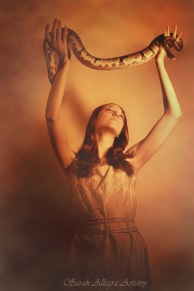 In Christian circles, you wouldn’t identify me by my faith unless there was something very unique about it. “She’s the woman that worships with snakes.” I guarantee you, if anyone in my church family included snakes as part of their normal worship activities everyone would know who that individual was, if not by name or sight, then by reputation.
 We all have a reputation. Some good, some bad, most a mix of both. The lady who drives the Aston Martin would certainly be known in most communities. And we all have things that make up our identity. Very few disabled people don’t recognize their disability as part of their identity, but it’s a defining characteristic of that person. Just like being an athlete or scholar, doctor, or maid becomes not only how others identify them but how they identify themselves.
 The point I’m trying to make is that you should expect behavior that correlates with the descriptors you use to define someone. The unsaved among the saved may be dressed less modestly. Their speech may be liberally sprinkled with expletives. You might see them drinking to intoxication, or find them bragging about things they’ve said or done that are not common among believers.
  Unless you are dealing with an abnormally moral individual there should be recognizable differences between the lost and the saved. You expect them to fit the Sesame Street standard—you know—one of these things is not like the other. That’s the Sesame Street Standard.
 I am who I am.
 Is that why my longing for my eternal home is met with admonitions that I must have hope? That it is wrong for me to desire the rapture in order to escape these earthly sorrows?
 Maybe that’s where the Holy Spirit steps in and performs a supernatural work in our hearts that enables us to receive God’s all sufficient grace instead of rejecting it in our agony . . . instead of taking action outside of the will of God due to complete despair and utter desperation.
 I had a biopsy Tuesday. I was a bit surprised when the doctor told me that I had handled the news that the biopsy was necessary in an appropriate manner – in other words – he was glad I didn’t freak out. This is the fourth time I’ve had to have follow-up appointments when the initial tests revealed unexpected results ATA (after the accident).
 It was a period of time in which feeling good (in spite of the fact that I was having a biopsy and all that implies) didn’t feel bad – didn’t feel as if laughing or smiling or enjoying simple conversation diminished the inherent value of my daughters. There was no guilt – no shame – and believe me I found many a reason to feel both of those things!
 Those thirty minutes were worth waking up Tuesday.

 8) To earn eternal rewards that will far outweigh the temporal suffering we experience in life:


 There are days and moments and very long nights when I think, I can’t do this anymore. Come to find out, that simple thought is a trigger for tears.
 continue to put on a brave face and hide the true depths of the pain and sorrow from each other so as not to increase their individual burden in this bizarrely intertwined protection dance we unconsciously perform. And as all this plays out within our home and personal relationships, the current culture demands that we have a positive attitude and recognize our blessings. It’s exhausting. It’s overwhelming. It’s frustrating. It’s impossible.
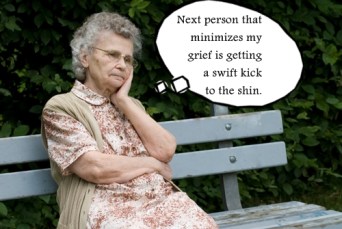 2. Avoid the use of platitudes and trite phrases. They serve to frustrate and unconsciously communicate unintended messages. (i.e., faith and trust in God mean things hurt less, our hope for eternity exchanges grief for joy, joy and happiness are the same thing, the salvation of the lost justifies the death of a loved one).
 5. Validate feelings. A grieving father who feels like beating the crap out of the person responsible for their child’s death is normal. It’s okay; it’s helpful actually to say, “I’d feel the same way if I were you.” Validating feelings in no way condones sinful actions. Feel free to tack on, “You’re not planning to act on that, are you?”, if in doubt.
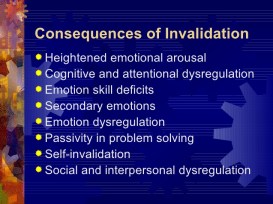 mourning mother recently told me, “Emotions are for emoting.” How an individual responds to their emotions can be right or wrong but never simply expressing them. Do NOT tell the grief-stricken that they can’t or shouldn’t feel any given way or that their feelings are sinful!
 8. Before you offer any advice, imagine yourself in that individual’s shoes; then personalize the advice. You are now the parent whose child just committed suicide. Consider how you might feel should someone tell you to count it all joy, or that God is good all the time, etc., before you offer any advice to the bereaved. Perspective changes when things get personal.
 Boxx Banter