RSS

Category Archives: Grief

Well With My Soul?

Well With My Soul?

Today I’m sharing another post from The Life I Didn’t Choose. It’s just too good not to share, and really, this blog site may have my name on it, but what I’m most interested in is the intersection of faith and real life. Heaven knows I don’t have life all figured out and I have so much respect and appreciation for fellow Christians who wrestle with their faith when they just don’t understand. They could turn their backs and walk away deeply wounded, but instead they choose to grapple with doubts and re-evaluate previously understood scripture trying to figure out if they got it wrong the first time around or if just maybe that scripture has a much fuller meaning than they realized in the past. Thank God Melanie is not afraid to question and wrestle with her faith!

I had never heard the final chapter of Horatio Spafford’s story. But you know what, I’m thankful, not for Spafford’s state of mind at his death, that saddens me, but to hear he struggled AFTER writing the triumphant hymn, “It is Well With My Soul”. If that sounds unkind, it’s not meant to be. Spafford’s struggle just makes me feel better about my own.

The truth is, I have personally found that in the immediate aftermath of my own tragedies, I am solid and strong in my faith. But down the road, down the road is another story all together. That’s why, not long after Bethany and Katie died, I posted on Facebook that I want to find Psalm 57:7a, “My heart is steadfast, O God, my heart is steadfast!”, to be true of me – because I was not confident that my heart would remain steadfast. As 2 Thessalonians 2:13b – 17 says, “. . . God has chosen you from the beginning for salvation through sanctification by the Spirit and faith in the truth. It was for this He called you through our gospel, that you may gain the glory of our Lord Jesus Christ. So then, brethren, stand firm and hold [fast] to the traditions which you were taught, whether by word of mouth or by letter from us. Now may our Lord Jesus Christ Himself and God our Father, who has loved us and given us eternal comfort and good hope by grace, comfort and strengthen your hearts in every good work and word.”

Living day to day with the fallout left behind, my faith can falter. Questions arise and I struggle to find answers, and sometimes, there are no satisfactory answers. Sometimes I have to find a way to make peace with a lack of answers or to make peace with the unacceptable consequences I am forced to with. There is just no easy way to get to that point. Intellectually, I understand God’s ways are not mine. In my heart, I believe God has a good plan. But in spite of those beliefs, I can’t seem to merge the beliefs of my heart and mind together. It’s like finding two puzzle pieces that fit together, knowing they fit together, but for whatever reason being unable to actually fit them neatly together.

My Dad likes to work puzzles. I like to work them on occasion myself. Sometimes when the manufacturer cuts the puzzle, the cut isn’t clean. When the box is first opened and the pieces spilled out you may find several pieces that are stuck together because the cut didn’t completely separate the pieces. So you tear them apart and start to work. But sometimes when you try to put the pieces together they don’t snap in place and lay flat. Instead they buckle up. Those puzzle pieces are a pretty good analogy for the way my heart and mind seem to work. In keeping with that analogy I believe that the Holy Spirit has to come along and sand off or smooth out those rough edges, so to speak, which allows the puzzle pieces (my heart and mind) to fit the way they are intended. I have settled in my heart that the Holy Spirit works to help me merge the beliefs of my heart and mind revealing a cohesive spiritual truth; the end of which results in spiritual maturity.

So while watching a fellow believer struggle, while struggling myself, is unpleasant (what an inadequate word!), I am resigned to the process. I don’t like it! I don’t like it at all! But I’m thankful for those who have wrestled and gained the prize, peace that passes all understanding.

And why is Melanie’s post relevant to Christians who have not lost a child? Let me use Melanie’s own words (with one slight modification) to explain: “Because the support (or lack of support) ALL BELIEVERS (substituted for bereaved parents) receive from their fellow Christians can make all the difference between losing sight of Jesus and finishing well, with our eyes fixed on the “Author and Perfector of our faith.” Read her post by clicking on “view original post” in red below; it’s much shorter than my introduction! 🙂

Melanie's avatarthelifeididntchoose

If you have been in a church that sings hymns, I’m pretty certain you’ve heard the backstory to the hymn, “It is Well With My Soul”.

Or at least the most popular version–Horatio Spafford lost four daughters in a tragic accident.  Only his wife survived the sinking ship on its way to England.   Once there, she sent a heart-rending telegram, “Saved alone” to Spafford who had not accompanied them on the voyage.

As the story goes, Spafford, upon crossing the Atlantic to meet his wife, passed over the spot of the sinking and the words to the famous hymn came to mind:

When peace, like a river, attendeth my way,
when sorrows like sea billows roll;
whatever my lot, thou hast taught me to say,
It is well, it is well with my soul.
Refrain:
It is well with my soul,
it is well, it is well with…

View original post 396 more words

 
2 Comments

Posted by on February 6, 2016 in Faith, Grief, Links


Tags: , , ,

Debate and Faith

Debate and Faith

Everything Melanie says resonates within me, but I love this post because, well, it resonates within me! She loves the Lord, she clings to Him as she wrestles with faith and doubt.

Take time to read this post, and scroll through her past posts as well. While the things she and I write about have often been birthed by loss, the issues she addresses cross over into so many other areas of life. She’s been a student of the Bible for a long time and just has so much to offer. Pull up a chair and soak up her hard earned wisdom!

(Click on “view original post” in red below to access the article.)

Melanie's avatarthelifeididntchoose

There are those who say faith means you never doubt.  Those who live by the creed, “Don’t ask questions!”

But I say faith is exactly what you cling to in the margins of doubt–when you have exhausted all the possibilities that exist in the physical, you-can-touch-it world and yet you KNOW there is MORE.

Now faith is the assurance (title deed, confirmation) of things hoped for (divinely guaranteed), and the evidence of things not seen [the conviction of their reality—faith comprehends as fact what cannot be experienced by the physical senses].

Hebrews 11:1 AMP

Questions are how you mark the borders of what you know and find the edges of what you don’t.

This week I judged a high school debate.  It took me back over a decade to the time and place my own children were competing in tournaments.  As I watched the eager and earnest faces of these…

View original post 374 more words

 
Leave a comment

Posted by on February 6, 2016 in Faith, Grief, Links


Tags: , , , , , , ,

Mercy, Forgiveness & Testimony

Mercy, Forgiveness & Testimony

I received the county 911 dispatch calls from our attorney’s office last year around this time.

That very day I listened to every recorded call.  Two calls featured my shrill, hysterical, voice in the background, which was surprising only in that I was completely unaware of the people who were placing those calls at the time.  They had to have been close at hand but their presence did not register in my mind.

The call Onstar placed for the owner of the speeding silver pickup was interesting in that they only seemed concerned with possible injuries to their driver.  I guess that’s the guy paying them and yet you’d think the Onstar operator, after discerning the wellbeing of his client, would inquire about other injuries as well.  What if the accident occurred when the road was deserted and their call was the only one placed to 911?


10403417_816648245063764_3713033303821133814_n - Edited

Following my foray into the past, into bystanders reactions to the devastation of my life; immeasurably sad, I sprinkled burial-scented bath salts (Frankincense & myrrh) into my tub (not out of morbidity but because I love the fragrance) and sank into the warm water neck deep to process the emotions weighing so heavily on my heart.

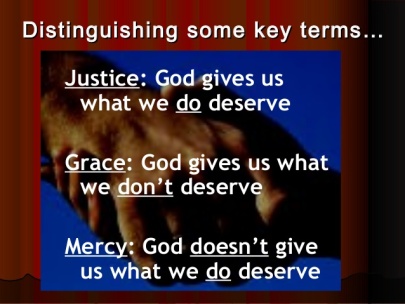
And like so many nights before, my thoughts circled.  But this time the conclusions drawn seemed to contradict each other.  I found myself still firmly rooted in the belief that God will ensure justice is served since the legal system failed us to such a colossal degree, and then another, more sobering thought took center stage.  I faced the thoroughly discouraging knowledge that in truth, justice may never be served for my daughters because of God’s grace and mercy.  All that’s required for any one of us to receive forgiveness is that we seek God with a repentant heart and Poof! – our sins are forgiven – covered by the blood of the lamb, who so graciously covered my sins as well.

distinguishing-some-key-terms-justice-grace-mercy-2-638

For the irrevocably injured this is a hard truth – an unpalatable truth, a bitter pill – and I found myself sobbing out my outrage, bath towel pressed to my mouth to muffle the sound from David and Gracen watching TV in the other room.

I found myself truly angry – enraged really – to consider that God will grant these men forgiveness full and free.  FREE!

Jesus-forgives-the-adulteress-001

I realize the key here is that the drivers, the prosecutor and the judge, each will first have to acknowledge and repent of their sin.  However, do they get to repent of a sinful lifestyle without specifically confessing the sins that led to the deaths of my daughters, the destruction of life as we knew it?  I know I never confessed each and every sin I’d committed when seeking salvation.

The possibility that mercy may be extended at such a great personal cost, without my consent or permission, is completely repulsive to me.  I’m not unaware of the irony of that statement in that that same grace and mercy was extended to me (although it should be noted that God, Himself did in fact grant permission).  This is not only an emotional battle but one I struggle with intellectually as well.

images (7)

Surprisingly, the idea of spending eternity with these men is not a such a difficult pill to swallow – only because the logical part of my mind is assured that is not a possibility. The Bible says at the point of salvation we become a new creature.  They may enter heaven with the same name but not the same nature and by golly, I will be made like Christ which will allow me to walk the streets of gold without stalking them and plotting to do them harm! For that I can be grateful as what kind of paradise would heaven be for me in I continued to harbor animosity toward any of these men and had to live eternally in their presence?

I hate this!  To forever and for all eternity be denied justice is a truth not easily accepted and one I know will require a considerable amount of excruciating personal struggle.  I have no desire to even contemplate the process.

Yet months and months later, that’s exactly where I found myself – contemplating a lack of justice and prayerfully forgiving these men – not for their benefit but for mine.  I highly doubt I can ever look upon the unlicensed driver, the prosecutor or the judge with anything but contempt, but my hope is their power to hurt me has been forever laid to rest.  The speeding driver, I think I can actually look at with pity – unless I find he too lacks remorse and that he assumes no responsibility for his own actions.  But, for now, I know no such thing and I will deal with forgiveness again should the need arise – for myself and because it’s commanded of me by my Savior.  But mostly for my selfish self so I can find a way to live free – without nausea – to lay down the burdens I’ve chosen to carry and those thrust upon me.

Someday, I hope to find my life no longer defined by the accident that forever altered it.  I hope there comes a day where following the introduction to someone new, the aside “That’s the woman whose children were killed in that car accident and . . .”  is no longer is tacked on either in my presence or behind my back as if I’m a novelty in a circus sideshow.

I hope the day comes where there are more notable things to define me than the losses I’ve suffered and the disappointments I’ve endured.

Words like “Bright, Passionate & Generous”“Joyful, Imaginative & Compassionate”, or “Courageous, Sassy & Tenacious” – the words found on Bethany and Katie’s headstones and reserved for Gracen’s.  I told her she’s the only one to be gifted with veto power.

Words that proudly proclaim the content of their character and personality more than the circumstance of their lives.  Words that speak of their true essence. Words that reflect the supernatural work of their Creator, their Savior and the Holy Spirit at work within.  Words that glorify God and forever testify to the immeasurable value of their lives, in spite of their far too soon departure from this world.  And yes, I hope David and Gracen can easily distill my character and personality down to three simple words on a headstone the only testimony of a life lived, choices made, and relevance assigned/ordained – by my Creator. I’m hoping for something more impressive than “Total book nerd”!

 
7 Comments

Posted by on February 5, 2016 in Adversity, Faith, Grief


Tags: , , , , , , , , , , , ,

Vanessa Martir – Creative Nonfiction

Vanessa Martir – Creative Nonfiction

My heart broke with the very first line. Families, and the way they interact are so complicated . . . we are all, parents and children alike, trying to grow up at the same time. So often unprepared to know how to respond to events we never expected to encounter, could not even imagine in our wildest imaginations.

As a member of the Christian bereaved support group for parents, While We’re Waiting, I’ve encountered families who are deeply grieving the death of a child who struggled with addition. This post, struck a cord within, for a number of reasons, including the elements of faith and adiction. For example this line:

“. . . I finally saw my brother that day in my aunt’s house, a year and three months after his overdose, when he said, “I’m a sin, sis. The bible says I’m a sin,” I finally understood his addiction, and I knew I couldn’t leave him again. My mind goes to an article I read a while back, “Five Unexpected Things I Learned from Being a Heroin Addict”: “If you know someone who’s using or has used, you should know that this isn’t as simple as them making bad decisions. They’re running from something that, to them, seems a whole lot scarier than a needle.”

The idea that this man believed the Bible called him a sin. We are all sinners and maybe it’s a minute distinction but none of us are sin itself. No where does the Bible say that! My heart breaks for this man who seemed unaware that Christ was the answer for his sin. That he need not have carried this condemnation.

And then, the very last paragraph . . .

“He died on June 24th, 2013, but I will never stop saying his name: Juan Carlos Moncada. And, I will never stop telling our stories. My grandchildren will know about him, and their grandchildren will know him. They will know him as my daughter calls him, “Tio Tio”; my Superman, the man who taught me about me about love and heartbreak and the costs of silence.”

The costs of silence. Oh, to know when to speak and when to hold counsel!

**Strong language warning.

(Click on “view original post” in red below to access the complete article.)

 
Leave a comment

Posted by on February 1, 2016 in Adversity, Faith, Grief, Links


Hard Times, Satan’s Devices & Faith

Hard Times, Satan’s Devices & Faith

The last quarter of 2015 was particularly hard for me.  Gracen had settled in well at JBU, David had changed responsibilities at work, which he was really excited about.  I on the other hand, encountered, a big gaping void.

Preparing to send Gracen to college and living independently after I had spent the last year and a half helping with her personal care needs, left me anxious on a level I’d never experienced before.  Her physical safety was my primary concern and following the deaths of three children, let’s just say I had little confidence that I would not lose Gracen too.

1k0

In addition, in April or May of last year I began fielding a new and distinctly different set of questions.  With graduation on the horizon people began asking me what I intended to do with my time – with the upcoming “empty nest”.   Not one person acknowledged that I was not supposed to have an empty nest.  No one seemed to realize that fear for Gracen’s safety, a premature empty nest and an utter lack of purpose might be frightening and emotionally overwhelming.  Then again, maybe people did understand but felt ill-equipped to address it so avoidance was deemed the most comfortable solution for everyone; myself included.  Unfortunately, avoidance left me feeling alone, stranded in my grief, disappointment and fear.  It also left me feeling as if Katie was unimportant in the eyes of the world and as if my fears for Gracen’s safety were unreasonable in spite of the fact that I knew Gracen was at high risk for injury on campus.

IMG_3801

So, by the time graduation passed, I was a bit of a mess.  I began taking an anti-depressant early in 2015 and by June I was unquestioningly aware that I needed more help.  So an anti-anxiety medication was added to the mix and it made a significant difference.  I had not realized just how much anxiety I’d been living with until the miracle of modern pharmaceuticals provided some much needed chemical relief.

Still, I was weary, frightened and at loose ends so once Gracen settled into school and dorm life, I settled into my bed.  I found myself alone, overcome with the grief I had suppressed in Gracen’s presence, fighting to process it or push down to avoid the excruciating pain and rudderless. I also began sleeping later in the day which affected my medication schedule.  One day I realized that I couldn’t recall when I’d last taken my prescriptions.  Knowing I had an upcoming appointment with my PCP I decided to wait to see him so he could help me restart them safely.  Looking back, that was not a good decision.  A downward spiral took hold.

medication-tired

A typical day looked . . . okay, looks (present tense), because this is still a typical day in my world . . . something like this.  I wake up, get a cappuccino or chai latte, return to bed to read.  I read, write, browse Facebook and email and nap on and off throughout the day. David comes home, FOX news comes on and more often than not he makes dinner.  After dinner, I read, he watches Fox and plays on the computer and finally, lights out.  I toss and turn, mind whirling and when I can’t stand my thoughts and the inability to fall asleep any longer, I start reading again.

Unless I have an appointment with my grief counselor, my trauma counselor (for PTSD), or my PCP everyday is much like the day before.  I’m comfortable with that.  The silence and being alone is easier than being around people. People make me anxious – incredibly anxious.  How does one answer all the oh so simple questions without making others uncomfortable?  How do I answer them without feeling pitiful myself?  “What have you been up to?”, “Will you get a job?”, “Any new hobbies?” A simple, “I’ve missed you” leaves me paralyzed and frantically searching for an appropriate response.  “Me too” is what longs to escape but “Um, thank you” is generally what spills forth.  And as to the what have you been up to question, not much is my reply. No new hobbies, no plans for a part-time job.  The reasons for those brief responses go unspoken as the listener will either feel uncomfortable with my answer or will try to explain to me why a job or hobby would benefit me.  Regardless, a simple “no” is awkward enough as it doesn’t open the door for further conversation.

Is my current daily activity healthy?  Surprisingly, the answer is yes. . . and no.

All those churning thoughts and my writing are a means of working through my grief. The reading is also good for me.  I read suspense, mysteries, thrillers, and romance. They engage the mind.  If I was simply laying in bed, not working through my sorrow and not engaging my mind, that would be cause for concern.

Facebook and email allow me safe access to the outside world.

And the sleep; it’s good too.  I’m trying to take my PCPs advice and get some much needed rest.  He pointed out that should I fail to recharge spiritually, physically and emotionally, I will be running on empty when Gracen inevitably needs additional support. To say Gracen’s shift from walking to using a wheelchair was an enormous change is an understatement of vast proportions.  Wheelchair use involves a mirad of complications I had never considered.  Transfers into and out of the wheelchair, bathroom use with and without handicapped facilities, transporting the chair, finding safe and viable entrance and exit doors, dealing with weather – oh my, dealing with weather!, and a multitude of unforeseen considerations became the new norm.  No one can estimate the demands the next transition in her health will require.  Therefore, I need to be prepared, or be able to get up to speed quickly, in spite of the emotional impact those changes bring.

So I find myself withdrawing from the world around me, to rest, to grieve, to avoid assuming responsibility for making others comfortable with the realities of my life.  I don’t have the motivation or the energy to continue to push myself. Gracen was my motivation.  For her, I would, and still do, force myself forward, but in her absence . . . I lack the impetus to do much of anything.  I’ve struggled with the blues in the past, but never before have I found myself fitting the defined parameters of the clinically depressed.  Just hearing those words uttered by my grief counselor left me deeply ashamed and utterly humiliated.

IMG_4260

Why?  Why would a diagnosis of clinical depression leave me ashamed and humiliated?  I mean really, my counselors keep reiterating that I have suffered loss on a scale uncommon to the average individual, so depression is certainly not an uncommon or even an unexpected response.  I think I felt ashamed because depression is a mental illness and in our society a stigma is still attached to mental illness. Secondly, I had higher, albeit, unrealistic expectations for myself and for my faith.  Clinical depression represented, in my mind, both a personal failure to overcome and, far more painfully, a failure to avail myself of the power of God.  It stank of insufficient faith; not an insufficient God.

At some point along the way I drank the kool-aid and ascribed to the cultural expectation that I was capable of conquering every obstacle by sheer force of will and tenacity.  I should have realized, and in fact, from an intellectual perspective alone, I knew that was lie of epic proportions straight from the slithering serpent in garden of Eden.  That far too prevalent belief system is nothing more than the heart and mind’s rebellious desire to proclaim the soul god.  It’s the cunning and insidious whisper of the snake luring us into believing that with enough knowledge, with enough determination, with enough effort, we are in control.

347cd084-1316-4a6b-ae11-7351050ea284In truth, that idea is nothing but a craftily designed hologram. An idea without formative substance. It’s equivalent to the land of Oz and the impotent wizard hiding behind the castle doors and green drape.

How many times have you heard or used the analogy that if it walks like a duck and talks like a duck, it’s a duck?  Therefore, a Christian can easily conclude in the deeply buried regions of their heart and mind, that if they fail to conquer the human emotions grief generates, from guilt to fear, sadness to anger, and so forth, they are failing to walk by faith.  They are failing to apply the principles of their faith.  They are not the Christian they believed themselves to be and often worse, they have failed to live up to the perceptions and expectation of fellow Christians to inspire saints and sinners alike, to give God glory and praise in the midst of their despair and to minister to others.  In other words, God is not insufficient, their faith is insufficient.  They have failed God’s test of their faith.

But is that really true?  This duck analogy sounds good, but is it universally applicable? The truth is that in a paradoxical fashion, faith demands doubt.  The very essence of faith is to fall short of fact.  Jesus has always been the bridge that spans the gap between what we know to be fact and what we trust to be true.  When my faith, when your faith, falls short of expectation are we then dismal Christian failures?  I don’t think so.  We have simply lived up to the limits of our personal faith at that point of time – and lived up to the very essence of faith in general.

The longer I live the more aware I am of exactly how dependent I am upon the Lord God Almighty.  I am the instrument He forms at the potters wheel for His use.   I am made in His image but I was not, nor was any human, created with His perfect power and holiness. As a result, I am vulnerable to temptation and a failure to differentiate between truth and lies and good and evil on occasion.  And yes, I have fallen victim to Satan’s devices.  I’ve both allowed Satan to cunningly communicate a stark untruth about a simple diagnosis and to lead me to question God’s love and kindness by contemplating the idea that He may have withheld the desires of my heart in spite of the fact that I did my best to delight myself in Him.

What exactly does it mean to delight yourself in the Lord you might ask?   Gotquestions.org addressed that very question and their answer follows:

Psalm 37:4 says, “Take delight in the Lord, and he will give you the desires of your heart.” Taking delight in the Lord means that our hearts truly find peace and fulfillment in Him. If we truly find satisfaction and worth in Christ, Scripture says He will give us the longings of our hearts. Does that mean, if we go to church every Sunday, God will give us a new Rolls Royce? No. The idea behind this verse and others like it is that, when we truly rejoice or “delight” in the eternal things of God, our desires will begin to parallel His and we will never go unfulfilled. Matthew 6:33 says, “But seek first his kingdom and his righteousness, and all these things [the necessities of life] will be given to you as well.”

Did God withhold the desires of my heart?  No.  Children were my heart’s desire and I’ve been blessed with four.  I got to love and nurture each one for a finite amount of time.

Did God steal the desire of my heart from me?  The answer to that is no as well.  My children were on loan to me.  They were always His creation and David and I the chosen stewards.

Were they taken from us because we proved to be unworthy stewards?  I don’t believe that at all, in light of scripture.  God predetermined the number of my childrens’ days and in the case of my daughters he allowed man’s free will to intersect with Bethany and Katie’s number of days.  The Bible tells us that sin impacts all of creation and the cost of sin is death.  So be it accident or illness, intent or natural event, all death can ultimately be traced back to sin.

IMG_4284 (1)My grief recovery is complicated by the anticipation of more loss and the very real and reasonable fear of the destruction another loss will wreck within my heart.  Even grieving families that aren’t dealing with progressive disease often struggle with the anticipation and fear of more loss.  They’ve lost their naiveté – they know bad things can and will happen to them – not someone else – down the road.  But for most it is a vague Spector on the periphery of their minds.  For me it is a far more tangible presence and I must find a way to make peace with that and what it teaches me about the Lord.

Our family was living with progressive disease long before the collision that took Bethany and Katie’s lives. The difference between then and now is the loss of worldly hope.  There is a popular saying, “Where there is hope, there is life.”  I have lost the majority of my worldly hopes.  I know just saying that out loud will cause a great many people to reflexively remind me of all the worldly hopes that still lie before me.  What they don’t understand is that I no longer wish to have any worldly hope.  Worldly hope leads to expectations.  Expectations often lead to deferred hope and as we are told in Proverbs 13:12,  “Hope that is deferred afflicteth the soul: desire when it cometh is a tree of life.” – Douay-Rheims Bible.

I prefer to invest my expectation in eternal hope alone; that of eternal life with my savior and fellow saints, because that hope is the only one guaranteed to come to fruition.  I’m confident my hope of eternity will be fulfilled and not deferred.

However, I have yet to make peace with the role progressive disease will play in our lives, precisely because of all my prior losses.  It feels unfair.  It feels too much to ask of any one believer.  If this is what God’s love looks like, my more cynical perspective leads me to beg Him to share the love (with someone else)!  And yes, God can carry me through anything He allows to happen in my life, but before anyone reminds me of that truth (because I am well aware it’s true) put yourself in my shoes.  Google ARSACS (a rare form of Muscular Dystrophy) and read about what it does to an individual and then imagine walking that path with your child.  Imagine helping your child as their health declines.  Imagine standing by helpless to change it or improve their quality of life.  Imagine the things I’ve eluded to and left unspoken.  Making peace with God’s plans, with His will, with His sufficient grace is far harder when it’s personal, when you find yourself “feeling” as if His grace might not be quite be sufficient for you after all you have endured already.

PTSD-battle-PINI have reached the point of acknowledging that the best I may be able to hope for in regards to ARSACS, may consist of a cycle of repeated but temporary interludes of peace.

We live in a continuous grief cycle.  Gracen loses a previously mastered skill and we mourn and despair it’s loss and the daily ramifications that ripple out in waves from that loss. Eventually, we adapt to her new normal and settle into a wary peace until the cycle restarts with a new loss.  It’s just the way life works in our home.  Every time the cycle begins anew, we hurt.  Fear arises as does disappointment and sometimes even despair. I’m not sure if the Holy Spirit is actually doing a new work of trust and peace with each cycle or if each cycle simply forces me to acknowledge an as yet unconquered weakness (or doubt) in my faith.  Maybe I just keep spinning my wheels without making any forward progress.  Yet a person who is maturing rarely notices the subtle changes until enough growth has occurred and their pants are inch too short.  I imagine spiritual maturity is as subtle a process as manifest in physical maturity.  It’s only looking back far down the road that real progress is recognized.

Food-antidepressantToday, I am doing well to say without shame, my name is Janet Boxx.  I am clinically depressed.  I have anxiety issues.  I have PTSD.  I self medicate my anxiety with food.  (Ok, that I’m ashamed of – although I’m happy to report that while I may be a glutton, at least for now I’m not a suicidal, drug or alcohol addicted, glutton).  I lack the motivation to return phone calls, emails  and text messages; to clean my house, pay bills, shop for groceries, do laundry and sometimes even to shower.  It is what it is and my response to my life’s circumstances is not abnormal in the bereaved parents community, even two years down the road.

Having said all that; do not drop by unannounced!  I still have the capacity to feel great embarrassment and utter mortification.  Just because I’m comfortable in my current state of sloth doesn’t mean I’m equally comfortable having friends and family witness it.

Before speculation germinates, let me just say that David has demonstrated the utmost patience and support. He has taken on the tasks I normally do without complaint, anger or resentment.  He has a servants heart and demonstrates his love for Gracen and I in actions more than words.  He guards my privacy. David is better at compartmentalizing his grief than I am.  He has not, nor has ever, abandoned me to my grief and more importantly has never criticized or judged the way in which I am coping with the very same losses he, himself, is dealing with.  Our experiences with trauma are different because we were exposed to different things and took on different roles at the scene of the accident, at various hospitals, at home caring for Gracen during her recovery, with the medical community and the legal system and we simply deal with trauma differently.

This is what my life looks like when the Potter decides the pot He previously formed has served its intended purpose.  This is what my life looks like once I was fractured into minuscule pieces, returned to softened clay, and set to  spinning on the Potter’s wheel while He molds me into a new shape with a new or more complicated purpose in mind (after all, I am still a wife and mother).

b7d1824f3c676afed4e1e924034f0d73

And you know what?  As ugly as this lump of clay currently is, as uncomfortable as it is for me to find myself in this state, it’s okay to be a lump of clay in the Creator’s hands. There is no safer place to be and while others, myself included, may worry about who and what I’m becoming, I’m confident God is not.  He sees beyond the here and now – past the dark tunnel I’m traveling through – clear to an eternal future where He will literally light my world.

 
23 Comments

Posted by on January 29, 2016 in Adversity, Faith, Grief, Muscular Dystrophy


Tags: , , , , , , , , , , , , , , , , , , , ,

the cost of compassion

Written by a fellow bereaved parent I connected with via the Christian bereaved ministry called While We’re Waiting. Melanie has been a blessing and encouragement to me as she daily depends on the Lord while working through her grief over the death of her son, Dominic.

Take a moment to discover the behavior Melanie argues makes us most like our Savior, Jesus Christ.

(Click on the link in red below to access the article.)

Source: the cost of compassion

 
1 Comment

Posted by on January 29, 2016 in Faith, Grief


Adventures in Limboland

I am living in Limboland – Purgatory, if you will, as it is just a little bit of Hell.  Limboland is that in between place – a pressed in place as the limbo bar is steadily dropping lower and lower.  My grief counselor described it as being forced through a funnel and she is right in that my circumstances have forced me from a wider plane – a place where options and choices once existed into a smaller place.  There are still choices but they have been greatly narrowed down and very few of the things I dreamed of for my life remain – or maybe the remnants of my dreams have been so warped that things like marriage and motherhood while technically still exist are barely recognizable as the dreams I once held.  My life is not a fairy tale.  It never was, but at one point in time, before the lenses of my rose colored glasses became scratched and cracked, the fairy tale still felt attainable.


img_0352But the limbo bar has lowered and I am left to bend and contort myself in an attempt to fit within the new shrunken boundaries of my life.

Standing before the bar – do I turn from the bar walking away and concede defeat in exhausted resignation or do I defiantly walk into it rebelliously refusing any attempt at attacking the challenge that lies before me?  Maybe I should twist and arch trying to negotiate a means beneath this bar that I once navigated with effort but a modicum of confidence.  But the bar has fallen so much lower now that I have no real confidence in my ability to contort myself beneath it and frankly, I wonder if I have the flexibility required to be successful and if I have the fortitude to deal with the humiliation of both a failure to try and/or a failure to succeed.

I once read to shut out the constantly churning thoughts; my minds futile attempt to either work out a new, happier ending, or at the very least to thoroughly examine every detail in order to contain it and be able to pack it away in a small box that gets shoved into a back corner of the closet – never to be reopened but too valuable, too costly, to discard.

Now I read to hide from the utter silence.  It is too difficult, or I simply have not learned the discipline of sitting silently before the Lord.  I’m impatient and it’s frustrating trying to hear that still small voice and instead nothing more than silence echoes back. Alexander Theroux once said, “Silence is the unbearable repartee.”  Can you relate?

So I’m imprisoned in Limboland although Purgatory is a more apt description in my estimation.  Trapped between what was, lingering in this silent spot waiting for my heart to heal sufficiently so that I’m prepared to move into whatever God has planned – no longer angry yet still wounded leaving me resistant to what comes next but simultaneously antsy at this inactivity.

Fernando Ortega sings a song, “I Will Wait For My Change”.  The chorus of that song goes:

“All the days of my struggle
I will wait for my change,
I will wait for my change to come.
Only do not hide Your face from me,
Don’t take Your hand away,
Don’t take Your hand away.
I will wait for my change to come.”

And this is where I find myself, waiting for my change to come, unable to see the Master’s face, trusting He will not take His hand away.  And fast on the heals of this refrain, an old Avalon song plays through my mind – the Master’s plea to me? – Avalon’s “Dreams I Dream For You”:

“You taste the tears
You’re lost in sorrow
You see your yesterdays
I see tomorrow

You see the darkness
I see the spark
You know your failures
But I know your heart

The dreams I dream for you
Are deeper than the ones you’re clinging to
More precious than the finest things you knew
And truer than the treasures you pursue

Let the old dreams die
Like stars that fade from view
Then take the cup I offer
And drink deeply of
The dreams I dream for you”

img_0351And I wait.  I wait for healing. It can’t be rushed.  It takes as long as it takes for the Holy Spirit to do His work in my heart – for my terror of God and His plans to subside – for my resistance to a future void of my most precious dreams to recede – for my heart to soften, for it to feel safe enough to tear down the protective walls I’ve built in an attempt (futile though it may have been) to guard my heart from any more excruciating pain.

We advise friends to wait on the Lord, to trust in the Lord as if doing either is a simple thing to accomplish – but the old man wars with the new man.  Intellectually we realize that yes, we do need to wait on the Lord, we need to trust in Him, but putting it into practice is no easy feat – it’s a life long battle played out in different arenas of our lives from the arena of work, to parenting, the lust of the flesh and the arena of pride.  The same battle plays out over and over demanding greater faith and more commitment with every consecutive battle.

My purgatory is not a punishment.  I sincerely believe that God intends this season between my past and my future as a time of rest, a respite from the storms I’ve weathered and a time of renewal before the next storm is unleashed in my life.  Believe me, I see the storm clouds on the horizon brewing and I’m not sure how much time I have before the next major storm in my life erupts.  But during this time of respite I am struggling to rest. It’s hard to shift gears from constant diligence to rest.  The mind has simply been conditioned to living on high alert and a new form of anxiety develops in the void left when the need for hyper awareness dissipates but you also know it’s just a matter of time before the winds whip up again and the storm is upon you with little or no warning.

How does one let down their guard in these kind of circumstances?  How does one quiet themselves?  I wish I had the answers.  Maybe, the truth I’ve yet to accept is that I’m dependent upon the Holy Spirit for that as well – that I’m dependent upon Him for every little thing.  He tells me to quiet myself and after metaphorically chasing my tail for far too long, I recognize that I can’t do it in own power and I break down and with humility ask God to help me to quiet myself.  Then I’m back to waiting until one day I randomly notice that I’ve gone completely still within.  It wouldn’t surprise me to find out this is exactly how it works as years ago I went through a very similar exercise in a battle over the power of fear in my life.  How hard these lessons are to learn!  How stubbornly defiant is the old man within, doggedly determined to tackle problems his way!  How ignorant, slow witted, or lackadaisical the new man is having to relearn the same process repeatedly!

So maybe that’s my answer and now I have to decide if I’m ready to begin that process. Again.  Am I ready to quit chasing my tail, to ask God to quiet my mind, my heart, my soul?  Have I reached that point where I know beyond a shadow of a doubt, that I cannot do this for myself?  That only God can quiet the restlessness within?  The demand for answers? The need for justice?  The fear of what this “next” plan holds?  Am I resolved to pay the cost of discipleship regardless of price demanded?  Am I ready?  Will I ever be ready or simply too tired of this chronic emptiness to stand still any longer?  Am I waiting on God or is He waiting on me?  I don’t know the answers.  I just don’t know.

img_0353

 
2 Comments

Posted by on January 18, 2016 in Faith, Grief


Tags: , , , , , , , , , , , , , , , , , ,

Lanterns & Stones

IMG_0276Preparations for this day, the second anniversary of the girls’s death, started a few weeks back. We ordered a package of Chinese Sky Lanterns and emailed family informing them that we intended to bring them to our Christmas celebration. The family was gathering on Christmas Eve and we wanted to give everyone a chance to write a message on a lantern, in preparation for flight. We also invited family to join us for the launch, December 26, 2015, at approximately 2:45 p.m. – Bethany & Katie’s heaven date and time.

In early afternoon it began to mist. The forecast for rain left me anxious. Following the news that our daughters’ fingerprints were not available so we could order a much desired memorial necklace for me and key chain for David, being able to launch the lanterns on the day of the girls’ death took on an increased level of importance for me.

IMG_0280

Family gathered at my in-laws home and we caravanned to the launch site. By the time we arrived, it was still misting and what had been a calm day had turned into a gusty day.  The manufacturer’s instructions said to choose a calm day and to have water or a fire extinguisher handy. We gave it a valiant effort, attempting to light a test lantern (one without a message) but it was not to be.

IMG_0281IMG_0282

We thanked the family for coming out and dispersed quickly because it had gotten considerably colder. On the way home, I looked over at my husband and quietly asked, “Are you disappointed?” (David doesn’t volunteer his feelings. If I want to know, I have to ask). A simple “Yes” was his reply.

“I am too, but you know, I’m not surprised, and not because of the weather. I guess I’ve grown accustomed to disappointment.”

And I have, but disappointment cuts much deeper when your hopes are tied to your dead child. Every dashed hope feels as if God is allowing you to be repeatedly kicked while you are down. It may be unreasonable, but then emotions are frequently illogical under the best of circumstances, and the anniversary of your child’s death is by no stretch of the imagination the best of circumstances.

The lanterns remained in our vehicle. No sense unloading them only to have them be a visual reminder of our disappointment every time our eyes landed upon the box in which they were shipped. They would go home with us the next day. Maybe we could try again on the anniversary of burial, I thought. It would be an equally fitting day, but that did not happen either.

IMG_0283

The truth is, we are destined to be disappointed over and over in the years to come. We will encounter big and small missed opportunities; there’s just no way to avoid it because Bethany and Katie are forever lost to us for the remainder of our days.

So maybe, it’s not a bad thing that I wasn’t surprised by the aborted lantern launch. Painful as it might be, I need to have realistic expectations where my girls are concerned. Even when the plans I make are a resounding success, they will still be bittersweet because my heart will always long for Bethany and Katie’s presence. Choosing to acknowledge circumstances that might derail my hoped for plans, will guard my heart from bitter disappointment. I need to protect my heart because it is considerably more vulnerable than it was in the past. I need to prepare for deferred hope because I don’t want to live a life underscored by constant sadness.

IMG_0304IMG_0313


If I picked up a stone and painted upon it’s surface the name of each and every disappointment I suffered through and stored those stones in a glass jar placed in a prominent location in my home where I’d look upon them every day; the constant visual reminder would surely result in bitterness and resentment toward God. However, if I placed those same stones in a lidded wooden box and set them in the same location, my response to those disappointments would be much different. I would no longer be able to see the evidence of my many disappointments. The same number of stones would accumulate in each container, but the lidded box would conceal exactly how much disappointment I’d suffered while the glass container would reveal the same information. One container demands you keep record of every perceived wrong, the other encourages you to release those over time. There’s nothing wrong with naming your disappointments. Doesn’t the Lord ask us to cast our burdens upon Him?
Satan encourages us to keep score. God invites us to surrender our disappointments to Him. Satan encourages dissatisfaction. The Holy Spirit helps us carry the weight of our disappointments until His supernatural work enables us to recognize them for what they really are; light and momentary afflictions.

So while I’m disappointed that my plans fell through, I will look for another launch date. Does it really matter that those lanterns light the sky on the day of the girls’ deaths or burial. Not so much, because I miss them every day. I don’t need to wait for a significant date to light up the sky displaying our love and longing for Bethany, Katie and Cole too.

 
Leave a comment

Posted by on January 8, 2016 in Faith, Grief


Tags: , , , , , , , ,

Grieving Mother Vilified

imageJob Being Scolded by his Wife, c. 1790, Francois-Andre Vincent

I recently read a blog post that contained a reference to Matthew 2:18b, “. . . Rachel weeping for her children and refusing to be comforted, because they are no more.” It brought to mind another reference to a grieving mother in scripture. Specifically, Job 2:8-10 which says, “And he took a potsherd to scrape himself while he was sitting among the ashes. Then his wife said to him, “Do you still hold fast your integrity? Curse God and die!” But he said to her, “You speak as one of the foolish women speaks. Shall we indeed accept good from God and not accept adversity?” In all this Job did not sin with his lips.”

One scripture reveals a frequently overlooked truth about grieving mothers. Grieving mothers do not want to be comforted – they want their children back! The second scripture seems to expect the reader to remember and consider that Job’s wife is also a grieving mother, because it certainly doesn’t come right out and say it.

“Curse God and Die”, words spoken by Job’s own wife, yet another villain in the book of Job. But is she really?

Search the commentaries and you will find that many believe that to be true.

The truth is, in today’s vernacular, her words are shocking and if we take them at face value, they are not what one would expect from an upright worshiper of God. Still the conclusions drawn by some commentaries go far beyond painting Job’s wife as an angry grieving mother. They assign her a role in this story that can only be based upon conjecture.

For example, Matthew Henry’s Concise Commentary says of Job’s wife, “His wife was spared to him, to be a troubler and tempter to him.” Interesting conclusion but think about who spared Job’s wife. God initially gave Satan power over all Job owned and restrained him only from touching Job himself. So God did not save Job’s wife to play the role of Satan’s tormentor; Satan did. Satan can hope that Job’s wife develops the attitude and has the influence to undermine Job’s faith, but unless she was demon possessed, he has no power to make her play that role. Satan could have spared Job’s wife assuming what her response would be but he could not be certain because he was not created with the ability to know the hearts and minds of men. So, at best, Satan could make an educated guess at how Job’s wife would respond just as he did when he stood before God Himself boasting that Job, God’s paragon of integrity, would curse God if he should take away all of the people and things Job most loved.

The Pulpit Commentary seems to concur. Allow me to refresh your memory and remind you that Job’s wife did not encourage Job to curse God and die after the death of her ten children. Nope. As the Pulpit Commentary points out, “Job’s wife had said nothing when the other calamities had taken place” instead she had “refrained her tongue, and kept silence, though probably with some difficulty.” The commentary goes on to state that, “Now she can endure no longer. To see her husband so afflicted, and so patient under his afflictions, is more than she can bear.”

Well, that’s one conclusion. But whose to say that this woman simply struggled to stand helplessly by and watch her husband suffer fast on the heals of the loss of her children? Whose to say she isn’t terrified that she will lose him too and that living in anticipation of his death is much harder than inviting it because it gives her the illusion of control in a life that has become defined by chaos and suffering. It’s a, let’s just get it over with attitude, eliminating the anxiety she is fighting to control.

The Pulpit Commentary goes on to say, “Her mind is weak and ill regulated, and she suffers herself to become Satan’s ally and her husband’s worst enemy. It is noticeable that she urges her husband to do exactly that which Satan had suggested that he would do, and had evidently wished him to do, thus fighting on his side, and increasing her husband’s difficulties.” Ouch, that’s harsh!

Where’s the compassion? These commentaries seem to focus on Job’s suffering and ignore the very deep grief of a mother who has just lost every single one of her children. This woman carried those ten babies in her womb, fed them at her breast, and nurtured them as they grew. A mother of that day and age had very defined responsibilities. Raising and caring for her children and running her household defined the bulk of her identity and life’s purpose. Not only is it likely that she fears the death of her husband but the protection and security he provides as well. Unmarried women were extremely vulnerable in that age. This commentary seems to overlook the very real and reasonable fears and emotions Job’s wife was surely experiencing.

The Pulpit Commentary continues to support the conclusions they’ve drawn: “The only other mention of her (Job 19:17) implies that she was rather a hindrance than a help to Job. Curse God, and die; i.e.”renounce God, put all regard for him away from thee, even though he kill thee for so doing.” Job’s wife implies that “death is preferable to such a life as Job now leads and must expect to lead henceforward.”

Is the idea that Job’s wife might, in her grief, consider death preferable to life really that shocking? I’m thinking the people who wrote this commentary have no firsthand experience as bereaved parents. I know, from talking to a number of mothers in mourning that this is absolutely not an unusual concept for a grieving mother to draw.

But then comes Gill’s Exposition of the Entire Bible. Gill points out that “Job had but one wife, and very probably she is the same that after all this bore him ten children more; since we never read of her death, nor of his having any other wife, and might be a good woman for anything that appears to the contrary; and Job himself seems to intimate the same . . .”

Gill contends that Job’s wife was not blaming her husband for insisting on his integrity and justifying his behavior, nor was she wondering aloud how he could keep his integrity “among so many sore temptations and afflictions”. Gill further states that Job’s wife was neither rebuking him for his religion and continued practice of it nor was she mocking him or hating him for continuing to live according to his to his religious convictions as Gill points out that Michal did David. Instead Gill contends Job’s wife was “suggesting to him there was nothing in religion, and advising him to throw up the profession of it; for he might easily see, by his own case and circumstances, that God had no more regard to good men than to bad men, and therefore it was in vain to serve him . . . ”

Gill also points out that “curse God, and die: which is usually interpreted, curse God and then destroy thyself . . . or do this [curse God] in revenge for his hand upon thee . . . [even] though [cursing God would have the following result] thou diest”. Gill finds this interpretation unlikely concluding it is “too harsh and wicked to be said by one that had been trained up in a religious manner, and had been . . . the consort of so holy and good a man”.

Gill explains that the phrase curse God and die can also “be rendered, “bless God and die”; and may be understood either sarcastically, “such as “go on blessing God till thou diest; if thou hast not had enough . . . and see what will be the issue [result] of it; nothing but death;” or understood to mean “wilt thou still continue “blessing God and dying?”

“Her words could also have been offered sincerely, as advising him to humble himself before God, confess his sins, and “pray” unto him that he would take him out of this world, and free him from all his pains and sorrow . . . ” or may be interpreted, “bless God”: take thy farewell of him; bid adieu to him and all religion, and so die; for there is no good to be hoped for on the score of that [God or religion] here or hereafter . . .”

Hmmm, could Job’s heartbroken wife, who had likely lost every trace of naiveté about the fragility of life, simply been encouraging her husband to make sure he was right with God prior to his impending death? Could her statement have been so emphatic because she was afraid for the state of his soul if his circumstances indeed reflected Job’s standing before God, which was a common belief of the time?

Was Job’s rebuke of his wife heated or was he simply attempting to broaden his wife’s spiritual perspective?

The Bible tends to read as a narrative, yet we here in the West are accustomed to reading stories liberally sprinkled with adjectives designed to ensure the reader understand the emotion or context relevant to the story.

The Bible, however, doesn’t coddle the reader with adjectives, and therefore interpretation becomes more challenging. For example, Job 2:9 does not read, “Then his wife incredulously or angrily said to him, “Do you still hold fast your integrity? Curse God and die!” And how do we really know if the correct translation is “Curse God and die!” Instead of “Bless God and die!”?

Likewise, Job 2:10a doesn’t read, “But he” reasoned with, yelled at, strongly rebuked or patiently corrected “her,” “You speak as one of the foolish women speaks. Shall we indeed accept good from God and not accept adversity?”

Was Job’s wife a villain as she is frequently portrayed? Overall, it’s not an important detail; unless you’re Job’s wife. But have you ever wondered why God left all those helpful adjectives out of his inspired Word? Could it be that He expects us to learn enough about the way people respond to grief in order to better discern the correct interpretation? Could it be that He wants us to take our time, meditate on His Word and ask Him to reveal those things if they could Help us to understand Him and His ways better? Could it be a bit of both?

As a bereaved mother, the manner in which Job’s wife is portrayed and understood is important to me. I hate it when others make judgments about how well or poorly I am traversing this passage through loss. We judge Job’s wife based on a few words with opposing meanings. We judge her because we are unaware that her words even have opposing interpretations. We jump to conclusions because the vast majority of people can’t begin to truly comprehend how a grieving mother thinks and at best can only imagine her thoughts and feelings. But in making these judgment her reputation and her integrity is either lauded or maligned which I believes bears consideration.

Still, the one very important detail that every commentary I consulted failed to address is that at the end of the book of Job, God had words of rebuke for Job’s friends, but not for his wife. Now that speaks to me! Maybe what the Bible doesn’t say can be as significant as what it does say.

The character and intention of Job’s wife may seem insignificant to many, but those who write commentaries seems to believe it important enough to explore. More importantly, 2 Timothy 3:16 proclaims that “All Scripture is inspired by God and profitable for teaching, for reproof, for correction, for training in righteousness;”. So, in my estimation, God felt the words of Job’s wife were indeed significant. God inspired the writer to record her words that the body of Christ might profit from them.

 
1 Comment

Posted by on January 7, 2016 in Adversity, Faith, Grief


Tags: , , , , ,

Looking Back on January 4, 2014

The alarm rings and David and I rise.  This is not our home, not our room, not our en suite bathroom.  How could we stay there without a single one of our girls?

We hit the showers and iron clothes and dress in fine, dark clothes befitting the occasion before slicing a pill in half and taking turns swallowing the pieces down.  The room is bright but our hearts are not.

We pack up our things and exit heading off to do the thing we least want to do but cannot bear not to.  It is January 4, 2014, and it is chilly out.  Another day of moving cement encased feet, one in front of another.  It’s day ten.

We arrive at the church and head to the sanctuary where we are greeted and hugged by longtime family friends, Jack and Sherry Erisman and their grown and married daughter, Maryann.  We turn and enter the darkened and silent sanctuary; empty but for two identical flower-draped caskets, and pictures of our smiling daughters standing alongside.  We walk slowly forward where I lay a hand first on one, and then the other casket, thankful we chose the bright, vibrant sprays of flowers, so reflective of Bethany and Katie in life.

I don’t want to be here!  No, that’s not right.  I don’t want to have reason to be here.  I wish the nightmare would end.  Wish I’d awake to find we’re pulling into our driveway ten days prior, December 26, 2013, at 3:15 in the afternoon.  That’s the time we would have arrived home had we not encountered Troy Robins.  Wish I could watch my three daughters, my impatient dog, O’rane and David climb from the van, stretch and tumble into the house dragging blankets, pillows, electronics and suitcases along with them.  If only I could rewrite that day!  If only . . .

Instead, Pastor Wes George and his wife Lisa join us and we prepare for the visitation that will be held before the funeral begins.  David and I stand facing the rear of the sanctuary, to the right of the caskets which will not be open for viewing.  Ten days is too long.  And then the doors open and  people begin lining up to share our sorrow and express their condolences.

That half-pill erased most of my anxiety over strangers and reporters.  Simple gratitude remained for those who patiently waited to hug us and tell us of their prayers on our behalf – for those who stooped to place a shoulder beneath the cross we struggled to carry that day and the nine before.  My focus was narrow.  The person before me, David to my left and Bethany then Katie to my right.

It was time.  Pastor and Lisa drew us back into the choir room behind the platform at the front of the sanctuary, gave us last minute instructions, inquired as to how we were holding up and gave us a moment to take a deep breath before the girls final service began.  And the music started – “He’s Been Faithful to Me”.

We reentered the sanctuary and took our seats huddling together, holding hands and focusing on the music and the brief synopsis of our girls’ far too brief lives.  Clinging to scriptures of faith and hope – scriptures of our loving God and an eternal future for our girls and for ourselves.

All too soon we were loaded into a car and driven to the cemetery where we found the girls’ caskets set at staggered heights with Hunt Chapel serving as a fitting backdrop for the faith we profess.  A few final words were spoken, and then . . . we turned our backs and walked away, my heals wobbling and sinking into the grass as we crossed the expanse of lawn back to the car.  We left our girls for the last time – the last time – in that beautiful and cold cemetery where nothing and no one would ever hurt them again.  Oh, the agony of it!

My only regret is that I do not have a picture of the graveside service.  The tent with friends standing and seated, the staggered flower topped caskets, the chapel and David and I standing before it all.  It’s an important, albeit devastating moment of our lives.  I’d like to have that moment under glass so I can slide my finger over it as I remember the beauty of the place, the beauty of the sorrow, and the beauty of broken hearts. Broken hearts are beautiful.  They reflect raw love in the wake of incomprehensible loss.

I remember that day in graphic detail.  The ride back to the church, the meal served upstairs for friends and family, the international students in attendance, the ladies who served lunch. I remember padding downstairs in stocking feet to load up plants and flowers to take to the hospital hoping to brighten Gracen’s room, hoping to share her sisters’ last day with her and so I could hold onto their beauty and fragrance until they were no more.  I remember saying goodbye to family, changing clothes in a bathroom stall, a quick stop home and driving back to Little Rock.  I remember the vast relief of seeing and touching Gracen again – still breathing – Thank God she was still breathing!

And as tears roll down my cheeks, I remember that day as if I am walking through it again on weighted feet with leaden heart as keening sounds claw their way up my throat to tightly clamped teeth and lips holding back the shrieks of pain and sorrow in deference to the now twenty year-old girl who lies on the sofa in the other room; oblivious to my journey down memory lane.

Yes, I remember that day as if it were yesterday.  I think it will forever feel like yesterday.

 
2 Comments

Posted by on January 4, 2016 in Faith, Grief


Tags: , ,