I came across a bit of dialog in some fiction I was reading recently. Within that dialog was a nugget — a small, small thought that struck a chord within. The male character was imploring the female character not to worry, but to please trust him instead. The author revealed the female’s thoughts more than a reply. The female’s internal response was that she could do that — trust him — for the time being, but also acknowledged that the time was coming when they would have to have a serious discussion about this issue in their relationship. The issue was the effect the male character’s abusive father played in their interaction as a couple.
The woman was afraid to blindly trust that the man had overcome the far reaching impact of abuse at the hands of his father; one of the two people every individual should be able to trust for unconditional and sacrificial love.
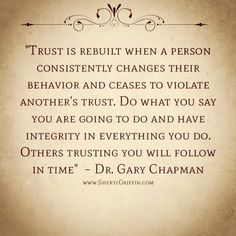 The author communicated that the woman needed more than the male character’s word that he was trustworthy — she needed more information to feel comfortable that the emotional wounds inflicted by the abusive father would not result in destructive, self-protective responses when their own relationship hit difficult challenges. In fact, the entire story was built around the fact that the male character had run and shut the female character out, at an earlier point in their relationship.
Personal, painful experience had taught the female character to be wary. She desperately wanted to trust, but experience had taught her a painful lesson and her own self-protective instincts were screaming that as hard as the male character was trying, trust damaged is not easily, and without evidence of change or misunderstanding, rebuilt. Fear and the instinct for self-preservation demanded more than unchallenged trust. She needed to know her trust was merited.
And this is that small nugget — the thought that struck a chord within as I read this work of fiction: This need for more evidence in the aftermath of deep wounds is not only normal but wise. Isn’t that what you, as a parent, would advise your child to do — Trust but verify? Is it then so hard to comprehend that the broken believer needs the same thing from God? Is it sinful? Personally, I don’t think so.
Eventually every Christian hears these words, “Don’t worry, trust God.” There’s absolutely nothing wrong with that advice, unless it is offered to someone who perceives themselves to be betrayed or abandoned by the God they are being encouraged to trust. 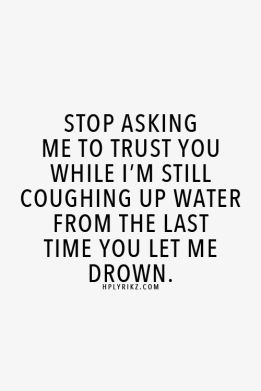 If that’s the case, the wounded Christian may very well be thinking, “Stop asking me to trust God while I’m still coughing up water from the last time He let me drowned!” Is it any wonder then that such advice is met with cynicism, anger, extreme frustration, ridicule or even abject terror? This biblical admonition heaps guilt and shame upon the struggling and broken believer.
The well-known phrase, Fool me once, shame on you. Fool me twice, shame on me!, comes to mind here doesn’t it? Self-preservation demands more than biblical platitudes. And lest that statement offends let me clarify before continuing. A platitude is defined as a trite phrase spoken as if it were profound or fresh. Synonyms for the word platitude include trite and cliché. The common theme in definition among all three of these words is the idea that a phrase has become commonplace and lost it’s effectiveness due to overuse. Can a Bible verse become cliché? Trite? A platitude? I think the answer is yes.
Oh, I can just imagine the hackles rising here, but please bear with me! Maybe the definition of those three words above should be expanded to include misuse as well as overuse. From my personal perspective, advice becomes trite when it is offered in a flip manner, without adequate thought or as a quick and easy fix to a complicated problem. And honestly, I am smart enough to realize that just because a verse has been overused or misused doesn’t make it any less true.
The real problem — what makes Bible verses about trust (in this case) into platitudes — is the failure to acknowledge that from the believer’s perspective, trust has either not been adequately established or for the more mature believer, trust is perceived as having been breached. Therefore, the admonition to trust God is both perceived as a criticism and an oversimplification.
Trust is developed over time. It’s the result of positive reinforcement — and damaged when it is betrayed or extended to someone prematurely or foolishly. I think, when a child is well cared for by its parents, trust is developed and the young mind assumes everyone is trustworthy. Life experience soon teaches the child that that assumption is invalid. Trust is eroded and less easily extended as we get hurt in big and small ways.
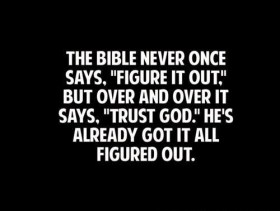 Yet the Christian faith appears to demand unconditional trust in the Savior we believe in but cannot see; cannot touch. It appears to demand that in the face of evidence to the contrary we hold fast to scriptures that seem to communicate the opposite of what life experience teaches us.
That word, appears, is really the key, don’t you think? Appearances are deceptive. Our culture is so driven by positive thinking that we gloss over the difficulties the Bible tells us will surely befall us and rush to the tail end of the verses that promise a positive outcome.
When we read Isaiah 40:31, ” . . . they that wait upon the LORD shall renew their strength; they shall mount up with wings as eagles; they shall run, and not be weary; and they shall walk, and not faint.”, we focus on the positive outcome of waiting upon the Lord. But I fear that we fail to recognize what this verse implies as we desperately cling to its promises. What this verse implies, but doesn’t explicitly say, is that the believer will find themselves weak and weary. Our strength need not be renewed if it is never weakened. Yet somehow, we interpret this verse to mean that we will never feel weak and weary, only that we will triumphantly mount up with wings as eagles! Then when we find ourselves weak and weary we wonder why or believe that we have somehow failed to live out our faith.
Likewise, Isaiah 43:2 says, “When you pass through the waters, I will be with you; And through the rivers, they will not overflow you. When you walk through the fire, you will not be scorched, Nor will the flame burn you.” When we read this verse we gloss over the fact that we will pass through the waters, through the rivers (fast moving current), through the fires. We overlook or maybe refuse to consider what it will feel like as we enter the waters and feel it quickly rising, threatening to overflow us and forcefully dragging us downstream. We fail to anticipate how it will feel when we feel the heat of the flames, smell singed hair and choke on the heavy smoke that surrounds us as we walk through the fire.
Instead we focus on the promise that God will be with us, that the waters will not drown us and the fires won’t burn us. It’s all stated without emotion as if fear, pain, discouragement and a multitude of other emotions won’t batter us in the midst of the flood waters and fiery flames of life circumstances. But the scriptures don’t promise that — they just promise God’s presence and protection from complete devastation as we go through those harrowing experiences. Ask the near drowning victim. Ask the individual who barely escaped without injury when a fire broke out in their home. Consider the Christian martyr; consider Paul who was whipped five times (39 lashes on each occasion), beaten with rods three times, stoned once, shipwrecked three times and spent 24 hours on the open seas (2 Corinthians 11:24-25) and imprisoned at least once. Were they unafraid in spite of the constant presence of the Holy Spirit? Doubtful, highly doubtful! More likely they were still terrified.
The Bible tells us to reason together with the Lord (Isaiah 1:18). To taste and see that He is good (Psalm 34:8). To try the Lord (Malachi 3:10), at least in regards to tithes and offerings. It doesn’t demand unconditional or unchallenged trust. God, by grace, gives us enough evidence to take that step of faith. *For further clarification on trying the Lord please read the notes at the end of this article.
 When faced with a believer who is grappling with difficult circumstances, who is afraid or discouraged, I, like every other Christian I know, struggle with how to respond – how to support and encourage. We want to fix the problem and when we are helpless to effect change we point them to the only One capable of pulling them through. We encourage them to trust God. But I wonder if that is the very last thing the hurting believer needs to hear. They, like the female character in the novel I mentioned above, need something more; more than unchallenged trust. The trust they had has been shaken by circumstances. They need more information; more knowledge and evidence to boost their confidence that their faith is grounded on a firm foundation and not built upon shifting sand.
I wonder if what the broken believer really needs to hear from fellow Christians is:
- A promise that prayers for either assurance or the restoration of their battered hope and trust in Christ will be lifted to the throne of grace.
- I wonder if maybe that struggling believer needs an acknowledgment that trusting God in their circumstances is not simply a matter of the will.
- That fledgling faith and perceived betrayal or abandonment results in shaky trust.
- That supernatural help is required to trust God more fully.
- That the believer’s need for more evidence that God is trustworthy is expected, entirely normal, and is no easy or simplistic feat.
And let’s be real here. The body of Christ is not strengthened when we refuse to acknowledge our doubts about God.
God is not afraid He will be found lacking. He’s completely confident that as we test our faith, as we reason together with Him, as we search to determine if He is good like He claims, we will discover He is all He proclaims Himself to be.
Life has taught me to expect disappointment, pain and suffering. It’s unrealistic to expect that I can simply ignore the lessons of days gone by and trust that God will not allow me to be hurt further. I need time to reexamine the evidence presented in the Word of God. I don’t think He is the least bit offended by that. And this is what I’ve discovered:
- What I need from God is the supernatural ability to rise above the pain and fear; not to believe in vain that more pain and sorrow will not befall me.
- That I don’t need encouraged to trust God more – I need to comprehend and make peace with what I can and cannot trust Him for.
- And I need supernatural help to find the peace that passes all understanding so that I can endure what lies before me without discouragement and despair — undefeated by circumstances and Satan’s mechanizations.
I think grace believing Christians still get tripped up in works related theology. I know I do. We think we are responsible for our spiritual growth. That if we just do the right things (practice the spiritual disciplines – Bible reading and prayer), acquire the right mindset (taking every thought captive, thinking on things that are pure and just, choosing joy) that we will overcome. And we are frustrated when we find that approach unsuccessful for ourselves and others. Intellectually we know we are dependent upon God to change us, but Satan’s deceptions woven into culturally ingrained messages have insidiously crept between the gaps in biblical knowledge within our hearts and minds. Truth has been perverted. Our beliefs have been infected with half-truths. And as a result . . .
We believe walking the walk equates to spiritual transformation.
We believe if we follow the prescribed formula, we will be successful at overcoming our problems. But that idea when boiled down . . .
Denies the very work and power of God in the lives of Christians!
That formulaic philosophy is grounded in works not faith. It disguises the truth that while we ascribe our spiritual well being to God we subconsciously restrict His participation as we try to solve our own problems; as we try to heal or improve ourselves.
Don’t get me wrong, there is great value in practicing the disciplines of the faith, however, those practices are the means by which we cooperate with the Holy Spirit in spiritual growth and maturity but they are not, in and of themselves, responsible for spiritual growth. Here is the truth . . .
- We cannot grow spiritually without supernatural intervention.
- Spiritual growth requires the work of the Spirit.
- Only the Holy Spirit can bridge the gap between our humanity and holiness in a process known as sanctification.
I don’t need encouragement to find a way to make myself do the impossible (heal myself).
I need prayer that God will do the impossible within me.
 I need fellow believers to recognize and acknowledge that healing will not come solely from activity on my part.
I need believers to tell me that they are praying for God to step in and do what I can’t do for myself, what no man, regardless of how strong willed they are, can do for themselves.
And frankly, I need Christians to verbalize (well, after I’m confident that they actually believe this) that unfinished healing isn’t representative of a failure on my part to cooperate with the Holy Spirit. Instead it means the Holy Spirit is still at work in my heart.
I wonder if those who read this blog think I might harp too much on the ill effects of the culturally popular positive thinking philosophy. But as my grief counselor pointed out to me Tuesday, the command to think upon things that are true and just, etc., is not at all a command to think positively or to dwell on only good things (which is exactly how I’d interpreted it). What’s true and just may not necessarily be good or positive.
I find myself at war within — cognizant that I am waiting on the Lord to do His work within my heart as I cooperate in those efforts, but simultaneously self-condemning — believing the cultural messages I’ve been raised with — that are ingrained within. The messages that say I can pull myself up by my bootstraps, that if I just apply myself I will succeed, that choosing joy eliminates sorrow. And while there may be a kernel of truth hidden within each of those messages, the success they promise is all predicated upon my works, not the power of God!
 Christians reduce the Word of God to a mere idol when we attribute spiritual growth to following biblical precepts while excluding the God who empowers that Word from the process.
Is that what I do? Is that what the Christian community of our generation does? Do we serve God ritualistically without humbling ourselves to acknowledge our desperate need of His personal intervention in our lives? Do we subconsciously deny or rebel against the power of God in our lives? Are we modern day Pharisees?
“These people come near to me with their mouth
and honor me with their lips,
but their hearts are far from me.
Their worship of me
is based on merely human rules they have been taught.”
~ Isaiah 29:13
I can’t effect true and real transformation in my life by the practice of spiritual disciplines in the absence of the supernatural work of the Holy Spirit. At best, I can create an elaborate facade that gives the appearance of transformation. There are things only the Holy Spirit can do. He, alone, is capable of transforming my life, thereby, increasing my trust in Him.
I wonder how I would have felt — what difference it might have made — if just one person had said to me, “Janet, you are going to have to trust God for Gracen’s health and future. But know this: spiritually mature trust is impossible without the work of the Holy Spirit in your life. Practice the spiritual disciplines to the best of your ability, but don’t beat yourself up when you find yourself afraid for the future, when you realize that you can’t force yourself to trust God by an act of your will alone. Understand supernatural intervention is required and it doesn’t happen overnight or even quickly.”
What would words such as those do for a broken or struggling believer?
What would they do for you?
*Notes on Trying the Lord
There is a fine line between trying the Lord, as in searching the scriptures to see what He says about Himself and trying the Lord by demanding that He prove to us He is worthy of our trust.
Got Questions?.org has a great article that discusses the distinctions between the two. And while the article says of Malachi 3:10 “This is the only situation given in the Bible in which God tells His people to “test” Him.” It later concludes that “The Israelites at Massah tested God because they lacked faith in Him. The Israelites in Malachi’s day were invited to test God because they had faith in Him.” (To read the article in its entirety, click on the following link: What Does it Mean to Test God?).
I am in no way advocating tempting the Lord. As a believer and disciple of Christ Jesus, I am coming to God from a position of faith. There’s an important distinction that must be drawn between coming to God doubting his power and character and coming to Him fully confident of his power and character yet confused because He didn’t behave as we expected. Are we not then trying our faith as opposed to testing God? (James 1:2-3)



 Walls have been erected.
 It’s 11:40 a.m.
 I feel like I’m sinking—sadness weighing me down—regardless of the medications I’m taking. Why can’t I overcome this? Is it possible that trauma causes bipolar disorder?
 I am very much aware of the painful emotions that accompany my past and current life circumstances. When I find myself confronted with “negative” emotions, I don’t allow myself the freedom to experience and work through them. No, instead I distract my mind from them primarily via fiction (emotional numbing) locking them to the far regions of my heart. I am constantly aware of the existence of this metaphorically locked box of emotions, but I refuse to open and cope with the contents. Shoot, I’m pretty sure the contents of that box are under so much pressure that the slightest move to open the box (maybe my next effort to shove new emotional turmoil into the box) will result in the contents being forcefully expelled like an erupting volcano — an apt description as rarely does a volcano erupt without prior warning and I’ve experienced years worth of prior warnings. Warnings that the pressure is escalating.
 The tension required to push those emotional realities away, to pack them into my own personal Pandora’s Box, is the tension that my emotional health is standing, or maybe in my case a better word is “balanced” or “teetering” upon. Like a car precariously balanced upon a cliff, one shift in weight forward without substantial counterweight will send the vehicle plunging over the cliff.
 On top of everything that implies, opening Pandora’s Box only allows past emotional trauma to be vented. How then, in this new weakened and vulnerable state, do I cope with the ongoing trauma progressive disease constantly thrusts upon me? Where is my shield of defense when the communication device or the stander is delivered? How will I cope with the installation and use of a tracking system in my home, let alone the day when it no longer makes daily life less physically taxing for both Gracen and I, but when it becomes a necessity I must use alone in order to properly care for her?
 The boxer in round ten is less capable of withstanding a body blow that was thrown with far greater force in round one. The boxer’s split skin, bruises, and broken ribs don’t heal between rounds. He just rests, catches his breath, gets his cuts taped up and smeared with antibiotic ointment while receiving instruction and encouragement to continue the fight.
 What will be my fate when the fight ends? Will God step in and call the fight? Will I find myself stretched out on the mat breathing heavily but defeated all the same or will I be doing my best to hold my hands up in victory when the final bell rings?
 I hope to be silently caught up in the air as God calls the fight or to hear the sound of the trumpet signaling the arrival of my Savior, rescuing me from this body of death and torment. But I fear I will continue to find myself stretched out on the mat breathing in the stale and bitter aroma of sweat and fear–yet another bout in my future, yet another beating to endure. Will I enter the ring the next time stronger and better equipped?
 On my more philosophical days, I have been known to think that I am far more blessed than those around me who seem to live lives devoid of tragic loss and health challenges. Truth be told, I’ve not found myself terribly philosophical in the two and a half years since Bethany and Katie’s lives were stolen by the selfish and reckless actions of an unlicensed driver. But I remember those moments in what feels like the distant past.
 According to John Powell, author of Why Am I Afraid to Tell You Who I Am? the two major causes of anxiety are supercharged repressed emotions and unmet emotional needs. Emotional needs include the need to feel accepted, approved of, believed in, forgiven, listened to, needed, important, useful, respected, valued, supported, understood, in control, trusted, and worthy to name a few. The cultural demand to overcome, to turn every negative into a positive promotes and encourages the unhealthy practice of ignoring emotional needs and repressing negative emotions.
 Given the opportunity, I would rewrite the story of my life. But in the recesses of my mind, the storm clouds of sorrow shift and briefly reveal the truth that hides behind; losses and sorrow have gifted me with things of great value. Empathy, compassion, and understanding poured out on others in an effort to help meet their emotional needs. The assurance of my salvation and an awareness of the solid foundation of my faith even as it is battered by the storm. The development of a more holy and heavenly perspective. And then the wind picks back up shifting the storm clouds once again obscuring those encouraging truths. And I am left frustrated and discouraged instead of philosophical; feeling more cursed than blessed, desperate to escape the suffering that plagues my daily existence and longing for unicorns and rainbows.


 Today is my one and only son’s birthday. If you read my Father’s Day post you know that he was, in the terminology of the latest trend, born still—a cord death. Cole did not die on the day of his birth. I always knew that. David and I were drawn to the hospital because I quit feeling him move. But even I didn’t know when he actually died.
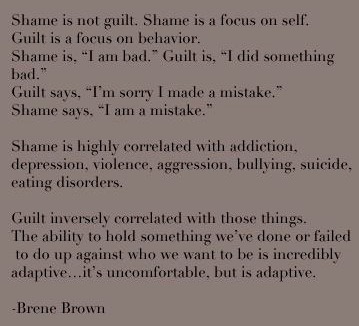 I knew with certainty then that I felt my child dying. The cord that was wrapped once around his arm and twice around his throat tightened suffocating him as he thrashed, fighting for his life. That devastating moment began the completely irrational guilt and shame cycle I struggled to overcome for years in spite of knowing full-well that had I understood what was happening, I would not have been able to save him. There was no way to get to the hospital, to have my son delivered, before his death. No possible way.
 “This hand is bitterness
 Boxx Banter