RSS

Author Archives: Janet Boxx

Unknown's avatar

About Janet Boxx

My name is Janet Boxx. I earned a Bachelor's of Science degree from Northwest Missouri State University before working at Mark Twain Bank and then Sprint. Following the birth of my fourth child, I left the business world to focus my attention on raising my family. In my lifetime, I've been inducted into two communities no one wishes to gain membership in; the special needs community and the bereaved parents society. I'm a wife, a mother and a follower of Jesus Christ. Like many of you, my life has not been a walk in the park. It's been challenging in a number of ways and has caused me to examine my beliefs, almost everything I thought I knew about God, with what His word actually says about Him. I'm comfortable with my struggle, but well, I'm afraid that other believers may not be comfortable with my confrontational approach as I question and search for understanding. I am in desperate need of real answers, real truth, and am a big believer in authenticity. Therefore, I'm not known to "drink the kool-aid" so to speak. I hate platitudes and simplistic answers to complicated issues. I believe the Bible is the inspired, infallible word of God, and that every word is "profitable for teaching, for reproof, for correction, for training in righteousness" just as 2 Timothy 3:16 proclaims. Heaven knows I don't always get it right, and at times I concede that I cannot find an answer, and choose to trust that the Holy Spirit will reveal it in time or that He will enable me to find peace in spite of my questions. As a result, I'm open to others questioning my conclusions, I just ask that they aren't worded as an attack but instead by pointing me to another scripture and asking me to consider it in light of the conclusions I've drawn. A little background may help you understand my blog posts, so here is my life in a nutshell. I married my husband, David, in 1987. Our son, Cole, was stillborn on Father's Day, June 21, 1992. We went on to have three beautiful daughters. Bethany was born in November of 1993, Gracen in December of 1995, and Katie arrived in October of 1997. We noticed some developmental concerns when Gracen was about a year of age. Katie developed similar issues around her first birthday as well. Their physical issues were minor and the pediatrician was not concerned. But as Gracen and Katie grew, the physical issues became more pronounced, affecting both their fine and gross motor functions which impacted daily life and learning. Fifteen years and multiple and doctors and tests later, in the spring of 2012, we finally received a diagnosis. Gracen and Katie had been born with a rare form of Muscular Dystrophy. ARSACS is a progressive neuromuscular disease. The prognosis was not pretty and we were devastated. I had so hoped a diagnosis would lead to a cure - a medication or treatment that would give the girls a normal life. During that fifteen year time span, Gracen also developed chronic daily migraine headaches. Life was challenging to say the least. The day after Christmas 2013, life got harder. As we returned home from celebrating Christmas with family, our van was involved in a three-vehicle collision. Bethany and Katie died that afternoon. My first blog post was written a few months later, in March of 2014. I've edited that post in order to correct minor details that I was unaware of when it was originally written and posted on Facebook. Otherwise, it remains as it was. My hope is that my posts will serve to validate the feelings of others who are struggling with difficult circumstances and trying to assimilate their feelings and beliefs, as they too, try to hold on, get through, and avoid bitterness. So welcome to our world. Join me as I continue to live life in the Refiner's fire. In and out I go as God allows the dross to rise and be swept away until He can see His reflection as He looks upon me. Please share your thoughts (speaking the truth in love) and let iron sharpen iron as we banter back and forth as we each struggle our way through this life until God calls us home. Janet

Canine Nesting: The Circling Mind

dogcircling

(Written mid-March 2015)

I awoke again to thoughts circling my mind as I feebly try to wrap my heart and mind around all that has happened in the last 14, almost 15 months.

Have you ever seen a dog settle down to take a nap?  The dog picks his spot them circles and circles and circles before settling into place.  At the first noise or distraction the dog pops up investigates and then picks a new spot repeating the process.  Circle, circle, circle, settle.  That’s pretty much how my brain works – restless fidgeting – circling around and around in an attempt to wrap my arms around all the facts so that I can process them and finally be done with them.

But there is no resolution – there will be no resolution – and maybe that’s the hardest thing of all to come to terms with.

Which leaves me with this truth . . .

My problem is with God.   Not the impotent prosecutor.  Not the foolish judge.  Not the ignorant man-child who placed me in this situation.  No, my problem goes straight to the top.  To the highest authority in all the world.  My problem is with God, Himself.  And how do I feel about that?  Well, this picture captures my current relationship with God quite well:

halt1

My hand extended before my body in the classic signal for “Stop!  Don’t come any closer!”  I haven’t walked away from Him, I simply cannot beckon Him closer.

I know God loves me, know He wants to comfort me, and know that I want His comfort and yet, right now, right now, His love just hurts.  His plans hurt.  His ways hurt.  His love for the lost hurts because He has allowed my children to die, He has allowed this pain, and will allow me to suffer again in order that my faith is refined and revealed, so that the lost will be saved, and that He will be glorified, all at the expense of my fragile, already broken heart.

It’s easier to mentally attack the humans involved than go rounds with the Lord Almighty. After all, God is always right.  His plans are always for my good and even the bad things He allows work for good for those who love Him and are called according to His purposes. There is no arguing your case or winning an argument with the Lord God Almighty, as Job discovered.

And so I fruitlessly continue the canine nesting ritual in my mind.  I continue shuffling through the events of that tragic day.  I continue circling round and round the behavior of the prosecutor, the judge, the man-child who swaggered into court.  All before turning my attention to the Lord in a conversation that goes something like this:

Me:  I’m mad at you. You hurt me.

God:  I know you’re hurt.  I know you’re angry.  I want to help you.  I want to comfort you.

Me:  Stay back!  You will just comfort me and then allow me to be hurt again.

God:  The hurt I allow leads to your ultimate healing.

Me:  I don’t want healed.  I just want my life back!

God:  There’s no going back.

Me:  I know that.  I hate that!  I don’t want to be here anymore but I can’t leave Gracen. She’s burdened by that knowledge.  She wants me and doesn’t want me at the same time. She loves me and resents me.  Only time and maturity will change that, but it hurts me to experience it and I’m afraid she might never quit resenting me – that we will never have a good mother/daughter relationship.

God:  She feels about you the way you feel about me.  You want me and don’t want me. You love me and resent my authority in your life.  Time and the Holy Spirit can and will fix the brokenness within you, but your terror of the personal cost of discipleship and spiritual healing wars with your anger over the direction my sovereign authority has taken in your life.  You want to feel my love and presence but at the same time you are terrified of me.

Me:  I don’t know what to do to change that.

God:  First, you can’t do it by yourself. You were never intended to.  But you do know what to do. You do know what steps to take.

Me:  Study Your Word and pray.

God: Yes, but your anger and hurt leads you to resist and you also know those things are not enough.  You know you can’t fix your problems with a formula.  You know that you have to allow the Holy Spirit to do His work within you and you know that doesn’t happen overnight.

Me:  I don’t know how to release the anger and hurt, especially knowing I will be hurt again.  I feel as if I am standing in the middle of a fast moving stream and the current is forcing me in a direction I don’t want to go.  I’m resisting yet I keep getting pushed forward.

God:  That fast moving stream is my will and I’m fully aware you don’t want to go where I’m taking you.

Me:  I really, really don’t want to go there.

God:  I’ll be with you.

Me:  That doesn’t make it hurt less.

God:  It does, it’s just that you no longer know what desperately alone feels like because I’ve been with you for so long.  To truly be alone feels much worse – you’ll have to trust me on that.

Me:  I still don’t know how to surrender my will to yours.  I still don’t know how to let go of the hurt and the anger.

God:  I’ll help you with that.  I’m already helping you with that.  It’s a deep wound.  Deep wounds take a long time to heal.  You just now found words to express what you are feeling.  It’s a step in the process.

Me:  The process sucks!

God:  Yep, fortunately, I have perfect patience.  You on the other hand, not so much!

Me:  A sense of humor?  Now you show a sense of humor?

God:  Hey, laughter is a good medicine, I designed it that way, and my timing is perfect.  You would have resented it if I had displayed it earlier . . .

(Feel free to call it my imagination, or call it God speaking with me.  Draw your own conclusions, but, I will say that things were revealed in my thoughts above that I was not consciously aware of prior to this time.)

Flash forward to December of 2015 and you will find that my hand is no longer extended before the Lord demanding that He stay back and give me space.  I have resigned myself to what I knew all along; that God alone can help me through this living nightmare.   We never stopped speaking, but there were things I refused to bring before Him.  There are still things I hold back.  I’m far from healed, far from OK even.  Over the last two years I have repeatedly asked the Lord, “What do you want from me?”  And instead of silence I hear a quiet, one word response.  “Rest.”

He’s not once reminded me of His sovereignty, as He did Job.  He’s never scoffed and told me to quit throwing a pity party.  He’s not demanded that I stop grieving and count my blessings.  He’s never once told me not to be afraid.  He just quietly encourages me to rest which I’ve found much harder to do than one would expect.  Resting requires more than slowing down and sleeping in.  This rest seems to include finding a way to be completely still before the Lord.  So the canine nesting ritual continues and I try to learn to rest.  But, even now, there is no condemnation from my Savior, for which I’m profoundly thankful.

 
2 Comments

Posted by on December 14, 2015 in Faith, Grief


Tags: , ,

Trauma Momma?

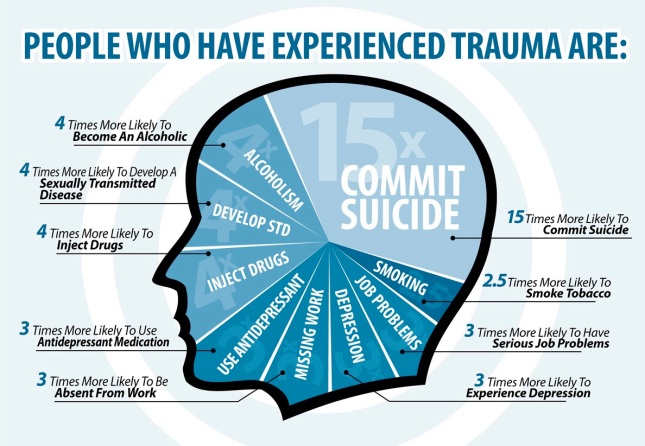
IMG_4279I haven’t wanted to talk about trauma and how it impacts an individual; those who grieve in particular. I haven’t wanted to go there primarily because of the reaction one receives if they try to talk about it; skepticism. I’m not sure if people think they can simply look at a person and tell they are dealing with the after effects of trauma, or if they simply don’t believe it happens to people outside of the military and first responder communities. Who knows? The truth is we all experience trauma; usually in small, manageable degrees. Generally we ride it out, push through it, brush it off and move forward and beyond it. We remain standing and to the outside world appear largely unscathed. But sometimes we experience trauma of a far greater magnitude. Below are the sobering statistics of how people are affected by trauma:

Traumatic experiences may or may not result in PTSD – Post Traumatic Stress Disorder. The general public understands little about this disorder. I understood little about PTSD and am slowly learning how it might impact an individual. What little people do know about the disorder has come from TV and movies and is usually, and justifiably so, attributed to military personnel who have seen and experienced frightful & life-threatening situations. Combat related PTSD generally results in the most severe effects and can dramatically alter an individual’s every day existence.

PTSD, like many other conditions, can be experienced in mild, moderate, severe or extreme forms. What most people don’t understand is that it can develop in an individual who lives in a continual state of heightened anxiety (soldiers on patrol who’ve never seen combat, individuals, especially children and family members who cope with life-threatening illnesses such as cancer, parents of special needs children, individuals who live in high crime neighborhoods or who have become refugees due to war or natural disasters all qualify) or PTSD can result from a single traumatic event.

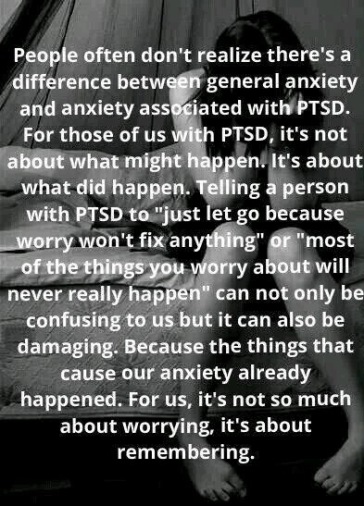
If you asked a random group of people to describe the symptoms of PTSD, I imagine the single most common response would be the occurrence of flashbacks. A heightened sense of situational awareness is another common symptom of PTSD and I believe, the general public is vaguely aware that sounds, smells, and images can trigger disproportionate responses in those who suffer with PTSD. Less understood are the more subtle ways in which people who have experienced trauma internally process their experiences and the ways in which previous trauma changes an individual and therefore, how they cope with subsequent traumas.

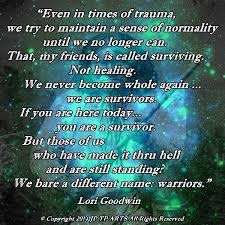
Shock is an additional component closely related to trauma. One thing I didn’t understand about shock was the duration of time an individual might live and walk through life under the influence of shock. I didn’t understand that disassociation, a means of separating oneself from the events until one is capable of dealing with them, is what long-term shock looks like.

There was and continues to be a lot I don’t understand about shock and trauma. For one thing, people are amazingly resilient and for another, every individual is unique and can respond and react to the same trauma in unique ways.

So what kind of symptoms are commonly seen in individuals who suffer from PTSD?

*Extreme reactions (emotional and physical) to sights, smells or sounds (triggers) that remind the individual of traumatic events

*Avoiding people, places, and conversations related to the trauma

*Avoidance behavior designed to escape thoughts, memories and heightened levels of anxiety, abuse of alcohol, over-the-counter or prescription drugs, watching TV, spending time on the computer or reading excessively; anything that numbs pain or distracts the mind

*Experiencing feelings of emotional numbness or detachment, lack of interest in things previously enjoyed, guilt and blaming of self and others, depression

*Inability to concentrate, irritability and/or angry outbursts, difficulty sleeping

*Panic attacks involving intense fear, heart attack symptoms including chest pain, numbness, tingling, dizziness, shortness of breath, shaking, sweating and hot flashes

*Nightmares about an event

*Flashbacks (visions of a traumatic event where the individual feels as if they are reliving the experience while awake)


Aside from combat exposure, what kinds of trauma can precipitate PTSD? Surviving or witnessing situations involving extreme stress such as physical or sexual assault, natural disasters, torture, imprisonment, accidents and the sudden or unexpected loss of a loved one. Law enforcement officials, firefighters, paramedics, and medical professionals frequently deal with traumatic situations that make them vulnerable to PTSD.

Simply surviving traumatic experiences puts a person at risk for developing PTSD. However, most people will not develop the condition. Experiencing extreme fear or helplessness during the traumatic event, seeing others injured or killed, isolation after the event and dealing with additional stress such as pain & injuries, loss of a loved one, home or job, and a history of mental health issues all increase the risk of developing PTSD. Women are twice as likely as men to develop the condition.

There are several ways to lower the risk of developing PTSD. Support from family, friends, support groups and developing a coping strategy are chief among them. Surprisingly, how well an individual personally believes they responded during and immediately following a traumatic event or through the course of a series of lesser traumas plays a role in the development of PTSD. If an individual is able to act in a manner they perceive as effective during the traumatic event, if they feel good about their response in the face of danger, they are less likely to develop PTSD.

More than a year after the collision I received a CD from the McDonald County Dispatch Center of the 911 calls and the coordinated emergency response efforts related to the car wreck my family was involved in. It was disconcerting, to say the least, to hear my shrill voice in the background of two of the 911 calls reporting the accident. There was a definite tone of hysteria in my voice. However, the first emergency service provider who arrived on the scene, the Pineville Fire Chief, Gregg Sweeten, told me that when he approached me at the side of our minivan where I was kneeling and supporting Gracen’s head and shoulders, he thought I was a bystander who had stopped to help and had no idea that I was a passenger in the vehicle, let alone Gracen’s mother.

The grief counselor I see asked me how I felt about hearing that I was not initially identified as a victim. I hadn’t really thought about it from that perspective but I’m glad she asked because it led me to analyze my feelings. It helped me to realize that overall, I feel good about my response in the aftermath of the motor vehicle accident. There are things I wish I had the wherewithal to do, such as checking for a pulse or deciding if CPR should be started.  But, I am thankful that I didn’t become hysterical to the point of inactivity or worse by far, to the place where my behavior prevented Gracen, David and O’rane from receiving needed medical care.

I’m glad I was able to help a bystander locate O’rane’s bag so the hospital would be aware of the medications he was taking.  I’m glad I was coherent enough to explain to David’s mother the scope of our accident quickly over the phone. I’m glad I was able to tell the paramedics that Gracen is allergic to penicillin, to verbalize the medications she takes and the name and nature of her disease so the medical team might know about potential drug interactions, etc. Had I fallen to my knees screaming out my agony and despair emergency workers would have been distracted from caring for Gracen, and frankly, her life hung in the balance at that point in time.

I am beyond grateful that I was able to hold it together so that she got much needed medical attention and that I am not left with the suffocating knowledge and guilt that would have surely destroyed me had my reaction in the moments following the collision resulted in a failure for Gracen to receive prompt medical care resulting in her death.

I can’t say I’ve handled every traumatic experience in the way most beneficial to my daughter. There were moments when pain was not well managed well and I escaped Gracen’s hospital room, in effect abandoning her to the care of the medical staff and leaving David or my sister-in-law, Sandy, alone in the room to cope with this new trauma. How does a mother, or a father for that matter, determine if staying with their child when they are personally falling apart is more harmful to their child’s psyche than leaving the room so that the child doesn’t carry the burden of their parent’s despair along with their own? All I know for sure is that had another family member not been present, the staff would have had to drag me out before I would have left Gracen alone regardless of my state of mind.

Several years ago, I was driving home from dropping Gracen & Katie off at school when I heard a news report on the radio. The report stated that research had shown that long-term care givers were among those who suffered from PTSD due to the constant anxiety. I remembered thinking at the time, “I wonder if I have that?”

Looking back, and having become aware of lesser known symptoms of PTSD, I can see that not only was I actively practicing classic avoidance behaviors but that both Gracen and I were exhibiting emotional responses common to those who suffer from PTSD long before the collision that so impacted our lives. Observing the physical changes related to Gracen’s disease, coping with chronic daily migraines as well as complicated migraines coupled with painful medical tests, fears related to safety and an uncertain future took a toll. The most painful of which is the realization that the avoidance behaviors that allowed me to continue to perform day to day tasks while enduring the unrelenting anxiety also resulted in distancing myself from greater intimacy with my daughters.
IMG_4284

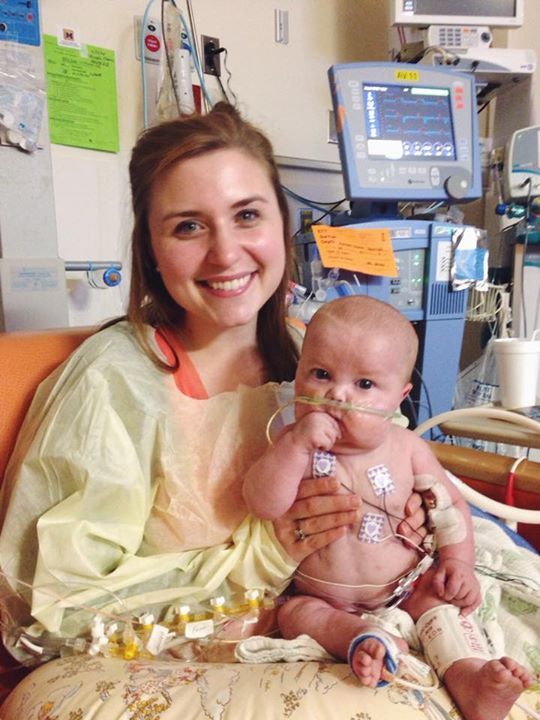
Avoidance behaviors serve to insulate your heart from further pain and are a form of psychological protection. For example, consider the mother of a child who is undergoing cancer treatment. You may find her consistently present in her child’s hospital room. She brings a book or her tablet to occupy her time while her child sleeps or during times when her child is undergoing tests she can’t be present for, such as an MRI. As her child’s condition worsens you may notice that during times when her child is awake the mother may still be consistently present, may meet every physical need but personally engages less frequently. She may play with her smart phone while her child watches a movie instead of watching with them. She may read while her child colors a picture instead of coloring with them. She slowly and without conscious awareness, disengages from personal contact. The behavior that grants her a distraction from her worst fears and the lack of control also creates an emotional disconnect that is nothing short of emotionally devastating when she becomes aware of them.

This is the face of PTSD.
IMG_4280Rarely can you identify an individual who is coping with PTSD by simply observing their behavior. Unless you are present when they encounter a trigger, have a flashback or wake up screaming in the middle of the night, PTSD can silently hide beneath a veneer of socially acceptable behavior.

Even when someone suffering from PTSD encounters a trigger or experiences a flashback you may not recognize the trembling hands, the internal panic, the flinch as gruesome images assault their minds. When they drop out of normal activities you may simply think they are grieving instead of recovering from a night without sleep or filled with nightmares. And how many people are privy to the methods of distraction utilized or the inability for those affected to perform simple tasks like returning phone calls, making appointments or paying bills?

Then shame takes center stage causing the individual to castigate themselves for all they can’t control or accomplish without understanding why the lesser known symptoms of PTSD are plaguing them. Unless they’ve seen a counselor they may not even know they have PTSD.

And of course, depression plays an active role as well. There’s also a difference between a mild or moderate case of depression and full-scale clinical depression. While the symptoms of mild and clinical depression are the same, the intensity of the feelings and the degree to which everyday life are impacted differ greatly. Common symptoms such as a change in sleep patterns (either sleeping too much or too little), new eating habits (evidenced by weight gain or weight loss), sadness, and a complete lack of motivation abound.

Outsiders look in and can’t understand why this person declines invitations. Why they don’t return to normal activities, get a job, or do any number of other things in order to help themselves never realizing the extreme melancholy, fatigue and shame often prevents them for taking the initiative to do anything. It takes too much energy or exposes their vulnerability to the outside world. Both are adequate deterrents by themselves.

Who wants to admit they are clinically depressed? Aren’t those people in institutions? Who wants to confess to struggling with PTSD? Isn’t that just a bid for attention? Who wants to admit that simple things are much too difficult – that they can’t quite cope – that they aren’t enough – that the awareness of their utter lack of control is terrifying?

Where is your faith, one might ask? Right where it always was, solidly grounded in my Savior, Jesus Christ. Then why can’t you trust in His loving care?

Consider Isaiah 43:2 with me.

“When thou passest through the waters, I will be with thee; and through the rivers, they shall not overflow thee: when thou walkest through the fire, thou shalt not be burned; neither shall the flame kindle upon thee.”


We like this verse because we concentrate on God’s promised care. But it seems to me that we only meditate on the “good” parts of the verse. We focus on the fact that the waters won’t overflow is, the fire won’t burn us or kindle a flame on us and that God will be with us, but we overlook or ignore the less desirable truth this verse reveals. We will be in deep water fighting to keep our heads above the surface. We will walk through the fire. And God will be with us – but we will still feel the water rise, we will still feel the heat of the flames. Experiencing PTSD and/or depression are not evidence of a failure to trust God, they are simply normal responses to trauma. PTSD, depression and anxiety, represent the deep waters and the firery flames of life’s tribulations. So we’d do well to recognize that it won’t be easy in spite of God’s presence. Additionally it will likely take a great deal of effort to try to respond in a Biblical way. Thankfully, there is love and grace and mercy when we stumble or outright fail to behave as we believe or expect we should.

There is hope of healing. Hope in making peace with an unknown future when experience has taught us that it will be painful. There is hope that we will exit the firery furnace without the stench of bitterness clinging to our hair and garments. There is hope that shock, depression, anxiety and PTSD will not define us but instead refine us, but oh, it’s a slow and painful process and we need to show ourselves grace along the way.

My personal prayer is that I will lower my self-imposed expectations. That I will be oblivious to the expectations and perceptions of others and that I will find overwhelming comfort in the unfailing presence and love of God, because the spirit is indeed willing but the flesh is oh so weak.

 
4 Comments

Posted by on December 3, 2015 in Adversity, Faith


Tags: , , , , ,

Graceful Gratitude

grace2

Thanksgiving started early for me this year. 2:15 a.m. to be exact.  That’s the time my cell phone rang alerting me that Gracen was in need of some help.  Following her call, I hurried to the bedroom next door to find Gracen flat on her back, thirsty, hot and trapped under her covers with her knees bent and sore.

I peeled her covers back and removed the new knee-high AFOs (Ankle/Foot Orthotics) she now wears to bed nightly. Then I helped her to straighten her legs out by pulling her ankles toward the end of the bed and simultaneously pushing down on her knees one at a time before getting her some water.

Through all that, she accepted help without one complaint, in spite of the fact that I slept through two text messages before she called my cell.

Then I kissed her goodnight for the second time and crawled back in bed hugging my pillow to my chest; and I thanked God for Gracen’s attitude and for the grace she demonstrates in the face of debilitating disease.

As I lay still waiting for sleep to once again overtake me, I absorbed the most recent physical changes in Gracen’s body.  It hurts to watch her body continuously fail her.  And I thought about gratitude. One thing I’ve found in the face of the deaths of my oldest and youngest daughters, Gracen’s injuries and progressive disease is that others, in sincere compassion, try to make me feel better by reminding me of the many blessings in my life.  It’s almost as if people believe that counting your blessings negates your sorrows; which is categorically untrue.

Gracen’s diminishing physical abilities actually set the stage for thankfulness for it is in light her losses that I find myself grateful for much simpler things.  In the wee hours of Thanksgiving morning I found myself thankful for my graceful daughter precisely because she has every reason in the world to be angry and resentful.

The point I’m trying to make is that gratitude is experienced in contrast to those things for which we are not thankful.  Andrew Downs said it far better in his book  Alex Hollick:  Origins:

“To walk in the shadows is not a curse and to walk in the sun is not a blessing.  They are simply relative points of harmony, by which we can appreciate what we have, what we once had and what we hope to have.  The sun means nothing without the shadows, nor would shadows without the sun.”

So, by all means, count your blessings; but don’t beat yourself up for the normal emotions that arise from trials and loss.  God doesn’t tells us to suppress our emotions.  He tells us to bring our burdens to Him and when we do, gratitude will likely follow as we witness His care and provision.

 
1 Comment

Posted by on December 1, 2015 in Chronic Illness, Faith, Grief


Tags: , , , , ,

What is the Value of a Child’s Life?

Silhouette, group of happy children playing on meadow, sunset, s

I recently recognized that a series of issues I’ve been struggling with all have one theme in common.   The thing that ties each of these issues together boils down to the worth of my children.

Death seems to strip an individual’s value from them in the eyes of the world.  Daily life moves forward and it’s not long before the phrase, “Out of sight, out of mind”, applies.

What is the value of one child’s life?  To their parents, their siblings, their extended family, their circle of friends and acquaintances, to the community they lived in and even to the world at large?  It doesn’t take a genius to figure out that their value generally diminishes as you go through the list.

The grieving long to have their loved one’s worth acknowledged, appreciated and validated beyond the funeral and burial, beyond the first week they return to work, beyond the year of firsts, beyond . . .

This bereaved parent questions her own value as well – to God in particular.  I wrote this quite awhile back.  It’s a prayer of a sort, and deeply personal, but it clearly reflects how circumstances can cause a person to contemplate their significance.  Keep in mind that my first child was stillborn, then I lost two in a car accident, and my surviving child has a rare and progressive form of Muscular Dystrophy.  I’ve taken a series of hits.

“Am I so much more expendable than other Christians?  Do my hopes and dreams mean so much less to You?  From a logical perspective I know the answer to those questions is no, but from an emotional perspective I’m not so confident.”

“Why do You keep hurting me or allowing me to be hurt?  Do I just suffer well for the cause?  Am I too stubborn or rebellious to learn the lessons you want to teach me without suffering?”

Value and worth, it’s a struggle I see other parents who mourn wrestling with.  Support groups, blogs, and Facebook posts are filled with the underlying theme.

Some make a shrine of their child’s room.  And the outside world shakes their heads in pity – failing to understand why.  Honestly, the parent may not be able to put into words why they do it themselves.  But their child’s possessions are a visual, touchable testimony of both their existence and who they were below the surface.  That room and the pictures they treasure, are often all the parents have to hold onto.  They’ve lost their child and cling to the things they loved and touched in their absence.

And really, if you think about the alternative, can you blame them?  Does anyone really think about the emotional price a parent pays when they sort through the remnants of their child’s life?  Do they realize how it feels to decide what to give away – and who to give it to?  What to keep.  What things most effectively reflect the child they loved.  What to throw away; now that, well that’s the nauseating one.  Disease or accident, murder, suicide, or addiction,  military or public service, has snatched their child from their hands and now they feel as if they are choosing to throw away their child, bit by excruciating bit.  Maybe the shrine makes more sense now.  It’s not shameful, it’s nothing less than a grieving parent defiantly refusing to toss away the evidence of their child’s life.  It’s all about value and worth.

Almost two years after the collision that killed my daughters, I am still sorting, still deciding what to keep, what to give away – what to throw away.  Granted, I was caring for Gracen, but I’ve had time to complete the task.  Every once in awhile, I open the doors to the two rooms that hold the things my children once touched and I make value judgments until my heart can tolerate it no more.

Some parents set up foundations in their child’s name for a cause their child was passionate about or to raise funds or awareness for the disease or tragic circumstance that took their child from them.  Those foundations meet needs, keep their child’s memory alive, and validate their child’s worth.  And some parents stand jealousy on the sidelines because their child did not live long enough to discover their purpose and passions.  There will be no foundation and their child will all too quickly be forgotten, overlooked, or intentionally left out for fear of reminding the grieving parent of their death.  Personalized gifts will not include their name, you will be introduced as the parent of one less child – and the parent of a stillborn child will not be asked about their child’s birth weight and length; all in the name of compassion.  It’s not always true that actions speak louder than words.  It’s amazing how loudly silence speaks.

Polite society encourages the family to let go, move forward, have another baby, take in foster children, adopt, and of course, be thankful for the children you have left; unwittingly conveying the message that the child you lost no longer has significance and that continued grief equates to a lack of appreciation for those you still have.

And the grief-stricken parent fights the war within; attempting to reconcile the worth of their child between the messages they receive from society and the intellectual truth that their child’s worth never stemmed from their accomplishments but from the fact that they were theirs and created by God.

The grieving parent is begging – demanding really – that society validates the worth of their child; their contribution, their significance in this world; regardless of their length of life.

I’m not sure any parent passes through the grief process until they either “feel” the validation they crave (because a small group of people do just that) or until they resign themselves to the real truth – that it is enough if they alone recognize the worth of their child in this world.  The battle within has been won, the enemy defeated by love – the love of God and the love of the parent.  The only thing the parent needs to let go of is the desire to have their child’s worth validated by society.  However, that’s easier said than done.  Knowing what needs to be done does not make it easy to do.  The heart wants what the heart wants, and it’s a process that’s mastered one painful step at a time.

 
4 Comments

Posted by on November 18, 2015 in Grief, Muscular Dystrophy


Tags: , , , ,

Thanksgiving 2015

imagejpeg (8)

This Thanksgiving we will return to Kansas City as we have for the last ten years. Every time we choose to go “home”, we pass the accident site twice. In fact, we rarely drive north unless we are heading back to see family and friends. The crosses usher in a heighten level of anxiety for the painful moments that are simply unavoidable. And the return trip heralds in memories of where it all went so wrong. To say I need to emotionally prepare myself for these trips is an understatement of gigantic proportions. But staying home – being alone in our unnaturally quiet house – is exponentially worse.

Gratitude and grief co-exist within my heart. Therefore, this year I plan to allow myself permission to do something I’ve never permitted myself to do in the past. If I feel overwhelmed, if the sight of healthy intact families, and bright futures pinch just a bit too much, I will slip off and ensconce myself in the room we make use of when we are in town.

I will not make myself be strong when I feel weak as I have done in seasons past. I will not force myself to wear a mask in order to make others comfortable in my presence. I’ve long been aware that I’m not responsible for how comfortable others feel with my grief, at the same time I’ve always assumed responsibility for shielding others from my emotions, for their sake and mine.  Frankly, an open display of my vulnerabilities is abhorrent to me. In the past I’ve felt as if leaving the room was just as bad as crying in public. Doing either draws attention and leads people to talk. Now, I’m just tired. I also realize that it’s not unreasonable or shameful to remove myself from a situation in which I’m uncomfortable. To remain, to pretend good cheer, that’s a burden too great for me to bear and this year – I just don’t have the energy.

Small talk is chief among my personal anxieties. I can talk about Gracen. I can talk about David; but I cannot talk about myself. I have absolutely nothing to share. So if conversation stalls, I will remind myself that I am not individually responsible for keeping the conversational ball in play. If asked questions that are awkward, I will, for the first time ever, say, “This is not a good time to discuss that.” or “I don’t want to talk about that.”

Deflection, a highly valuable social skill, is not one I’ve ever become adept at using. Over the years I’ve been put on the spot and found myself exposing vulnerabilities to family, friends or mere acquaintances to my personal detriment. In the coming weeks I will practice simply not answering a direct question by responding with a question of my own.

Grief is teaching me a world of useful and unexpected lessons and fiction has provided a multitude of examples from which I intend to draw. (I knew I’d eventually uncover a completely reasonable excuse to justify the inordinate amount of reading I indulge in.)

Most importantly, I will remind myself of this truth:  Honesty does not require transparency; nor does it require vulnerability. It is my right to choose both when and what I feel comfortable sharing and with whom I wish to be transparent and vulnerable.

I don’t want attention or pity: I want privacy and understanding. I don’t want others evaluating how I’m doing based upon their personal perceptions. If asked, I’ll share what I’m comfortable sharing and hope if others later inquire, that no more than what I’ve shared will be disseminated. Anything more is little more than fodder for gossip.

I will never forget how gutted I felt when I bumped into a friend following the death of my son and she said, ‘I heard you weren’t doing very well.’ What was worse was realizing that the person who reported on my well-being had never asked me how I was doing; they simply watched me and drew their own conclusions.  Gossip hurts.  While long forgiven, and completely beyond my control, I remain hypersensitive to how I am portrayed to others. It’s my reputation and it’s my heart that suffers for idle words spoken.

While the things above may seem simple to many, they are challenging for me. So this year, I will keep the commitments I’ve made to myself and will do my best to let go of the things I can’t control. There is grace and forgiveness for those things.

Of the many things for which I’m thankful – the blessings among the thorns, I’m most grateful that I still have David and Gracen. However, I dread that moment that often occurs at Thanksgiving gatherings when asked to share that for which we are thankful. To express my thanks for my husband and daughter draws attention to those who are missing. It’s awkward – for me and for everyone else. While grief may overshadow my gratitude, that doesn’t mean I don’t recognize and appreciate my blessings. So this year, I will give thanks, but I might not have a happy Thanksgiving. Contrary to what the Veggie Tales teach, a grateful heart is not always a happy heart; and that’s OK, gratitude is sufficient.

 
2 Comments

Posted by on November 16, 2015 in Grief


Tags: , ,

Bethany’s Song – A Tribute Video

This video is a tribute to Bethany Boxx. Bethany was my son’s best friend and the love of his life. Our family loved Bethany very much and she is terribly missed. Bethany and her little sister Katelyn’s lives ended way to soon in a needless traffic accident caused by a reckless driver, driving without a driver’s license. The song is written and performed by Emma Nilsson who wrote this song as a tribute to the positive, strong, smart, beautiful, young Bethany. Our hearts goes out to the Boxx family, Alex Nilsson, and everyone who knew Katelyn and Bethany. They will be missed and never forgotten. Rest in peace. — Jakob Nilsson

 
1 Comment

Posted by on November 2, 2015 in Links, Music


Tags: , , , , , , , , ,

Metamorphosis

image

Larry Howard Jones, who served as the Music Minister of our church in KCMO, always shared the best illustrations about matters of faith when he taught the College & Careers class.

I remember him telling us that at the point of salvation God sees the new believer through Christ’s righteousness. That we could picture ourselves clothed in Christ’s pure white robe of righteousness. That from the point of salvation forward God sees us as if we were just as sinless as Christ Himself.  Not that God is unaware of our flaws, not at all, but He has cast our sins as far as the east is from the west.

So this statement about the butterfly resonates within me. Because, regardless of how God perceives me, regardless of where I am on this road to sanctification, I do not perceive myself as Christ-like.

When we look upon ourselves the image is warped. When others look upon us, the image is also warped. It’s like we are looking at two different sides of a funhouse mirror. We see our failures, our sins, and often magnify them beyond a true representation of our true character. Friends, are often kinder (but not always). They tend to see a more wholistic view of our character but often inflate the true nature of our character ignoring lesser sins.

The media, oh the media, radically enhances a public figures character or viciously destroys it making one Saint or sinner depended upon their agenda. They gloss over or ignore behavior in order to present the viewing public with a predetermined image of a public figure, be it celebrity, politician or a high profile businessman. The media of today no longer reports news it manipulates news and we are often the unwitting victims of the spin doctor.

Only God sees us precisely as we truly are. Only God knows the heart. Only God knows our true motives and if they are pure and righteous or proud and self-serving. “For now we see through a glass, darkly; but then face to face: now I know in part; but then shall I know even as also I am known.” 1 Corinthians 13:12 (KJV)

Only God has the ability to see us both as we are today and as we will be, when we are made like Christ. Only God can envision us, the as yet unfinished work of His hands, as clothed in the pure radiance of Christ’s righteousness.

This picture of a butterfly and the quote attached to it remind me that I can’t accurately discern my true character. That when friends evaluate my character, I may appear as a pretty butterfly, but to those who don’t like me much, I probably look more like the less attractive moth, but God sees me in every single stage of transition. He sees the metamorphosis – the work in process – the blending of the two sides of the funhouse mirror, still imperfect, ever changing day to day as the Holy Spirit performs the work of sanctification in my life.

But one day, one day, I will be revealed in pure sanctified glory, like the most rare and beautiful butterfly, to everyone, myself included – no more distortion- and that’s how I will be known for all eternity.

 
Leave a comment

Posted by on October 31, 2015 in Faith


Tags:

CAM – Burning House

Chorus:

I’ve been sleepwalking
Been wandering all night
Trying to take what’s lost and broken
Make it right
I’ve been sleepwalking
Too close to the fire
But it’s the only place that I can hold you tight
In this burning house

 
Leave a comment

Posted by on October 22, 2015 in Links, Music


Tags: ,

Nancy Guthrie, Hearing Jesus Speak Into Your Sorrow

From the While We’re Waiting Bereaved Parents Support Page on Facebook October 16, 2015:

“In times of sorrow and disappointment, everything we believe can be called into question, can’t it? Yet if we turn away from God, there really is no other place to go for meaning or peace. Anywhere away from him is hopelessly dark and empty.”

~Nancy Guthrie, Hearing Jesus Speak Into Your Sorrow

And ain’t that just the truth? There really is no where else to go for meaning and peace. Sometimes that’s a supreme comfort and others, well, when His plans just don’t align with mine, When His plans leave my heart flayed open and aching, sometimes I just want to hide from His presence – which, may be my inclination but certainly isn’t even a remote possibility!

Psalm 139:7-12

7 Whither shall I go from thy spirit? or whither shall I flee from thy presence?

8 If I ascend up into heaven, thou art there, if I make my bed in hell, behold, thou art there.

9 If I take the wings of the morning, and dwell in the uttermost parts of the sea;

10 Even there shall thy hand lead me, and thy right hand shall hold me.

11 If I say, Surely the darkness shall cover me; even the night shall be light about me.

12 Yea, the darkness hideth not from thee; but the night shineth as the day: the darkness and the light are both alike to thee.

 
Leave a comment

Posted by on October 22, 2015 in Faith, Grief, Links


Tags: , , ,

Why You Never Really Stop Grieving the Loss of a Child

For the rest of my life, I’ll be missing the should-haves. By Lexi Behrndt

1442010595-baby-photos

The day I realized Charlie would have turned 13 months hit me and hit me hard. Lincoln, my first started walking at 12.5 months. He should be walking right now. And for a moment, I imagined my life as if I were normal. I’d walk out of this room, and there he would be, toddling, getting into things he shouldn’t be, pulling every book off the shelf, just because he could. He’d leave a constant trail of clutter everywhere he went.

I’d walk out of the room, lay eyes on him, and when he saw me, he would smile, a big toothy grin. He’d have six teeth. Drool would be dripping down his chin, a pool around the collar of his shirt. His brother, Lincoln, would be nearby. Lincoln could never resist staying far from him. They would be sharing toys, and I know Lincoln would be getting frustrated and throwing a tantrum in there. I also know that Charlie always laughed the most when Lincoln would throw a fit.

Charlie would be in the perfect hand-me-downs, all the clothes I couldn’t resist buying on the Target clearance racks for Lincoln, Charlie would be wearing them in with the same chubby thighs, bulging belly, and perfect arm rolls.

He’d be saying momma right now. He’d cry my name out when he would get mad, and you know what? I wouldn’t even mind for one second. I’d do anything to hear “momma” just once from that sweet voice.

And when he cried, I’d scoop him into my arms, hold him like the baby he once was, and I’d kiss his perfect lips. I’d tell him that his mommy loves him, and that I’m right here as I rubbed his sandy blonde hair, and wiped the tears as they rolled down his cheeks.

It’s fun to play pretend. It gives my heart a moment of relief. That’s the way it should be — Charlie, healthy and whole and in my arms. Me, the mother of two boys who keep me running constantly with tired eyes, stained shirts, and an overflowing heart. This is the way it should be, except seven months ago, when his little lungs became too sick from congenital heart disease and pulmonary hypertension, I held him in my arms while he breathed his final breath, and I kissed him for the last time.

I didn’t just lose a baby. I lost a toddler.

I lost a goofy 3-year-old, making mischief, causing me stress, and making me giggle at his silly comments.

I lost a kindergartner, backpack on, running to kiss me with sweaty blonde hair and dirt under his fingernails at school pick-up.

I lost a third grader, helping him with math problems, and still tucking him in at night.

I lost a preteen. Reminding him to put his deodorant on everyday. Reminding him that no matter how insecure he might feel, his mom will always have his back.

I lost a high schooler. Cheering him on at a game, helping him prep for his first big date, watching as he grows into independence as a young man, one that I raised.

I lost an adult child. One who I would love forever, because no matter how old I will grow, he would always be my baby.

All the things Charlie could be. All the things he should be. I lost, and instead I hold a child-size walnut urn and cling to every memory I hold from six and a half months in my arms.

When we lose our children, we don’t just lose them at the stage they were when they passed. We lose them at every stage we missed, and our hearts will forever ache with that knowledge. There’s a whole crock of crap that says grief follows a method. It stays neatly in lines, clean, tame, strategic. When a child dies before a parent, there is nothing normal, neat clean, or tame about that.

For the rest of my life, I’ll be missing the should-haves. His little years. His growing years. The moments he should be making me rip my hair out, then the sweet ones, like the day I take him to get his license. Or the day he tells me he is going to propose. Or the day that he becomes a father. I’ll never get those days. Grief will never be methodical or neat.

And one thing I’ve learned from mothers much further along in this journey than me: grief doesn’t end. Out of a broken, beating heart comes endless love as it ebbs and flows through the constant cycles of grief. Sometimes gentle, sometimes heavy. The reminders are always there. The love is always there. After all, a mother never stops loving the child she carried.

1441992618-syn-ghk-charlie-and-me
The author with her little boy, Charlie.

From: The Mix

 
Leave a comment

Posted by on October 22, 2015 in Grief, Links


Tags: ,