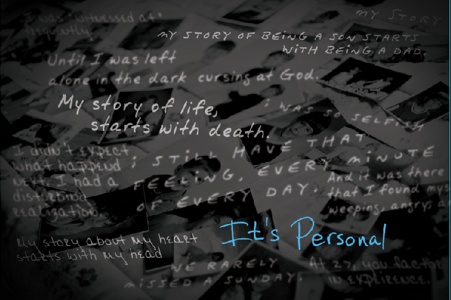
When my son, Cole, died . . .
When Gracen and Katie were diagnosed. . . and every fear filled moment prior to that . . .
When Bethany and Katie died . . . and Gracen was in surgery, then the ICU . . .
When David and I sat in courtrooms. . .
Every loss, every painful moment. . .
Was deeply personal . . .
Between God and I.
Between me and Jesus.
Between us—the Holy Spirit who resides within and the old and new man (the human and the holy) battling within.
If I believe that God has plans for me—that everything that happens to me is filtered through His hands first—that He allows and disallows things in my life—that none of it surprises Him—if I truly believe that then . . .
It’s personal.
So, so very personal.
And that’s the hard part, you know, because I do believe all those things.
And while I immediately recognized those events as personal disappointments or tragedies, and I also recognized them as personal on a spiritual level, that truth (losses being spiritually personal) was a bit overshadowed by some well known scriptural references.
When we find ourselves in deeply personal situations we often try to step back so that we can see the big picture. Isn’t that our goal when we think about verses like Romans 8:28 and Jeremiah 29:11?
These are forward thinking verses. Verses that lead us to think far down the road; past pain and suffering. Let’s consider Romans 8:28 first:
“And we know that God works all things together for the good of those who love Him, who are called according to His purpose.” ~ Romans 8:28
A common interpretation of Romans 8:28 is that tragedy will be redeemed by testimony. You don’t testify to yourself. You testify to others. And as such Romans 8:28 becomes a call to ministry. And all of the sudden my personal tragedy is no longer personal as a corporate expectation forms in the minds of men.
The first Sunday I returned to church I heard how my testimony was already at work in the lives of others. A number of people have mentioned ministry opportunities to me. And really, there is absolutely nothing wrong with that. I want to give back or I wouldn’t write a blog; among other things. It’s not a complaint. I’m just trying to use these examples as a means of helping you understand that the personal nature of my spiritual issues?, obstacles?, concerns?, frustrations? . . . whatever you want to call them, was lost and overshadowed to a degree as I considered God’s overall purpose for my disappointments and losses.
God’s purposes always seem to reach beyond a single individual. They are often His means of reaching the lost, conforming the saved into the image of Christ, gaining the glory He so richly deserves, and the culmination of all of those things in a multitude of believer’s lives leads us to the fulfillment of end times prophecy.
God’s purposes may be personal, but they are also corporate.
And Jeremiah 29:11:
“For I know the plans I have for you,” declares the Lord, “plans to prosper you and not to harm you, plans to give you hope and a future.” ~ Jeremiah 29:11
Despite the individualized nature of Jeremiah 29:11, it somehow serves to depersonalize the events of life. Maybe it’s because I am fully aware that that verse was written to a group of people not any specific individual such as the biblical examples of God speaking directly to Moses or Joshua or the prophets. Jeremiah 29:11 was written to the Babylonian exiles promising the return to their homeland—after 70 years.
70 long years.
Every single exile suffered individual and personal tragedies. But the message was for a group. . . all those plans for God’s people . . . plans for prosperity, for hope and a future . . . plans that weren’t harmful . . . were plans for the overall group of exiles—and very few, if any of those exiles, would survive to see the fulfillment of God’s promise. The message would have been passed down from parent to child to grandchild as the 70 year exile played out.
We apply Jeremiah 29:11 to individual circumstances, but I wonder if, like the Babylonian exiles, those promises for prosperity, hope and a future—for plans that do no harm, won’t be realized by the individuals we try to encourage in dark days. Maybe the New Covenant audience for that verse is for the Bride of Christ as a whole, more than it is for believers individually.
And that is why I was shocked to find myself telling my grief counselor so emphatically that every issue I am struggling to overcome can be categorized as personal spiritual angst.
It’s not corporate.
The body of Christ may benefit from the tragedies of my life but they don’t share my tragedies. They don’t experience my suffering.
Those standing on the outside looking in . . .
Are not standing in the crumbling ruins of their lives.
And talk (biblical or not) is cheap—it’s easy—when you are on the outside looking in precisely because it’s not personal.
That’s not to imply that others don’t sincerely care.
It’s just so much easier to offer advice—to take advice—when it’s not personal.
But it’s devastatingly personal for me.
 It’s devastatingly personal for the young father whose wife succumbed to breast cancer. . .
For the parent whose child has committed suicide. . .
For the family whose home has been destroyed by a fire.
And each of those things are a bit deceiving because each one is merely a domino in a line of dominoes. Financial strain, mental health issues, etc., always follow.
Adding insult to injury, the believer often finds that God is silent. It may be that we are so desperately grasping for answers that we are unable to hear His voice, but sometimes He just holds His peace. Job knew something about that.
God’s taken what you knew or had and seemingly abandoned you.
And beneath the layers of grief and sorrow and loss lies the apparent betrayal of your closest friend and ally.
It is so very, very personal.
And you are left to chose to take His hand believing that He has something good for you ahead. . .
While fearing more of what experience has taught you . . .
Or choosing to stumble around in the dark at your own risk.
What is more frightening to a broken believer? To a believer who has experienced great loss not everyday hardships?
And while outsiders look in from the safety of their own relatively stable lives expounding upon God’s goodness, His plans, His working all things out for good, we, the walking wounded, are reminded of John the Baptist and John the Revelator and of Stephen. Not every saint is set free from the prison they’ve been cast into. Some die there after they have been exiled and tortured mercilessly.
Is it any wonder that some choose to sit still in the darkness instead of stumbling forward on their own—instead of taking the hand that led them to destruction before?
It’s personal.
It’s not just about the circumstances or the situation you find yourself in, it’s about the personal nature of those circumstances—of that situation. It’s about knowing God allowed them, or didn’t prevent them from happening to you individually.
Talk to me when your world has collapsed around you. Talk to me when you are afraid. Talk to me when you can name your fears and when they are a vague Specter looming threateningly over your shoulder, unnamed but real nonetheless. Talk to me when you are afraid to take your Savior’s hand and when you are equally afraid not to. Talk to me when the ability to project a positive outlook has been striped from your arsenal of weapons. Talk to me when it becomes desperately and intimately personal. Then I will think you understand. . .
Because the fact that it’s personal . . .
That it feels like you’ve been blindsided by a betrayal of trust. . .
Makes all the difference in the world.
“God is good all the time” is not a flip statement you rattle off to project confidence in your Savior. It’s not a mantra you repeat hoping to convince yourself of its truth. Those six words are a sacrifice of praise that are torn from the depths of despair and lifted in defiance from the ashes of a life burned down around you.
They are costly and precious.
They are the widow’s mites.
They are absolutely all she has left.
“And He looked up and saw the rich putting their gifts into the treasury, and He saw also a certain poor widow putting in two mites. So He said, “Truly I say to you that this poor widow has put in more than all; for all these out of their abundance have put in offerings for God, but she out of her poverty put in all the livelihood that she had.”” ~ Luke 21:1-4
“The sacrifices of God are a broken spirit; a broken and contrite heart, O God, you will not despise.” ~ Psalm 51:17

 It’s 11:40 a.m.
 Boxx Banter